
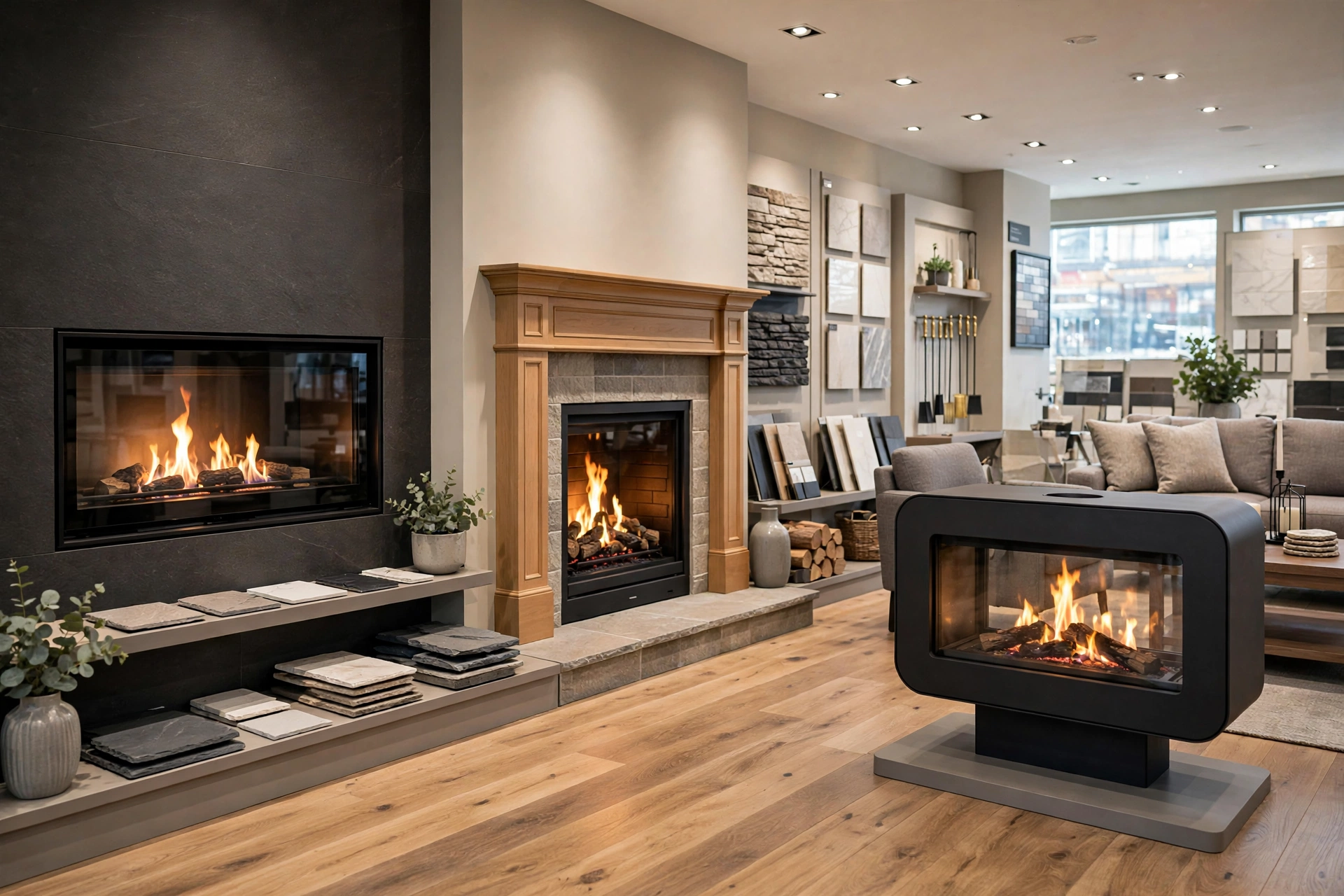
The questions to ask a ventless fireplace dealer are not about style or price first. A ventless (vent-free) gas fireplace burns fuel indoors with no chimney, so it releases combustion byproducts, including carbon monoxide, directly into the room and draws on the room’s own oxygen. Before anything about looks or budget, ask exactly how the unit handles that, whether it is certified to the national safety standard, and whether it is even legal in your area. A dealer’s answers to those three questions, more than any brochure, tell you whether you are dealing with someone who understands vent-free combustion or someone reciting a sales script.
How Does This Unit Handle Combustion Byproducts?
Ask this before you ask about BTUs, finish, or delivery date. A ventless fireplace has no flue, so the carbon monoxide, water vapor, and other combustion byproducts it produces stay in the room unless the appliance is designed to limit them. A good dealer will name the oxygen depletion sensor (ODS) by function, not just by acronym: it is a sensor that shuts the gas valve if oxygen in the room falls toward 18.5 percent, closing off fuel before combustion becomes inefficient. Fairfax County Fire and Rescue states plainly that “the two primary concerns with ventless fireplaces are carbon monoxide and oxygen depletion,” and recommends buying a unit with an ODS and installing a separate carbon monoxide detector in the same room (read 2026-09-18). If a dealer waves off the CO question, cannot explain what the ODS does, or tells you a detector is unnecessary because the fireplace “shuts itself off,” that is a stop-and-walk answer, not a sales quirk.
Is This Model Certified to ANSI Z21.11.2, and Can You Show Me the Paperwork?
Every vent-free gas appliance sold legitimately in the US is tested to ANSI Z21.11.2, the national standard for unvented gas-fired room heaters and fireplaces. ProCom’s own owner’s operation and installation manual for its PC32VFC vent-free gas firebox states the unit “has been tested and approved” for use with gas logs certified under this standard (read 2026-09-18). Ask the dealer to show you the certification on the unit’s rating plate or in its manual, not just tell you it exists. A dealer who can pull up the actual document, or point to the plate on the display model, is doing the paperwork right. One who says “they’re all certified, don’t worry about it” and cannot produce it on request has skipped a step that matters more than the finish color.
Is a Ventless Fireplace Even Legal Where You Live?
This is the question most buyers skip, and it is a real gap: some states, and some cities within states that otherwise allow them, restrict or prohibit unvented gas fireplaces and heaters, and local building and fire codes vary by jurisdiction inside the US. A dealer selling nationally through a website is not automatically checking your local code for you. Ask directly: has this exact model been approved for install at my address, and has anyone confirmed that with the local building department or fire marshal? If the answer is a shrug, or “we ship everywhere, it’s up to you,” get it in writing from your own local building department before you sign anything. This is also the moment to ask about your homeowners insurance and whether the fireplace needs to be disclosed, since an undisclosed unvented appliance can complicate a claim later even where the fireplace itself is perfectly legal to own.
How Did You Size This Unit for My Room?
An oversized ventless fireplace in a small or airtight room depletes oxygen faster and produces more combustion byproduct per hour of use than a correctly sized one. A dealer who asks about your room’s square footage, ceiling height, and how airtight the house is (newer construction and recently sealed homes hold in more combustion products) is doing the sizing work. A dealer who quotes a BTU number off a sales sheet without asking those questions is guessing. Ask specifically whether they used the manufacturer’s own sizing worksheet or calculator for your room’s volume, and ask what happens if the room is smaller than the minimum the unit’s manual requires. This also connects to how the unit is meant to be run day to day: ask whether you’ll need to open a window when the fireplace is running, since the honest answer depends on the model, the room, and local code, not a blanket yes or no.
Who Actually Installs It, and Are They Licensed for Gas Work?
Gas line connections and any modification to an existing gas supply are licensed-trade work, never a DIY project and never something a general handyman should touch. Ask who physically connects the gas line: is it the dealer’s own licensed gas fitter or plumber, a subcontractor, or does installation fall to the buyer? Ask for a license number and ask whether a permit and inspection are part of the process, since many jurisdictions require both for new gas appliance connections. A dealer who says “it just plugs into your existing line, anyone can do it” is wrong on the safety and often wrong on the code, and that answer alone should end the conversation.
What Does the Manual Say About Clearance to Combustibles?
Clearance to combustible materials, walls, mantels, and floor coverings is specific to the exact model and is set by the manufacturer’s own tested installation instructions, not by a general rule of thumb a dealer recalls from memory. Ask the dealer to pull the clearance table from that specific unit’s manual and show it to you in writing, rather than quoting a number from a different model or “typical” install. If a mantel, hearth surround, or existing built-in is part of your plan, ask whether the dealer has actually checked those measurements against this unit’s table, or is assuming it will fit.
What Happens After the Sale?
A dealer’s answers about maintenance and support tell you whether they expect a long relationship or a single transaction. Ask how often the unit needs professional service, who performs it, and what a typical service visit costs. Ask what the warranty covers and, separately, what it does not, since gas valve and sensor components are often treated differently from the firebox or logs. This is also where seasonal upkeep belongs: a start-of-season safety checklist run every year before first use catches sensor and burner issues that a dealer’s one-time install visit will not.
What’s the Full Cost, Not Just the Unit Price?
Ask for a written, itemized quote that separates the unit price from labor, any gas line work, permit fees, and venting or hearth accessories. Ask whether the quote assumes your home already has gas service to the room, since running a new line changes the cost substantially. Rather than press for an exact dollar figure here (prices vary by region and by the specific job), ask the dealer to walk through each cost category by name. A dealer who resists breaking the quote into parts, or bundles everything into one number with no itemization, is making it hard for you to compare against a second quote, which is itself worth noticing.
Will This Affect My Home Insurance, and How Long Can It Run Per Day?
Two related questions dealers rarely raise on their own. First, ask whether your insurer needs to be told about the new appliance, since some policies treat unvented gas fireplaces differently from vented ones. Second, ask what the manufacturer’s manual says about maximum daily run time. Fairfax County Fire and Rescue recommends that “ventless fireplaces should only be used for six hours or less a day, or whatever is recommended by the manufacturer,” and to never run one unattended or overnight. If you want the fuller picture on run-time limits and why they exist, how long a ventless fireplace can safely run traces the number back to its source rather than repeating a rounded figure.
Red Flag Answers at a Glance
| You ask | Good-dealer answer | Red flag answer |
|---|---|---|
| How does it handle CO and oxygen use? | Names the ODS by function; recommends a separate CO detector | “It shuts itself off, you don’t need a detector” |
| Is it ANSI Z21.11.2 certified? | Shows the rating plate or manual page | “They all are, don’t worry about it” |
| Is it legal here? | Points you to the local building department or fire marshal | “We ship everywhere, it’s up to you” |
| Who installs the gas line? | Names a licensed gas fitter or plumber, mentions permit/inspection | “It just plugs in, anyone can do it” |
| What’s the clearance to combustibles? | Pulls the exact model’s manual table | Quotes a number “from experience” |
| What’s the full cost? | Itemized: unit, labor, gas line, permits | One bundled number, resists a breakdown |
No single question here guarantees a good outcome by itself. Even a dealer who answers every one of these correctly is still selling an appliance that depends on your own follow-through: sizing the room correctly on your end, keeping a working carbon monoxide detector in place, and not exceeding the manufacturer’s run-time guidance. These questions filter out the dealers who would not have told you that anyway.
FAQ
Do all ventless fireplace dealers install the gas line themselves?
No. Some subcontract to a licensed gas fitter or plumber, and some leave gas line work to the buyer entirely. Ask directly and get the answer in writing before you commit, since gas connection work should only ever be done by a licensed professional.
Is an oxygen depletion sensor the same as a carbon monoxide detector?
No. An ODS shuts off the fireplace’s gas supply when oxygen in the room drops too low; it does not measure carbon monoxide directly. Fire safety authorities recommend a separate, dedicated carbon monoxide detector in the same room regardless of whether the unit has an ODS.
Can a dealer tell me a ventless fireplace is legal without checking local code?
Not reliably. Legality varies by state and, in some cases, by city, and a dealer selling online or across a wide territory is not automatically checking your specific address. Confirm with your local building department or fire marshal before installation.
Should I get more than one quote?
Yes, especially when a dealer resists itemizing the cost into unit, labor, gas line work, and permits. A second, itemized quote is one of the fastest ways to see whether the first dealer’s numbers and installation plan hold up.
What should I do if a dealer can’t answer the ANSI Z21.11.2 question?
Ask again, in writing, and ask to see the rating plate or manual page. If they still cannot produce it, treat that as a reason to look at a different dealer, not a detail to skip.