
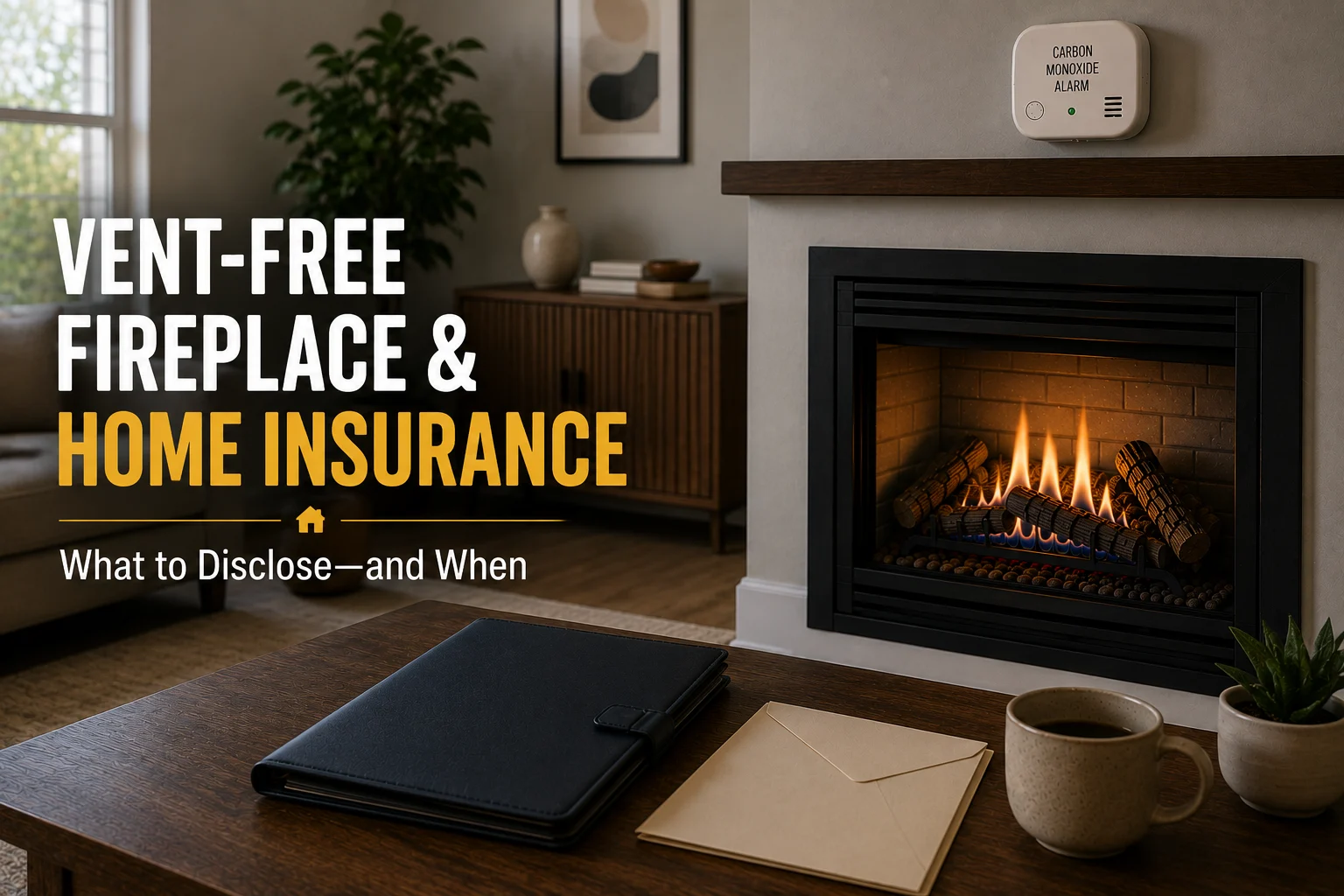
A vent-free gas appliance discharges its combustion products into the room, including carbon monoxide, nitrogen dioxide and water vapor. A working carbon monoxide alarm is a condition of operating one, and that is set out on our page about why.
Whether the appliance is permitted where you live is the prior question, because an appliance that is prohibited locally is a different conversation with an insurer than one that is permitted. Start at are ventless fireplaces legal where you live.
Now the question. Do you have to tell your insurer, and will they care?
The short answer
Tell them, in writing, and keep the reply.
We are not going to tell you what your insurer will say, because we cannot know it, and neither can any general page. What we can say is that the failure mode here is entirely one-sided. Disclosing an appliance and being told it does not matter costs you an email. Not disclosing one and finding out at claim time costs you the claim.
What we can verify, and what we cannot
This is worth being explicit about, because this SERP is full of confident statements about what insurers do.
We can verify what the code says. The provisions below are published, quotable and dated.
We cannot verify what any insurer’s policy says, because policy wordings are contractual documents that vary by insurer, by product, by state or province, and by year. We publish no premium figure, no percentage, no claim-denial rate and no named insurer’s position on this page, because we found no source that would license one and a number invented here would be repeated elsewhere within a month.
Anyone telling you that “insurers charge X percent more for a ventless fireplace” should be asked which insurer, which product, which jurisdiction and which year.
Why an insurer would take an interest at all
Four reasons, each of which is checkable against something.
It is a fuel-burning appliance. Insurers routinely ask about heating sources, supplemental heaters and solid-fuel appliances on an application. A gas appliance in a living space is the kind of thing those questions exist to capture.
Permits matter. Where installation required a permit and none was pulled, the installation is unpermitted work. Insurers ask about unpermitted alterations, and it is the sort of fact that surfaces after a loss rather than before one. A licensed gas fitter and a permit record are the two documents that close this.
Compliance with the adopted code matters. All read through UpCodes on 28 August 2026: G2406.2 prohibits appliances in sleeping rooms, bathrooms, toilet rooms and storage closets subject to narrow low-input exceptions; G2445.5 caps the aggregate input rating of all unvented appliances in a room at 20 Btu/h per cubic foot of volume; G2445.3 caps a single unit at 40,000 Btu/h; G2445.2 states that unvented room heaters shall not be used as the sole source of comfort heating in a dwelling unit. An installation outside any of these is an installation contrary to the adopted code, whatever an insurer chooses to do about it.
Some jurisdictions prohibit the category outright. Our ban and restriction page sets out what we confirmed at source with dates. An appliance installed where it is prohibited is a materially different risk from one installed where it is permitted.
What to actually send
Keep it short and factual. An email creates the record; a phone call does not.
- What the appliance is. Manufacturer, model, fuel type and input rating in Btu/h from the data plate.
- Where it is. The room, and the room’s approximate dimensions if you have them.
- Who installed it, and when. Licensed installer’s name if you know it.
- Whether a permit was issued, and the permit number if you have it.
- That a working carbon monoxide alarm is in place.
- A direct question: does this affect my cover, my premium, or any condition of the policy?
Then keep the reply. A written answer from your insurer is worth more than every general article on this subject combined, including this one.
If you are buying the house rather than the appliance
Raise it with your insurer during the offer period rather than after closing. An appliance that turns out to be uninsurable, or insurable only on terms you did not expect, is much easier to deal with while the price is still being discussed. The same documents that satisfy an insurer, the data plate reading, the permit record and the installer’s licence, are the ones a home inspection will also turn on, so gathering them once serves both.
If the answer is unfavorable
You have three routes and none of them involves concealing anything.
Bring the installation into compliance. If the problem is the room, the input rating against room volume, or a missing permit, a licensed gas fitter or qualified hearth technician can tell you what is achievable. This site publishes no gas-line, gas-connection, installation or removal procedure at any depth, and this is licensed work.
Change the appliance. A direct vent or sealed combustion unit removes the mechanism that creates the concern, and is compared in direct vent versus ventless. An electric unit removes combustion entirely; see vent-free gas versus electric.
Change insurer. Appetite for this risk varies between carriers, which is precisely why no general page can tell you what “insurers” think.
A note on freshness
This page is about a subject that moves. Insurer appetite, policy wording and adopted codes all change, and an answer you were given three years ago is not an answer you have now. That is the same decay problem this site writes about in why last year’s legality answer may be wrong, applied to a different document.
If you have had the appliance for years and never mentioned it, the right time to send that email is now, not after a loss.
What this page does not do
It gives no legal or insurance advice, states no policy term, and names no insurer.
It publishes no premium effect, no percentage and no cost, and it does not tell you whether your claim would be paid. Only the company holding your policy can answer that, in writing, on your policy.