
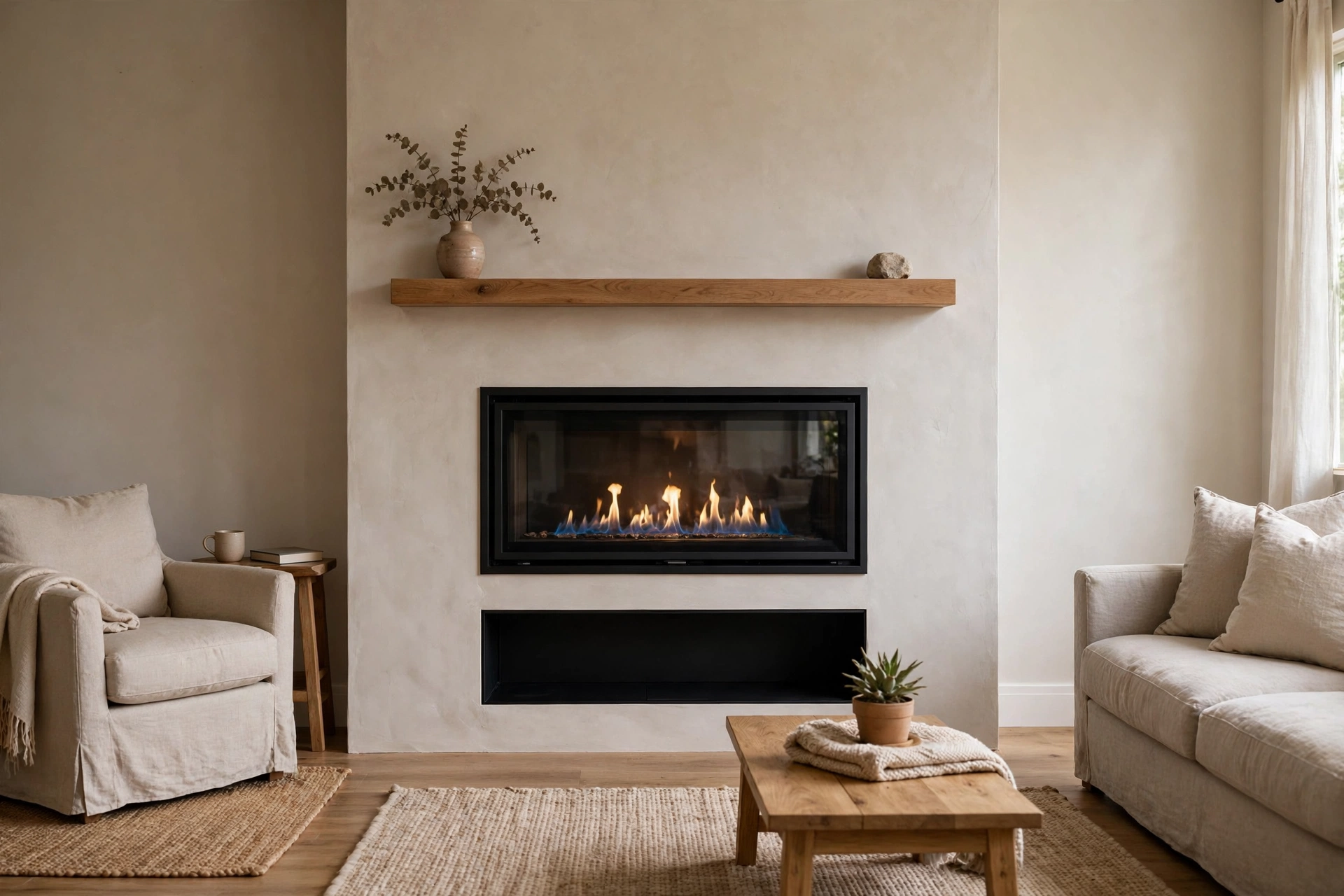
Ventless fireplace clearance requirements are not one number you can copy from a blog post and build to. Before any clearance matters, understand what the appliance is doing: a vent-free fireplace burns fuel and releases its combustion byproducts, including carbon monoxide, directly into the room, and it relies on an oxygen depletion sensor (ODS) to shut itself off if oxygen runs low, not to prevent those byproducts from forming in the first place. Once that is clear, your real clearance to combustibles comes from three places only: your unit’s own listing and installation manual, the fuel-gas code your city or county has adopted, and your local fire marshal’s amendments to it, not a generic chart.
Ventless Fireplace Clearance Requirements: Why There Is No Universal Number
This is the part every generic guide skips, and it is the reason a single figure would be wrong for most readers who used it. NFPA 54, the National Fuel Gas Code (nfpa.org, accessed 2026-09-18), governs how gas appliances are installed in the United States, and it treats clearance to combustibles as a function of an appliance’s listing, not a flat rule that applies to every fireplace in every home. A listed, vent-free fireplace can only be installed at the clearances its testing laboratory certified for that exact model, which are printed in its own manual. An unlisted appliance cannot legally be installed against combustible material at all, regardless of distance.
On top of that, states, counties and cities do not all adopt the same edition of the model codes, and many add local amendments through their fire marshal or building department. A clearance that satisfies one jurisdiction’s adopted code edition may not satisfy your neighboring county’s. That is the structural reason nobody can answer “what’s the clearance for a ventless fireplace” with one figure that is true for every unit and every address, and it is why this page will not give you one either.
Jurisdiction is not a formality here, either. Some states restrict or prohibit new vent-free installations outright, and federal housing rules go further: HUD’s national housing quality standards (24 CFR 5.703) bar unvented gas, oil or kerosene space heaters from HUD-assisted housing entirely, and a 2023 policy update removed the variance that had let some agencies allow them as backup heat. None of that changes what a manufacturer’s manual says about a specific model’s certified clearance, but it does mean the appliance itself may not be legal to install at your address before clearance is even a question. That is one more reason to start with your local building department rather than a national chart: it can tell you whether vent-free is permitted at all before you get to how far it has to sit from the wall.
The Hazard Behind Every Clearance Rule: Carbon Monoxide and Oxygen Depletion
Clearance rules exist for two separate hazards, and it helps to keep them apart. The first is fire: keeping combustible material far enough from a heat source that it never ignites. The second, and the one that actually kills people with vent-free appliances, is what the appliance puts into the air while it runs. The U.S. Consumer Product Safety Commission has treated carbon monoxide from unvented gas heaters as a life-safety issue since the late 1970s and 1980s, when it moved to require an oxygen depletion sensor on unvented gas space heaters after finding a pattern of CO deaths tied to them.
An ODS is a shutoff device, not a guarantee. It closes the gas valve when the oxygen level in the room falls to roughly 18 to 19.5 percent, which is meant to happen before carbon monoxide reaches a dangerous concentration. It is not a substitute for the conditions that make running one safe in the first place, and it is not a reason to skip a working carbon monoxide alarm in the room. Room size and fresh air also matter more than most buyers expect, and the common idea that cracking a window “fixes” ventilation for a vent-free unit does not hold up; see what opening a window actually does and does not do before you treat it as a safety measure.
Where to Find the Clearance Number That Actually Applies to Your Unit
Three documents outrank every blog post, including this one, and they agree with each other or you have not finished checking.
| Source | What only it can tell you | When it has the final word |
|---|---|---|
| Your unit’s installation manual | The exact, lab-certified clearance for your model and installation type | Always, for the distance itself |
| The adopted fuel-gas code (NFPA 54 / IFGC) | The minimum legal framework your city or county enforces | When the manual is silent or the install is inspected |
| Your local fire marshal or building department | Whether vent-free is permitted at your address at all, and any local amendments | Before you buy or install anything |
Your unit’s own installation manual. This is the only place your certified clearance distances live, because they came from the same lab that listed the appliance. As one real example, Majestic’s installation manual for its MJ27NR/MJ27PR unvented gas log heater (hearthnhome.com, accessed 2026-09-18) sets its own clearance and enclosure requirements specific to that model; a different manufacturer’s model will carry different numbers, which is exactly the point. If you cannot find your paper manual, the data plate inside the firebox has the model and serial number you need to pull the correct one from the maker’s own site.
The fuel-gas code edition your jurisdiction has adopted. Most of the country works from NFPA 54 or the International Fuel Gas Code, but the specific edition, and any local amendments to it, is set at the state or city level, so the same model can face different paperwork in two different counties.
Your local fire marshal or building department, before you install anything. This is who confirms the manual and the adopted code actually agree for your address, and it is the same office that signs off at inspection. If you already have a unit installed and have never had this confirmed, an existing ventless fireplace safety check before winter is the way to close that gap without waiting for a problem to force it.
What Changes the Distance for Your Specific Model
A handful of variables push a unit’s certified clearance up or down, and knowing them helps you read your own manual correctly rather than guess at someone else’s.
Listed versus unlisted. A listed appliance has a lab-tested clearance; an unlisted one has none it can legally use near combustible material, full stop.
How the unit throws heat. Appliances that use metal, ceramic or similar material to direct radiant heat forward generally need more front clearance than appliances built around convection, because the front-facing surface runs hotter.
What surrounds it. Wood mantels, drywall, fabric trim, curtains and upholstered furniture all count as combustible material and each has its own required distance in the manual; stone, brick, tile and metal generally do not carry the same restriction, but “generally” is a manual question, not a rule of thumb to build from.
The room itself, not just the wall. A tightly sealed, well-insulated home changes how quickly combustion byproducts and depleted oxygen build up in a room, independent of how far the unit sits from a wall stud. That is a separate risk factor from clearance-to-combustibles, and it is worth reading on its own if your fireplace sits in a basement or an unusually airtight home.
Input rating (BTU). Higher-output units typically carry larger minimum room-size and clearance requirements in their own certification, which is one more reason the manual, not a chart, is the document that matters.
Installation Is Licensed Work, Not a Tape-Measure Exercise
None of the above turns into a project you do yourself. Confirming and setting clearance correctly means connecting or modifying a gas line, verifying an appliance’s listing against its installation, and satisfying a local inspector, and that is licensed installer work in every jurisdiction that permits vent-free appliances at all. A licensed gas fitter or hearth installer pulls the permit, matches the unit to its manual, sets the clearances the manual specifies, and gets the inspection that makes the installation legal, not just measured. Do not attempt to reduce a manual’s stated clearance with a homemade heat shield or reflective barrier; a reduced clearance is only valid when it comes from a listed protection system tested with that exact appliance, and that is also a decision for the installer and the inspector, not a DIY judgment call.
FAQ
What is the clearance to combustibles for a ventless fireplace?
There is no single figure. It is set by your specific unit’s listing and printed in its installation manual, then checked against the fuel-gas code edition your local jurisdiction has adopted.
Can I reduce ventless fireplace clearance with a heat shield?
Only if the reduction comes from a listed protection system tested with that exact appliance and approved by your inspector. A homemade shield does not change a manual’s stated clearance.
Do ventless fireplace clearance rules differ by state?
Yes. States and cities adopt different editions of the model fuel-gas codes and can add local amendments through their fire marshal, so the same appliance can face different requirements in different jurisdictions, and some restrict vent-free installations outright.
Is a ventless fireplace safe if it has an oxygen depletion sensor?
An ODS is a shutoff device that closes the gas valve when room oxygen drops too low; it is not a substitute for a working carbon monoxide alarm, adequate room size, or following the manual’s operating conditions.
Who do I call to confirm my ventless fireplace’s clearance is correct?
Start with your unit’s manufacturer to get the correct manual for your model and serial number, then confirm the installation against your local fire marshal or building department, ideally through a licensed installer who pulls the permit.