
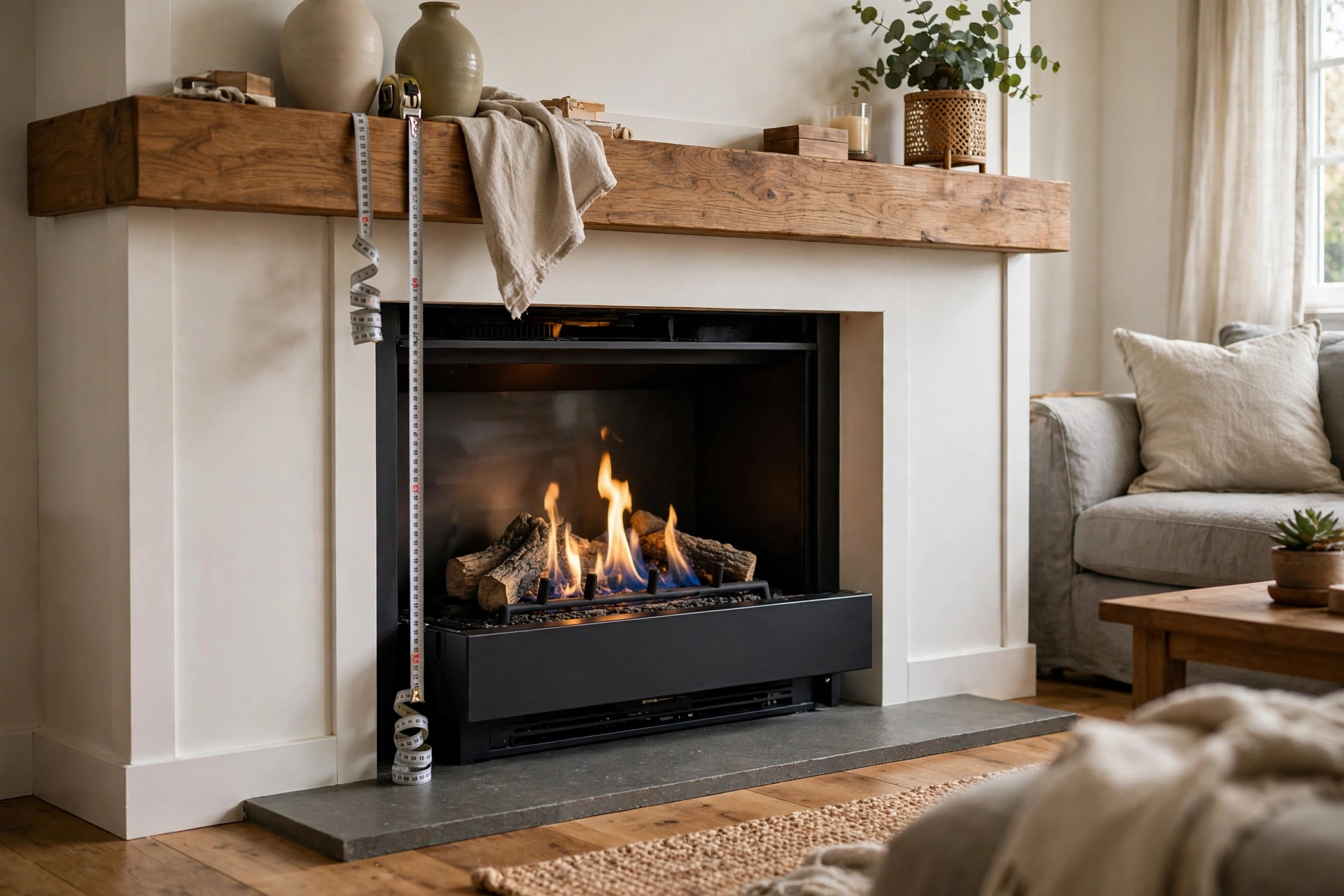
Ventless fireplace mantel clearance is not a number you can look up once and reuse. A vent-free gas fireplace has no chimney, so every product of combustion, including carbon monoxide, stays in the room, and the mantel clearance a manufacturer allows is tied to that specific unit’s tested burner output and its oxygen depletion sensor (ODS), not to a generic chart written for wood-burning fireplaces. Before you measure anything, treat the combustion hazard as the reason the number exists at all: the safe clearance, the working carbon monoxide detector, and the manufacturer’s own installation manual are one decision, not three separate shopping steps.
We have never installed, lit or burned a ventless fireplace, and we make no claim to have. What follows is drawn from published safety guidance and manufacturer documentation, named where it is used, so you can verify it against your own unit.
The combustion reason a generic clearance number is not safe here
A vented fireplace sends its exhaust up a flue. A ventless (vent-free) gas fireplace does not have one, so the heat, moisture and combustion byproducts it produces, including carbon monoxide, release directly into the room. That is why every certified vent-free gas appliance carries an oxygen depletion sensor designed to shut the gas off before oxygen in the room drops to an unsafe level. ANSI Z21.11.2, the US listing standard for unvented room heaters, requires that sensor as a condition of certification, but the standard does not set one clearance distance for every model it certifies. An ODS also watches oxygen, not carbon monoxide directly, and a room can accumulate CO before oxygen depletion is severe enough to trip the sensor. The Consumer Product Safety Commission has warned for decades that fuel-burning heating appliances are a leading source of home carbon monoxide deaths, and continues to urge a working, audible carbon monoxide alarm in any room that holds one, as its winter heating safety alert states (CPSC, read 2026-09-18). A mantel clearance figure is meaningless if the appliance beneath it is not also monitored for CO with a dedicated detector, not the color-changing strip kind.
Why generic mantel-clearance charts do not apply to your unit
Search for mantel clearance and you will find widely repeated rules of thumb: how far above the firebox opening a mantel should sit, how much farther it must move if it projects from the wall, and how much space should separate it from combustible trim at the sides. Those rules come from general fireplace and masonry guidance, most of it written for wood-burning fireplaces and open hearths, where the concern is radiant heat and ember exposure over hours of a hot, open fire.
A ventless gas fireplace is tested and listed as a complete system, burner, firebox, and any approved mantel or surround kit, against a different standard entirely. Some vent-free units are listed for near-zero clearance on certain sides when installed exactly as tested; others require considerably more room than the wood-burning rules of thumb suggest, because the ODS and burner geometry sit differently from model to model. There is no way to know which pattern your unit follows without its own paperwork, and applying a masonry-fireplace rule to a gas appliance can put a combustible mantel closer to the heat source than the listing allows, or waste usable space when the tested clearance is actually much smaller.
The two do not overlap the way one shared chart implies:
| What a generic mantel chart assumes | What a vent-free gas fireplace listing actually sets |
|---|---|
| One universal rule works for any fireplace | Each model is tested and listed as a complete system, with its own manual |
| Clearance is mainly about embers and radiant heat from an open flame | Clearance also accounts for burner geometry and where the oxygen depletion sensor sits |
| A bigger gap is always the safer choice | A listed “zero clearance” side can be correct for that exact model; a bigger, untested gap on a different configuration is not automatically compliant |
| Any heat-resistant paint or finish will do | The manual’s tested finish and its clearance figure are a matched pair, not independent choices |
Where your ventless fireplace mantel clearance number actually lives
Every certified vent-free gas fireplace ships with a rating plate, usually on the unit’s frame or inside the control compartment, showing the model number, input rating and the standard it is listed to. That model number is the key to the only clearance figure that matters: the installation manual for that exact model. Manufacturers such as Empire Comfort Systems, Duluth Forge and Monessen Hearth publish these manuals on their own sites, searchable by model number, and the clearance-to-combustibles table sits inside, usually alongside the mantel, shelf and surround dimensions the listing was tested with. If you cannot find the manual, the manufacturer’s own customer support line can supply it from the model number alone; a retailer’s product page or a mantel seller’s blog is not a substitute, because neither one tested the combination with your unit.
If you are still comparing which kind of vent-free appliance to buy, our breakdown of the types of ventless gas fireplaces explains why logs, inserts, stoves and wall units each carry their own construction and clearance requirements even within the same brand.
What a fire marshal or code official adds that the manual does not
The manufacturer’s manual sets the minimum the appliance was tested to. Your local fire code, adopted at the state or city level, can require more, and in some jurisdictions can prohibit vent-free appliances in certain rooms outright regardless of what the manual allows. A local code official or fire marshal is the one who confirms which edition of the code your jurisdiction has adopted and whether a permit and inspection are required before the mantel and surround go up, not the mantel’s box or a national blog post. That clearance number also becomes paperwork later: if you disclose the fireplace during a sale or a claim, our guides on what a home inspector flags around a ventless fireplace and what to disclose to your insurer both trace back to whether the installation matched the manual and the local permit, not to a generic clearance chart.
Materials and finish do not stop mattering just because clearance is met
Meeting the listed clearance distance is the floor, not the whole answer. Wood, MDF and most paints and finishes are combustible, and a mantel that sits at the minimum listed distance can still discolor, dry out or, over years of cycling heat, become a hazard if the finish is not rated for sustained heat exposure. Manufacturer manuals that allow tighter clearances often specify a heat-resistant finish or a heat shield as a condition of that tighter number, not an optional upgrade. Treat any clearance figure as paired with the material and finish it was tested with, and do not swap in a different wood, paint or stone once the number is confirmed.
Where this stops being a homeowner decision
Confirming a clearance number from a manual is homeowner work. Moving, reframing or altering the gas connection to fit a mantel or surround is not. Any change to the gas line, the firebox opening or the structure around a vent-free appliance should go through a licensed gas fitter or qualified hearth installer, working from the manufacturer’s instructions and under whatever permit your local building department requires. We do not publish an installation or gas-connection walkthrough at any level of detail, and no clearance figure in a manual or on this page is a substitute for that permit and that inspection.
After the mantel is up, the clearance question does not end
A confirmed clearance and a working carbon monoxide detector are a starting condition, not a one-time task. Materials shift, seals age, and detectors expire. Fairfax County’s Fire and Rescue Department, in its ventless fireplace safety guidance (read 2026-09-18), advises pairing any vent-free fireplace with an audible carbon monoxide alarm in the room, limiting run time to what the manufacturer recommends, and shutting the unit down immediately if an alarm sounds. Our existing ventless fireplace safety check walks through re-confirming clearance and detector placement each year, since neither one is a fit-and-forget item.
What we checked, and when
CPSC’s winter heating safety alert on carbon monoxide from fuel-burning heaters, and Fairfax County Fire and Rescue Department’s ventless fireplace safety guidance, both linked above and read 2026-09-18. General knowledge of ANSI Z21.11.2 as the US listing standard for unvented room heaters and of oxygen depletion sensor function drawn from manufacturer and safety-agency documentation reviewed the same date. Clearance figures for any specific model come from that model’s own manual, not from this page.
Frequently asked questions
Is there a standard ventless fireplace mantel clearance in inches?
No single number applies across brands or models. Each vent-free gas fireplace is tested and listed as a system with its own clearance-to-combustibles figures, found on the rating plate and in that model’s installation manual. Treat any number you see on a general blog as a starting point for questions, not an installation instruction.
Can I install a wood mantel over a ventless gas fireplace?
Sometimes, at the distance and with the finish the manufacturer’s manual specifies for that model. Wood is combustible, so the manual’s clearance figure and any required heat-resistant finish or heat shield are conditions of a safe installation, not suggestions.
Does a local fire code override the manufacturer’s clearance number?
It can add requirements on top of the manual, or restrict where vent-free appliances are allowed at all, depending on the jurisdiction. Confirm the adopted code edition and any permit requirement with your local building department or fire marshal before finalizing a mantel or surround plan.
What does “zero clearance” mean on a vent-free fireplace listing?
It means the specific model was tested and listed to sit flush, or nearly flush, to combustible material on the sides named in its manual, under the exact conditions of that test. It does not mean every side, every finish or every accessory can be placed with no gap; the manual states which sides and which conditions the rating covers.
Who do I call if I cannot find my unit’s clearance specifications?
Start with the model number on the rating plate and search the manufacturer’s own site for that model’s manual. If it is not posted, the manufacturer’s customer support line can supply it. For anything involving the gas connection or structural changes around the firebox, a licensed gas fitter or qualified hearth installer is the next call, not a general contractor or a DIY forum.