
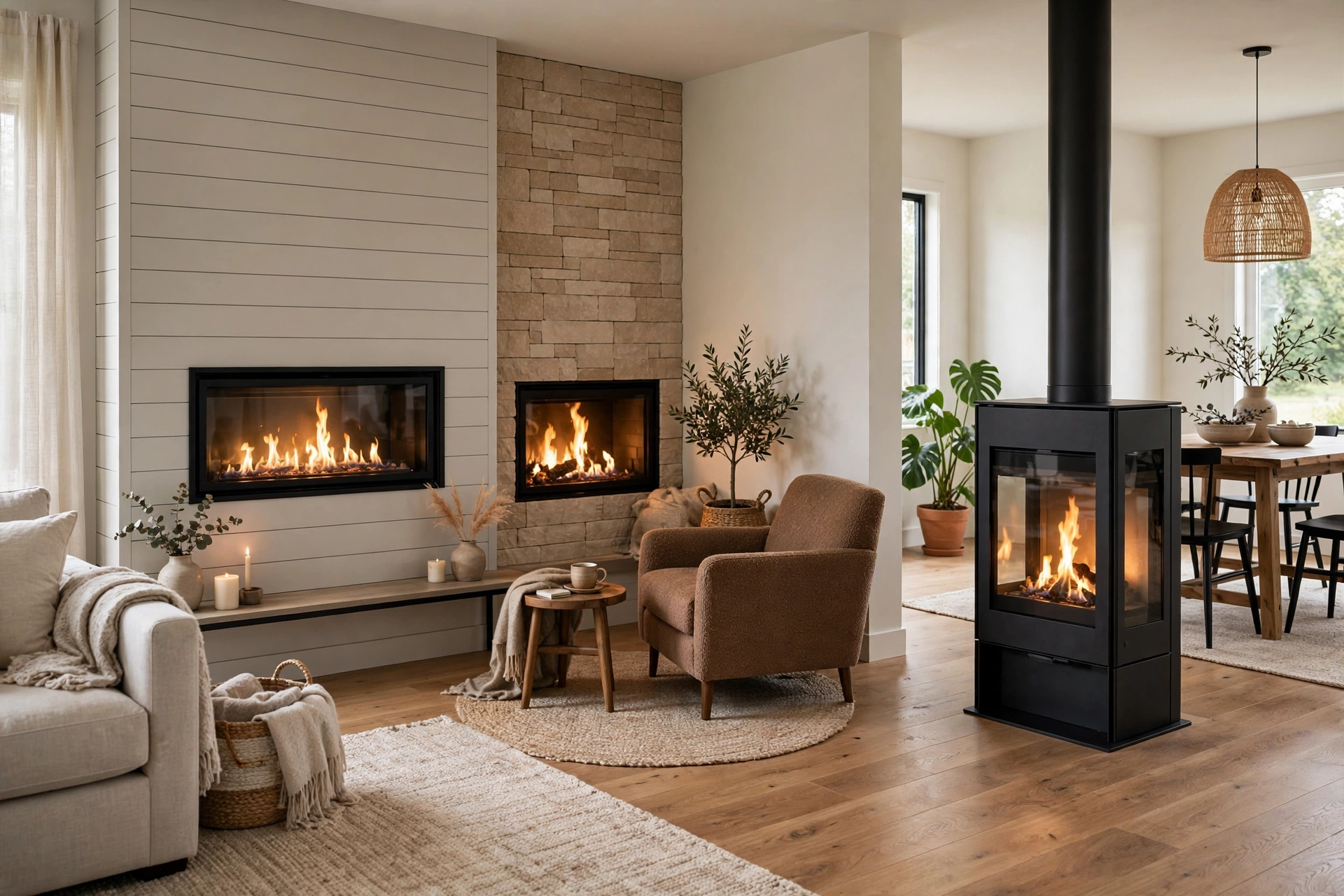
The three ventless fireplace placement options are a corner unit set diagonally across two walls, a wall-mounted unit hung flush against one wall, and a freestanding unit standing away from any wall. Each changes the construction job, not the appliance’s basic hazard. A vent-free appliance has no flue, so wherever it sits, it burns fuel and releases the products of that combustion into the room it is in. A working carbon monoxide alarm and the appliance’s own oxygen depletion shutoff are conditions of running any of the three, and the room’s volume and your local code decide whether that spot is legal at all before the layout question matters.
We have never installed, lit or burned one of these appliances, and we do not claim to have. This page is built from the manufacturer documentation and the government safety sources named where they are used, each with the date we read it.
The constraint that applies before any placement choice
Placement is a construction and layout decision. Whether you may run the appliance in that room is a different decision, and it comes first.
The US Consumer Product Safety Commission has repeatedly warned that furnaces, space heaters and fireplaces are linked to carbon monoxide poisonings and deaths every year, and has pointed to a working carbon monoxide alarm and adequate combustion air as the core precautions for any fuel-burning appliance used indoors (CPSC, “CPSC Warns Of Hazards from Furnaces, Space Heaters and Fireplaces,” read 2026-09-18). A vent-free unit’s oxygen depletion sensor is a separate device: it shuts the gas off when the room’s oxygen falls to a set point, and it does not detect carbon monoxide. Neither device changes with placement. A corner installation, a wall-mounted unit and a freestanding stove all need both, in the same room, regardless of how the appliance is positioned.
Before you plan where the unit goes, confirm the room is one where an unvented appliance is allowed to go at all. That is a room-volume and jurisdiction question, not a layout question, and it is covered in full in our guide to types of ventless gas fireplaces, which walks through how the code treats logs, inserts, stoves and wall units as one class regardless of shape.
Ventless fireplace placement options: what actually changes between the three
| Placement | Where it sits | What the structure must provide | What stays the same |
|---|---|---|---|
| Corner | Diagonally across two walls | Clearance on both flanking walls, not just one, plus floor or hearth protection the manual specifies | Room-volume limit, ODS, CO alarm, licensed gas connection |
| Wall-mount | Flush or recessed against a single wall | Studs (or the specific wall type) rated to carry the unit’s weight, and the wall surface the manual lists as acceptable | Room-volume limit, ODS, CO alarm, licensed gas connection |
| Freestanding | On the floor, away from any wall | Floor protection and clearance on every side, since nothing shields the appliance on any face | Room-volume limit, ODS, CO alarm, licensed gas connection |
Read the middle column. The differences between these placement options are almost entirely about what the wall, floor or corner has to be built to accept. None of them changes the combustion hazard, the room-volume math, or who is allowed to make the gas connection.
Corner placement: two walls, not one
A corner unit sits in the angle where two walls meet, which is why it frees up more usable floor space than a flat-wall installation in a small room. The trade is that a corner installation is not just “the same unit turned sideways.” Manufacturers publish a separate rough-opening or clearance diagram for a corner install because the dimensions genuinely differ from a flat-wall install: ProCom’s own installation manual for its PC32VFC vent-free firebox includes one figure for a standard opening and a distinct figure for a corner opening, with different measurements attached to each (ProCom PC32VFC Owner’s Operation and Installation Manual, read 2026-09-18). That is the pattern across the category, not a quirk of one brand: whichever unit you are looking at, treat the corner figure and the flat-wall figure as two different documents, and use the one that matches your actual layout.
Corner placement also means checking clearance on both flanking walls, plus anything mounted on either wall nearby, such as a shelf, a curtain, or a television. A distance that clears one wall does not automatically clear the other, since the two walls are not the same distance from the firebox at every point along the diagonal.
Wall-mount placement: what the wall has to be
Wall-mounted units are the shape most people picture when they hear “flush against the wall.” The unit’s weight has to be carried by the wall, which is why the manual will specify whether the mounting bracket needs to land on framing studs or whether the unit is rated for a particular wall assembly. Some wall-mounted models are listed for installation on a combustible wall surface directly, without added framing; others are not, and that distinction is set by the individual listing, not by the category. Ventilation still matters at a wall-mounted unit exactly as it does anywhere else in the room. If you are deciding whether a window needs to be cracked with one running, our page on what opening a window actually does separates what that step accomplishes from what it does not.
Freestanding placement: flexible, not exempt
A freestanding vent-free stove is not attached to a wall at all, so it offers the most flexibility for where in a room it goes. That flexibility is about the floor plan, not about the rules. The unit still needs clearance to combustibles on every side, since there is no wall behind it acting as a boundary, and it still needs the floor protection its manual specifies. It is also still subject to the same aggregate room-volume limit and the same prohibited-room list as a corner or wall-mounted unit. Being able to move it away from the outlet you’d otherwise use does not move it out from under the code.
Where placement is off the table, regardless of the shape
Some placement questions are not answered by choosing corner, wall-mount or freestanding, because the room itself is the problem, not the layout inside it.
Bedrooms and bathrooms are restricted at the room level, not the shape level. Model fuel-gas codes generally bar unvented room heaters from sleeping rooms, bathrooms and similar enclosed spaces, with a narrow exception that a local code official can approve for a single small wall-mounted unit under specific conditions. That exception describes a specific, code-official-approved installation, not a decorative fireplace of any shape you might otherwise choose, and it is not something a homeowner decides alone. If a bedroom or bathroom is the room in question, take it to your building department before you take it to a retailer.
Basements and tightly sealed homes change the risk at any placement. A newer, airtight house or a below-grade room exchanges air with the outside more slowly than an older, leaky one, which is exactly the condition that makes the same appliance behave differently in two houses of the same size. Our page on ventless fireplaces in a basement or airtight home covers what changes and why a placement that is fine in one house is not automatically fine in another.
Rentals need permission before placement is your decision at all. If you do not own the structure, the wall you want to mount into, the corner you want to frame, and the gas line you want run are not yours to modify without the landlord’s and often the building department’s sign-off. Our guide to ventless fireplaces in a rental sets out the three permissions that have to be in place first.
What to confirm before you commit to a spot
Before you settle on corner, wall-mount or freestanding for a specific room, confirm four things with documents rather than assumptions: that the room is not a prohibited space, that the room’s volume supports the input rating you are considering, that the specific model’s manual covers the installation type you intend (corner, wall or floor), and that a licensed gas fitter or qualified hearth technician is doing the gas connection. None of those four are placement questions in the decorating sense, and none of them are answered by a product photo.
Connecting any of these units to a gas supply, wherever it ends up sitting in the room, is licensed work. It is done by a licensed gas fitter or a qualified hearth technician, working to the manufacturer’s instructions and under whatever permit and inspection your jurisdiction requires. We publish no gas connection procedure and no installation walkthrough at any level of detail, for any of the three placement options.
Frequently asked questions
Does a corner ventless fireplace need less clearance than a wall-mounted one?
Not as a rule you can apply from a web page. Corner installations require clearance on two flanking walls instead of one, and manufacturers typically publish a separate diagram for the corner configuration because its dimensions differ from a flat-wall install. Read the specific model’s manual for the figures that apply to your unit.
Can I put a freestanding ventless fireplace anywhere in the room?
Anywhere that is not a prohibited space and that meets the clearance and floor-protection requirements in the manual, yes, with more flexibility than a wall-mounted unit. It still falls under the same room-volume limit and the same bedroom and bathroom restrictions as a corner or wall-mounted unit, so “freestanding” describes the footprint, not an exemption from the rules.
Is a wall-mounted ventless fireplace easier to place than a corner unit?
It is a different structural question, not an easier one. A wall-mount needs a wall rated to carry its weight, at the studs or wall type the manual lists. A corner unit needs two walls cleared instead of one. Neither is inherently simpler; each shifts what has to be confirmed before installation.
Can I install any of these placement options myself?
The framing, hearth protection or wall preparation may be within a homeowner’s scope if the manual allows it, but the gas connection is not. That step is licensed work for a licensed gas fitter or a qualified hearth technician, under your jurisdiction’s permit and inspection requirements, regardless of whether the unit ends up in a corner, on a wall or freestanding.
Do placement options change whether I need a carbon monoxide alarm?
No. A working carbon monoxide alarm is a condition of operating any vent-free appliance, in any of the three placements, because all three release combustion products into the same room. The alarm and the appliance’s oxygen depletion shutoff apply identically regardless of where the unit sits. For the full safety picture, see our answer to are ventless gas fireplaces safe.