
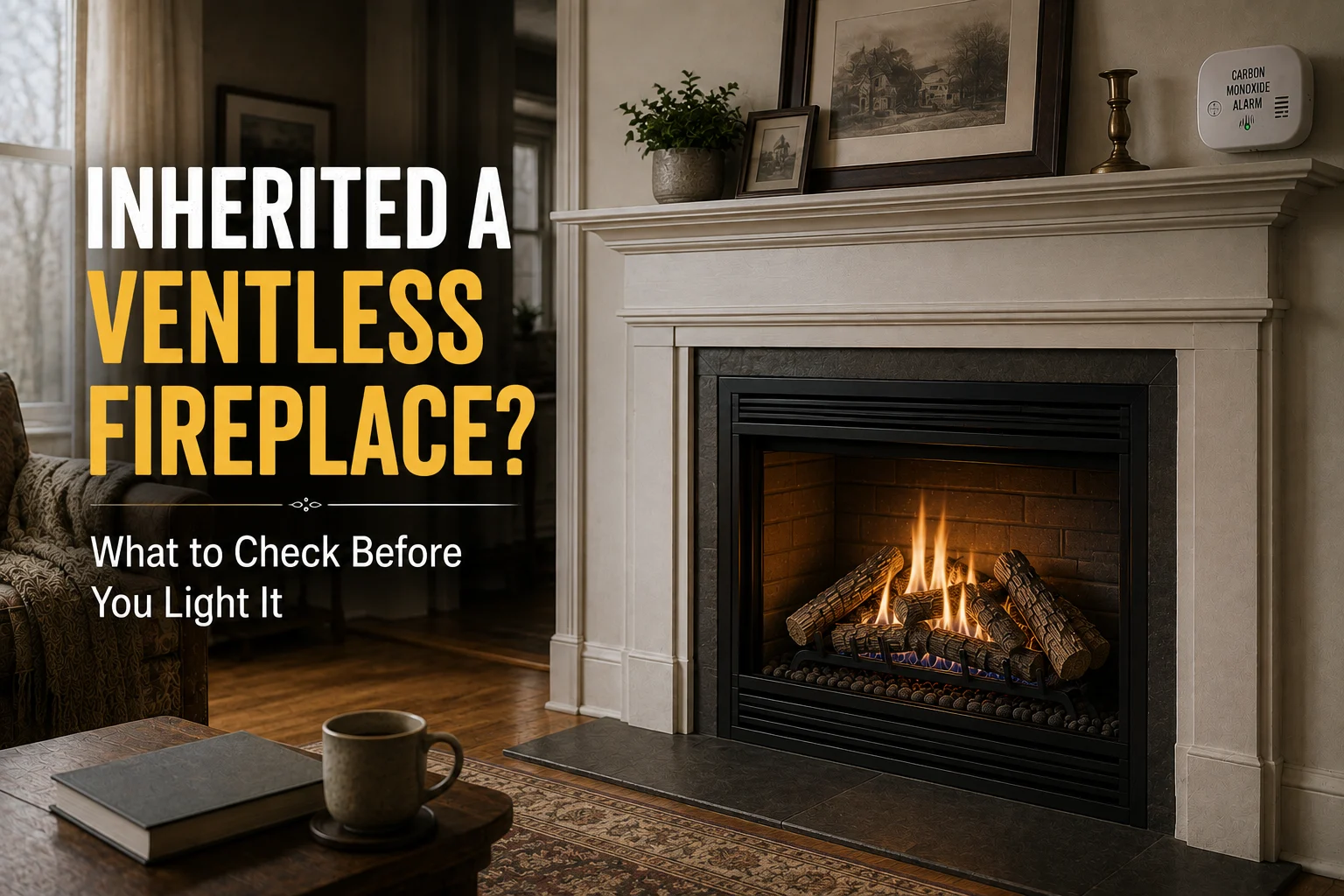
A vent-free gas appliance burns fuel in the room and puts the products of that combustion, including carbon monoxide, nitrogen dioxide and water vapor, into the air you breathe. A working carbon monoxide alarm is a condition of operating one, not an accessory. If you have inherited one of these with a house and there is no CO alarm in the home, that is the first item on the list and it comes before everything else here. Why it is a condition explains the reasoning.
This page is for a specific reader: you did not choose this appliance, it was already in the house, and the heating season is coming. You have no manual, no idea who installed it, and no idea whether it was ever permitted. That is an extremely common position and almost nothing on the SERP is written for it.
Nothing below is a repair procedure. It is a review, and it is designed to end in one of three places: use it, get a qualified hearth technician out, or do not light it.
Step 1: Establish whether it is even permitted where you are
Do this before you look at the appliance, because it can settle the question on its own.
Several US states and Canadian provinces restrict or prohibit unvented gas appliances, and municipalities frequently go further than their state. Our page on where vent-free appliances are banned or restricted sets out what we could confirm at source and dates every claim, and the companion page on checking your local code covers the municipal layer, which is the one that catches people out.
An inherited appliance raises a question a new purchase does not: it may have been installed before a rule changed, or without a permit at all. Neither is something you can determine from a web page. It is a question for your building department, and our page on asking them the right question exists to make that call short.
Step 2: Find out what it actually is
A surprising number of homeowners do not know whether the thing in their fireplace is vent-free or vented, and the two look similar. This distinction decides everything else, so establish it before you go further. The categories are laid out in types of gas fireplaces, vented versus ventless.
Then find the data plate. It is a metal or foil label, usually inside the firebox, behind a control door, or on the underside of the unit. It carries the manufacturer, the model number, the serial number, the fuel type and the input rating in Btu/h.
Photograph it. That photograph is what lets you find the manual on the manufacturer’s own website, and the manual is the only document that applies to your specific appliance. A retailer page describing a similar model is not it.
If there is no data plate, or the label is unreadable, treat that as a reason to have a qualified hearth technician look at the unit before it is lit.
Step 3: Check the room against the rules the code states
With the input rating from the data plate, three code provisions become checkable. All three read through UpCodes on 28 August 2026.
Is it in a room where it should not be? IRC G2406.2 states that appliances shall not be located in sleeping rooms, bathrooms, toilet rooms, storage closets or surgical rooms. The exceptions are narrow: a single wall-mounted unvented room heater in a bathroom at not more than 6,000 Btu/h, or in a bedroom at not more than 10,000 Btu/h, in each case with the shutoff system of G2445.6 and, for a bedroom, meeting the volume criteria of G2407.5. A decorative fireplace of the kind most people inherit is well above both figures. The detail is on our bedroom and bathroom pages.
Is the room big enough? IRC G2445.5 caps the aggregate input rating of all unvented appliances in a room or space at 20 Btu/h per cubic foot of volume. You have the input rating from the data plate and you can measure the room. If the answer is close or over, stop and get a professional opinion.
Is it being asked to do a job it is not for? IRC G2445.2 states that unvented room heaters shall not be used as the sole source of comfort heating in a dwelling unit, and G2445.3 caps a single unit at 40,000 Btu/h input. If the previous owner was heating the house with it, see can a vent-free fireplace be your only heat source.
Step 4: Look, without taking anything apart
These are recognition points. None of them is a repair instruction, and none of them involves touching the gas supply, the valve, the orifice or the burner assembly.
- Soot or black marks on the wall or ceiling above the unit. A sign of incomplete combustion in the past. Route it to a technician rather than washing it off and moving on.
- Logs or media that are cracked, crumbling, or clearly not where they were designed to sit. On a vent-free unit, log placement is a combustion setting rather than a decorating choice. If they have been moved and you do not know the correct arrangement, that is a technician job and the manual’s diagram is the reference.
- Corrosion, insect nests or debris in the burner area. Common in an appliance that has sat unused, and a reason to have it looked at.
- Any smell of gas at any time. Do not light it, do not operate switches, get everyone out and call your gas supplier’s emergency line and then a licensed gas fitter.
- A CO alarm in the home that is missing, dead, or older than its own stated replacement date. Replace it before the appliance is used.
Step 5: Decide, and know where the line is
Use it only if the legality question is answered, the data plate and manual are in hand, the room passes the code’s volume rule, the CO alarm works, and nothing in step 4 turned up.
Get a qualified hearth technician or licensed gas fitter out if any of those is unresolved, if there is soot, if the logs have been disturbed, if you cannot find a data plate, or if the appliance has been unused for years. An annual professional service before the heating season is the normal expectation for a combustion appliance, and we publish no interval or price figure because both vary by region and by unit.
Do not light it if the legality question comes back as no, if there is any smell of gas, if there is no working CO alarm, or if it is installed in a bedroom or bathroom outside the narrow exceptions above.
What this page will not do
It will not tell you a clearance distance, because a clearance figure comes from your specific unit’s manual and the adopted code and nowhere else, and a wrong one is a house fire.
It will not walk you through any gas-line or installation work. That is licensed work, it does not appear anywhere on this site at any depth, and it never will.
And it will not tell you the appliance is safe. It tells you what to check, what the code text says, and where to stop.