
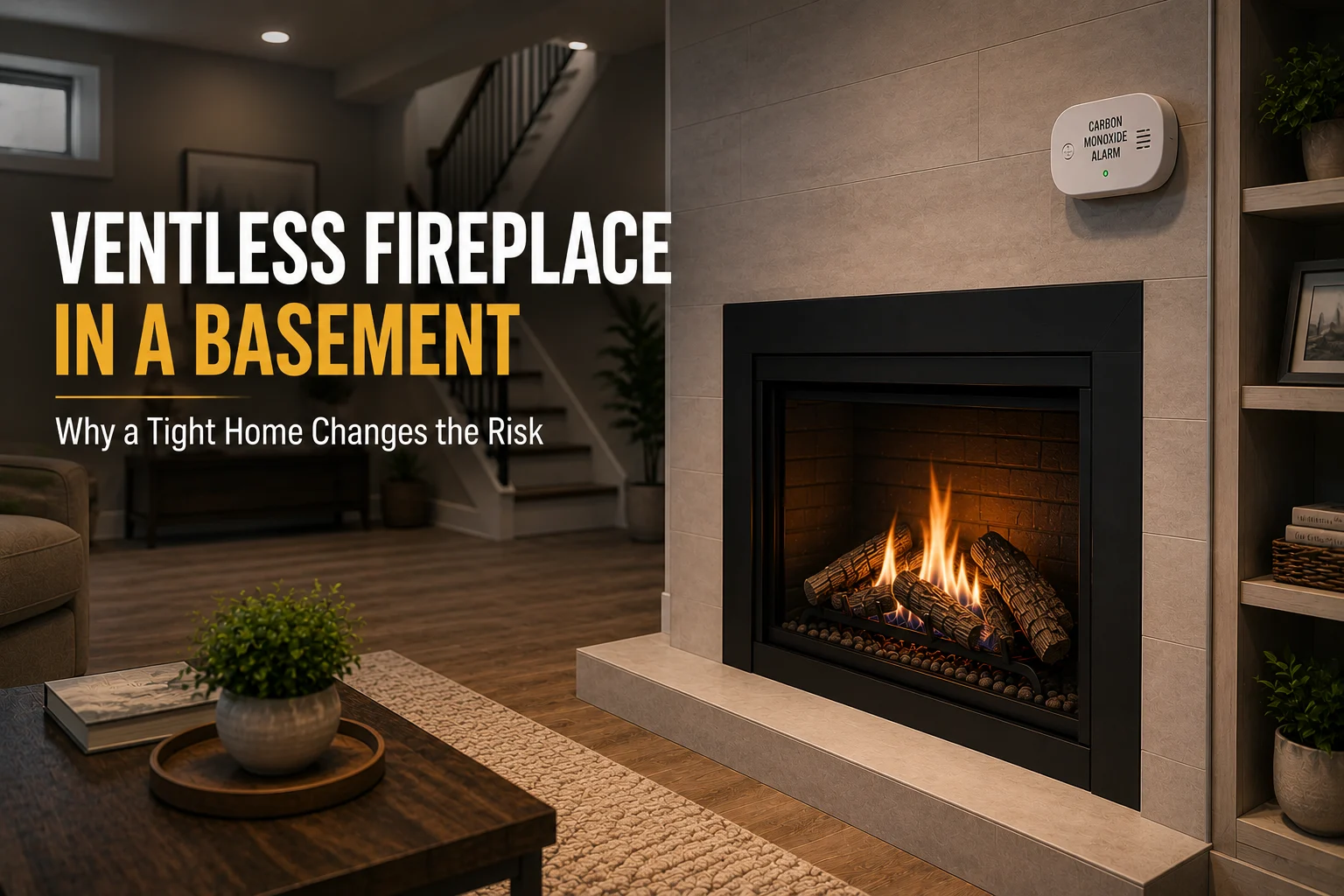
A vent-free gas appliance exhausts its combustion products into the room. Carbon monoxide, nitrogen dioxide and water vapor all end up in the air you are breathing, and a working carbon monoxide alarm is a condition of operating one, not an accessory. That is the whole subject of our page on the CO alarm and it applies before any of the guidance below.
Whether you may install one at all is a local question. Several states and provinces restrict or prohibit the category and municipalities frequently go further than their state. Start at are ventless fireplaces legal where you live and confirm with your own building department.
With those two in place, this page answers a question readers ask constantly and the SERP mostly ignores: my house is new and sealed up tight, or the room is a finished basement. Is that better or worse?
The short answer
Worse, on the mechanism, and the code’s room rule does not correct for it.
A newer, tighter building envelope is designed to exchange less air with the outside. That is the point of it, and it is why the house is cheaper to heat. But every argument for vent-free operation depends on the room’s air being continuously diluted and replaced by the rest of the house and ultimately by outside air. Reduce the air exchange and you have not reduced the appliance’s output. You have reduced the removal.
A basement is the same problem with three extra factors: it is often the least ventilated space in the house, it frequently has the smallest openable window area, and it is where a homeowner is most likely to install a heater and then close the door.
What the code rule actually says, and what it assumes
The model residential code controls this with volume rather than with air exchange.
- IRC G2445.5: the aggregate input rating of all unvented appliances installed in a room or space shall not exceed 20 Btu/h per cubic foot of volume.
- IRC G2445.3: an unvented room heater shall not have an input rating in excess of 40,000 Btu/h.
- IRC G2445.6: unvented room heaters shall be equipped with an oxygen-depletion-sensitive safety shutoff system that acts when the oxygen in the surrounding atmosphere is depleted to the percent concentration specified by the manufacturer, but not lower than 18 percent.
(All three read through UpCodes on 28 August 2026.)
Read them together and one thing becomes visible. The rule is stated in cubic feet of room volume, which is a measure of how much air is in the room. It is not a measure of how fast that air is replaced. Two rooms of identical volume, one in a 1930s house with single glazing and one in a 2024 build with a sealed envelope, satisfy the same volume rule and behave differently in practice.
This is not a defect anyone is hiding. Volume is measurable with a tape measure and air exchange is not, so a prescriptive code uses the number a building official can check. But a reader deciding whether to put one of these in a tight basement should understand which quantity the rule is proxying for and which one actually governs the outcome.
What we will not publish
No air-change figure, no blower-door number and no minimum-ventilation rate for this appliance appears on this page. We looked for a source that would license one for a general case and did not find one, and inventing a threshold in a category where the failure mode is carbon monoxide poisoning is the exact failure this site exists to avoid.
What can be said without a number: your own manufacturer’s installation manual sets the conditions for your specific unit, and it is the only document that applies to your appliance. Where the manual and a retailer’s website disagree, the manual is the document that counts.
The ODS is not the answer to this question
Readers often reach for the oxygen depletion sensor at this point, on the reasoning that a tight room simply means the ODS trips sooner and the appliance shuts down.
That reasoning is a partial truth and the partial part is dangerous. The ODS acts on oxygen concentration. It is not a carbon monoxide detector, and what it does and does not catch is a page of its own: the oxygen depletion sensor, what it catches and what it does not. Treating a shutoff device as permission to operate in a worse space inverts what the device is for. It is a last line, not a design margin.
The same goes for the reflex of cracking a window. Opening a window in a tight house does restore some air exchange, and it also removes a large part of the reason the appliance was chosen, which is a point our page on the 99 percent efficiency claim makes at length: the prescribed mitigation is precisely the heat loss the efficiency number claims to have eliminated.
Basements specifically
Three things separate a basement from an equivalent room upstairs, and none of them appears in the volume calculation.
Openable area. Many basements have no operable window at all, or a single small one. If the mitigation of last resort is ventilation, a basement is the room least able to provide it.
Water vapor. A vent-free burner puts water vapor into the room. In a basement, which is already the part of the house most prone to moisture problems, that has consequences beyond air quality. We own the appliance’s vapor output as a subject and we do not publish indoor humidity ranges, which belong elsewhere.
Usage pattern. Basements are dens, workshops and spare rooms, which means the door gets closed and the appliance runs for long stretches with one person present and nobody else in earshot. That is the pattern the CO alarm exists for.
Where this stops being a decision you can make from a web page
If you are looking at a tight new build, a finished basement, or any room where you cannot answer the ventilation question confidently, the next call is to a qualified hearth technician or a licensed gas fitter, and the one after that is to your building department. They can look at the room. We cannot.
If the answer comes back as no, that is not a dead end. The categories that remove this whole mechanism, by sealing combustion off from room air or by not burning anything, are compared in direct vent versus ventless and in vent-free gas versus electric.
This site publishes no gas-line, gas-connection or installation procedure at any depth. That is licensed work everywhere, and a page that walks you through it is a page that gets someone hurt.