
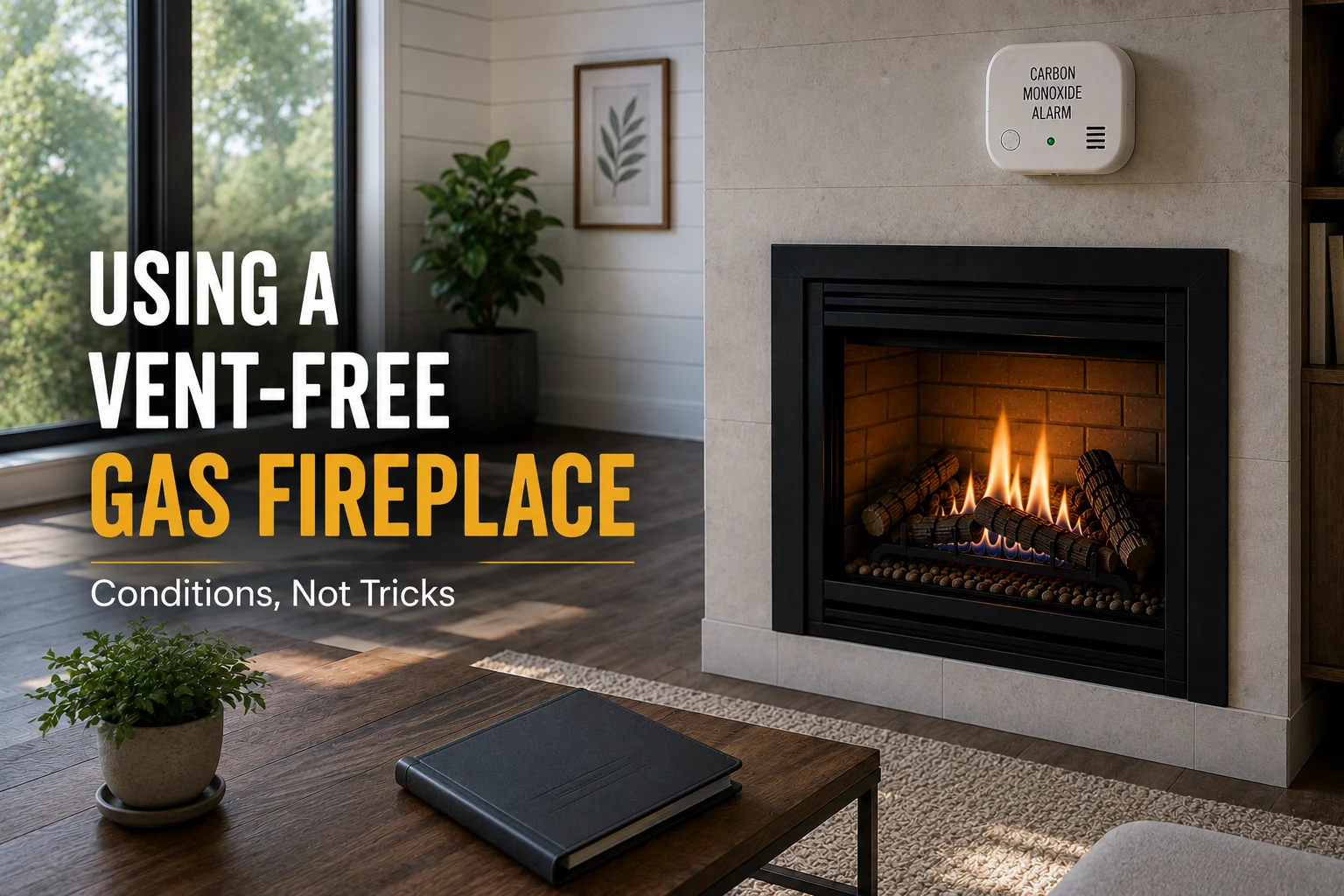
A vent-free gas appliance burns fuel in your living space and puts everything it produces into that space: carbon monoxide, nitrogen dioxide, water vapor and the rest. A working carbon monoxide alarm is a condition of operating one, not an accessory to it. That is the first sentence of this page because it is the first sentence of the subject, and the reasoning is on why a CO alarm is a condition of use.
If you have not yet established that the appliance is permitted where you live, do that before you read the rest. Are ventless fireplaces legal where you live is the starting point and your building department is the authority.
This page is for the reader whose appliance is already installed. It is not a list of tips. It is the set of conditions under which this appliance is designed to run, the signals that mean stop, and the point where the job stops being yours.
The one document that outranks this page
Your manufacturer’s installation and operating manual. It carries your unit’s input rating, its minimum room requirements, its operating and attendance instructions and its service schedule. Different units carry different limits because they have different ratings and certifications.
If you do not have it, photograph the data plate, which is usually inside the firebox or behind a control door, and use the model and serial number to find the manual on the manufacturer’s own site. A retailer’s product page is not the manual. Where the two disagree, the manual is the document that counts, and where this page and the manual disagree, the manual wins.
The conditions of operation
These come from the model residential code, all read through UpCodes on 28 August 2026, and they hold every time the appliance runs rather than only at installation.
A working CO alarm. Not a recommendation. Test it at the start of the heating season and replace it at the date printed on it.
The right room. IRC G2406.2 prohibits appliances in sleeping rooms, bathrooms, toilet rooms and storage closets, with narrow exceptions for a single wall-mounted unvented room heater at not more than 10,000 Btu/h in a bedroom or 6,000 Btu/h in a bathroom, in each case with the shutoff of G2445.6. Most decorative fireplaces are above both. See the bedroom page and the bathroom page.
Enough room volume. IRC G2445.5 caps the aggregate input rating of all unvented appliances in a room or space at 20 Btu/h per cubic foot of volume, and G2445.3 caps a single unvented room heater at 40,000 Btu/h.
Supplemental use only. IRC G2445.2: unvented room heaters shall not be used as the sole source of comfort heating in a dwelling unit. See can it be your only heat source.
Someone awake and present. Carbon monoxide is colorless and odorless and a sleeping person gets no warning. CPSC’s newsroom archive carries a release proposing a ban on unvented gas space heaters in 1978, one approving a mandatory standard in 1980, and one revoking that standard in 1984. We cite those titles and years only, because cpsc.gov returned an HTTP 403 to our fetch on 28 August 2026.
A functioning oxygen depletion shutoff. IRC G2445.6 requires it to act when the oxygen in the surrounding atmosphere is depleted to the manufacturer’s specified concentration, but not lower than 18 percent. It is a last line, not a licence. What it does and does not catch is on its own page.
Through the season, month to month
Before the first fire of the year. Test the CO alarm. Check the burner area for dust, debris, insect nests or anything that has fallen in. Confirm the logs or media are in the manufacturer’s arrangement, because on a vent-free unit that is a combustion setting and not a decorating choice. Look at the wall above the unit for staining that was not there in March.
Every burn. Look at the flame when you light it and again after a few minutes, so that you know what normal looks like on your unit. Notice whether anyone in the room develops a headache. Notice whether the windows are streaming.
Once a year. Have a qualified hearth technician service it. We publish no interval other than the annual expectation that applies to combustion appliances generally, and no cost figure, because both vary by region and by unit and your manual sets the requirement for yours.
At the end of the season. Follow your manual’s shutdown instructions. Do not improvise a procedure involving the gas supply.
The signals that mean stop
Each of these is a stop condition. None of them is a problem to work around.
Anyone develops a headache, dizziness or nausea while it is running, easing when it is off. Turn the appliance off, open a door or window, get everyone into fresh air, and do not restart it until a qualified technician has examined it. Do not talk yourself out of this one; it is the pattern the whole category’s risk is built around.
Any smell of gas. Do not light it, do not operate electrical switches, get everyone out, and call your gas supplier’s emergency line, then a licensed gas fitter.
The CO alarm sounds. Out of the house, then call the emergency number, then the fire service or gas supplier. Treat it as real every single time.
The flame changes color or shape from its normal appearance. A combustion-quality signal, and a technician’s job.
Soot or black marks appear above the unit. Incomplete combustion. Stop using it and get it looked at rather than cleaning it off.
The ODS keeps shutting the unit down. That is the safety system operating, and it means something about the room or the appliance has changed. Never bypass, disable or defeat it. No page on this site will ever tell you how, and any page that does is telling you how to be poisoned.
Water running down the windows every evening. The water vapor side of the same output, and a sign the room’s air exchange is not keeping up.
What you never do yourself
Anything involving the gas supply, the valve, the orifice, the burner assembly or the pilot mechanism is licensed work. A licensed gas fitter or a qualified hearth technician does it.
This site publishes no gas-line, gas-connection or installation procedure at any depth and it never will. That is not caution about liability. It is that a mistake in that work is a fire or a poisoning, and a web page cannot see your appliance.
Cleaning the glass with the product your manual specifies, and vacuuming dust from the room, are yours. Everything past that is not.
If this appliance is turning out to be the wrong one
That is a legitimate conclusion to reach, and the alternatives are compared elsewhere on this site: direct vent versus ventless for a unit whose combustion is sealed away from the room, vent-free gas versus electric for one where nothing burns, and vent-free versus a pellet or wood stove if the goal is real supplemental heat.
What this page does not give you
No run-time figure, because we traced the one in circulation and could not find a parent document for it. No clearance figure, because that comes from your manual and the adopted code and a wrong one is a house fire. No ppm threshold, because for indoor nitrogen dioxide no agreed standard exists to quote.
And no statement that the appliance is safe. This page tells you the conditions and the stop signals, which is what an honest page in this category can do.