
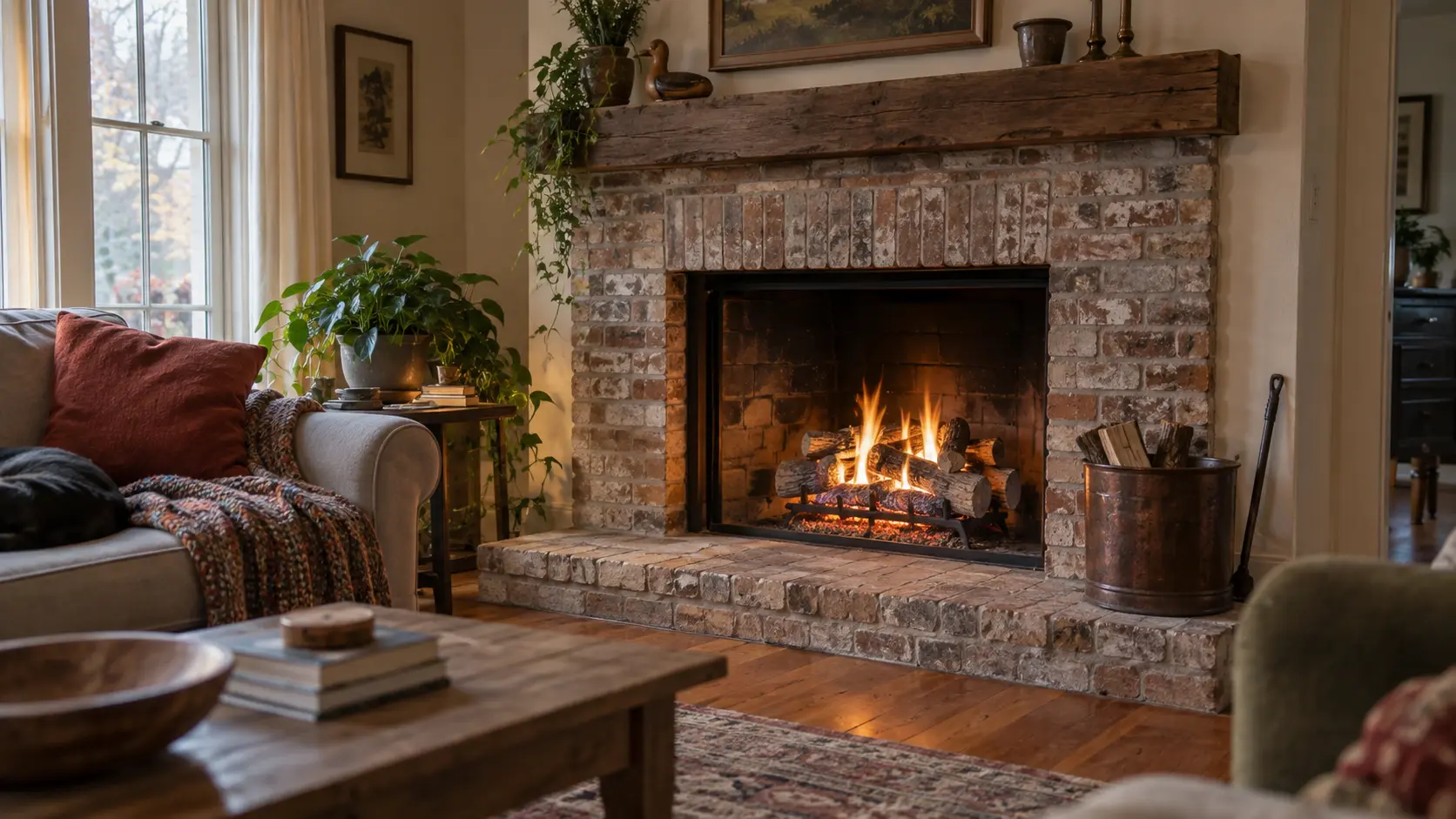
The four types of ventless gas fireplaces on the market are vent-free log sets, vent-free inserts and fireboxes, freestanding vent-free stoves, and wall-mounted vent-free heaters. What separates them is where the appliance physically goes and what it needs to sit in. What does not separate them is the thing that matters most. All four burn fuel in the room and release the products of that combustion into the same room, and all four sit under the same code limits.
Before any of this is a shopping question, it is a permission question. Unvented gas appliances are permitted in much of the United States, restricted in some places and prohibited outright in others, and the answer is set by the code your state, county or city has adopted, not by whether a retailer will ship to your address. Start with our overview of whether vent-free fireplaces are legal and then run the process in how to check your local code before you buy. If your jurisdiction says no, the shape of the appliance is not a decision you have to make.
We have never installed, lit or burned one of these appliances, and we make no claim to have. This page is built from published code text, product standards catalogues and manufacturer documentation, each named where it is used. We publish no rankings, no picks and no prices on this subject.
Carbon monoxide before the shopping list
A vent-free appliance has no flue, so every product of combustion stays indoors. The US Consumer Product Safety Commission calls carbon monoxide the “Invisible Killer” because it is “a colorless, odorless, poisonous gas”, and reports that more than 200 people in the United States die every year from accidental non-fire carbon monoxide poisoning associated with consumer products (CPSC Carbon Monoxide Information Center, read September 2, 2026). The Environmental Protection Agency lists “unvented kerosene and gas space heaters, woodstoves, fireplaces, gas stoves” as sources of combustion products and names “carbon monoxide, nitrogen dioxide, particles” among what they release (EPA, Sources of Combustion Products, read September 2, 2026).
A working carbon monoxide alarm is a condition of operating any of these appliances, not an accessory you add later. That is true of the log set and the wall unit equally.
The four types of ventless gas fireplaces, and what actually differs
| Shape | Where it goes | What it needs to sit in | What usually differs |
|---|---|---|---|
| Vent-free log set | Inside an existing masonry or factory-built firebox | A firebox the manual accepts, prepared as the manual requires | Log arrangement, burner style, whether a remote or wall control is offered |
| Vent-free insert or firebox | Into an existing opening, or into a new framed opening | A structure built to the manual’s dimensions and clearances | Glass front or open front, trim and surround options |
| Freestanding stove | On the floor, away from the wall, often on floor protection | Floor protection and clearances from the manual | Cast styling, viewing area, whether a blower is offered |
| Wall-mounted heater | Hung on a wall | A wall the manual accepts, with its stated clearances | Blue flame or infrared burner, thermostat knob or manual valve |
Read the middle column twice. The difference between these products is mostly a construction difference, and each manual states its own requirements for the structure and the clearances around it. That is why our guide to choosing a vent-free gas fireplace, like every honest page in this category, refuses to publish a general clearance distance in inches. The number belongs to the model, not to the category.
What does not change, whatever shape you buy
The model code treats these appliances as one class, and the limits follow every shape into every room.
Section 621.1 of the 2021 International Fuel Gas Code requires that “unvented room heaters shall be listed in accordance with ANSI Z21.11.2 and shall be installed in accordance with the conditions of the listing and the manufacturer’s instructions” (read September 7, 2026). Section 621.3 states that “unvented room heaters shall not have an input rating in excess of 40,000 Btu/h (11.7 kW)”. Section 621.5 limits the aggregate input rating of all unvented appliances in a room to “20 Btu/h per cubic foot” of that room’s volume. Section 621.2 states that “one or more unvented room heaters shall not be used as the sole source of comfort heating in a dwelling unit”. Section 621.6 requires an oxygen-depletion-sensitive safety shutoff system. Those five were read on UpCodes on September 2, 2026.
None of those sections cares whether the appliance is a log set or a wall unit.
Bedrooms and bathrooms are not a shape question either
Section 303.3 of the same code prohibits appliances in “sleeping rooms, bathrooms, toilet rooms, storage closets or surgical rooms, or in a space that opens only into such rooms or spaces”, subject to a short list of exceptions. Two of those exceptions cover a single wall-mounted unvented room heater with an input rating not greater than 6,000 Btu/h in a bathroom and not greater than 10,000 Btu/h in a bedroom, each subject to volume criteria.
Those exceptions describe small wall-mounted heaters approved by a code official. They are not a description of the decorative fireplace most people are shopping for, and they are not something a homeowner self-certifies. Our page on vent-free appliances in bedrooms sets out the prohibition and the narrow exception in full. Shopping for a wall unit rather than a stove does not move you inside that exception.
The mistake that costs the most: vented and vent-free look identical online
A vented gas log set and a vent-free gas log set photograph the same way, sell through the same retailers and sit in adjacent categories on the same page. They are different appliances, certified to different standards, with different requirements for the fireplace they go into. The label and the manual settle which one is in the box. The photograph never does.
If you are still deciding between the categories rather than between the shapes, our comparison of vented and vent-free gas fireplace types is the page to read first. If your plan is to put vent-free logs into a fireplace that currently burns wood, that is a specific decision with its own conditions, and we cover it in converting a wood fireplace to vent-free gas logs.
What the shape does change: the install, and who is allowed to do it
Here is the honest difference. A log set dropped into an existing firebox, an insert built into a wall, a stove standing on floor protection and a heater hung on a wall are four different construction jobs, with four different clearance sets and four different ways to get the structure wrong. What they share is the gas connection, and the gas connection is where this stops being a homeowner decision at all.
Connecting any of these appliances to a gas supply is licensed work. It is done by a licensed gas fitter or a qualified hearth technician, working to the manufacturer’s instructions, under whatever permit and inspection your jurisdiction requires. We publish no gas connection procedure and no installation walkthrough at any level of detail. Ask your building department whether the installation needs a permit and an inspection before you buy anything, and get the installer’s license number before work starts.
What we checked, and when
2021 International Fuel Gas Code sections 303.3, 621.1, 621.2, 621.3, 621.5 and 621.6, as published on UpCodes, read September 2 and September 7, 2026. CSA/ANSI Z21.11.2, “Gas-fired room heaters, volume II, unvented room heaters”, as listed in the ANSI and CSA Group standards catalogues, checked September 7, 2026. CPSC Carbon Monoxide Information Center and EPA, Sources of Combustion Products, read September 2, 2026. Codes are amended and adopted locally, so verify the edition in force where you live.
Frequently asked questions
Are vent-free gas logs and a vent-free insert the same thing?
No. A log set is a burner and ceramic logs designed to sit inside a firebox you already have. An insert or firebox is the enclosure itself, built into an opening. They are bought differently and installed differently, and each carries its own manual with its own clearance and structure requirements. Both are unvented appliances under the code, so both carry the same input rating cap and the same room volume limit.
Which type of ventless gas fireplace is safest?
No shape in this category is certified as safer than another, and we will not rank them that way. Every one of them burns fuel in the room and releases the combustion products into the room, and the code applies the same input limits, the same oxygen depletion shutoff requirement and the same prohibited locations to all of them. The variables that actually change your risk are the room’s volume, the appliance’s input rating, your jurisdiction’s rules and whether the installation followed the manual.
Can I put a vent-free stove in a bedroom if it is small?
Do not plan on it. Section 303.3 of the 2021 International Fuel Gas Code prohibits appliances in sleeping rooms subject to narrow exceptions, and the bedroom exception covers a single wall-mounted unvented room heater rated at not more than 10,000 Btu/h, subject to volume criteria and to the approval of your code official. That is not a decorative stove, and it is not a decision a homeowner makes alone.
Does a wall-mounted unit need less clearance than a stove?
Sometimes, but never as a rule you can apply from a web page. Each model’s manual states its own clearances to combustible materials, and those distances are part of the listing that makes the appliance legal to install. Two wall units from the same brand can carry different figures. Read the manual for the exact model before you plan a location, and confirm the plan with your installer and your building department.
Do all four types need the same certification?
The code requirement is the same. Section 621.1 of the 2021 International Fuel Gas Code requires unvented room heaters to be listed in accordance with ANSI Z21.11.2 and installed in accordance with the conditions of the listing. What you verify is the specific unit’s own label and manual, which name the standard the appliance was listed to and the organization that certified it. If a product page makes a certification claim the label does not, believe the label.