
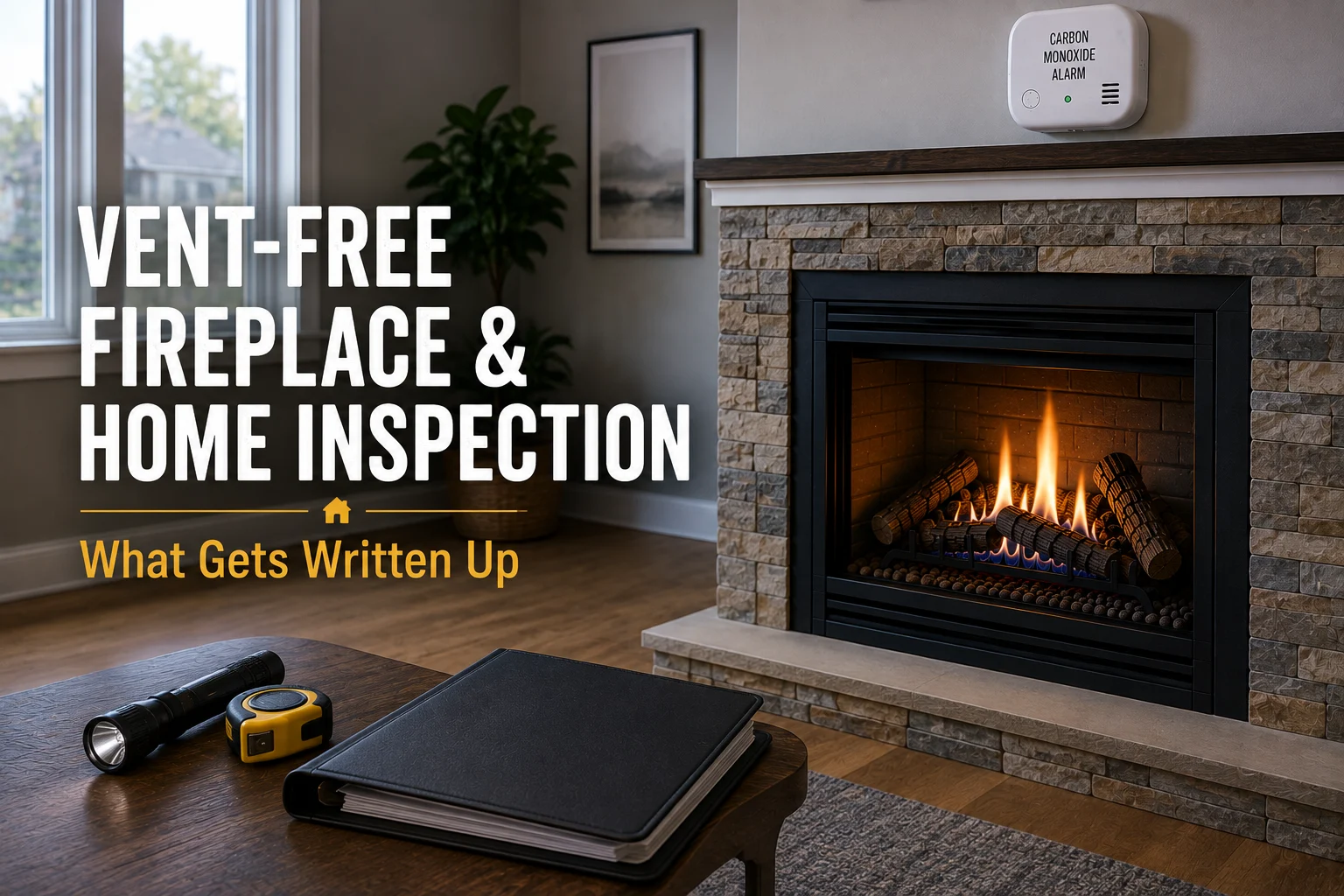
A vent-free gas appliance discharges its combustion products into the room, including carbon monoxide, nitrogen dioxide and water vapor, and a working carbon monoxide alarm is a condition of operating one. That is the reason inspectors take an interest, and it is set out on our page about the CO alarm.
Whether the appliance is permitted at all is decided by the code adopted where the house stands, and that varies by state, province, county and municipality. Start at are ventless fireplaces legal where you live.
This page is for two readers: a seller wondering whether the fireplace will cost them at closing, and a buyer whose inspection report has just come back with something about it.
What an inspector will do
A home inspector is not a code official and generally does not issue violations. What they do is observe, describe and recommend, and a fuel-burning appliance that vents into the living space is exactly the kind of thing a report describes at length.
Expect an inspector to:
- Identify the appliance type. Vented and vent-free units look similar and inspectors are trained to tell them apart. The distinction is in types of gas fireplaces, vented versus ventless.
- Read the data plate for manufacturer, model, fuel type and input rating in Btu/h.
- Note the room it is in. This is the single most common finding, for reasons below.
- Note the presence or absence of a carbon monoxide alarm.
- Note visible signs of poor combustion, such as soot or staining on the wall above the unit.
- Note whether logs or media appear to be in the manufacturer’s arrangement, because on a vent-free unit that is a combustion setting rather than a decorating choice.
- Recommend evaluation by a qualified specialist wherever any of the above is unclear. That recommendation is not a verdict; it is an inspector declining to guess.
The findings that come up most
The room
IRC G2406.2 states that appliances shall not be located in sleeping rooms, bathrooms, toilet rooms, storage closets or surgical rooms. The exceptions are a single wall-mounted unvented room heater at not more than 10,000 Btu/h in a bedroom, or 6,000 Btu/h in a bathroom, in each case with the shutoff system of G2445.6, and for a bedroom meeting the volume criteria of G2407.5. (Read through UpCodes, 28 August 2026.)
Most decorative vent-free fireplaces are well above both figures. A unit in a bedroom or a bathroom is therefore the finding most likely to appear in a report and the one hardest to argue away. See the bedroom page and the bathroom page.
The room volume
IRC G2445.5 caps the aggregate input rating of all unvented appliances in a room or space at 20 Btu/h per cubic foot of volume, and G2445.3 caps a single unvented room heater at 40,000 Btu/h. An oversized unit in a small room is checkable with a tape measure and a data plate, and inspectors do check it.
Whether it was ever permitted
An appliance installed without a permit is a live problem at resale in many jurisdictions, and it is a question a buyer’s attorney or agent may raise even when the inspector does not. Records sit with the municipality, and a seller can establish the answer before listing rather than during negotiation.
The house type
If the property is a manufactured home, this is not a local question. 24 CFR 3280.709 requires complete separation of the combustion system from the interior atmosphere, which is a US-wide federal requirement attached to that class of housing, and an unvented heater does not meet it.
The jurisdiction
Where the appliance is prohibited outright, an inspection report saying so is the least of the problem. Our page on where the appliance is banned or restricted sets out what we confirmed at source and dates each claim, and why last year’s answer may be wrong now covers the fact that this content decays.
What a seller can settle before listing
In rough order of how much difficulty each one prevents:
- Establish legality for your address, with the building department rather than with a search result.
- Find the permit record, or establish that there is none.
- Find the data plate and the manual, and keep both with the house documents. A buyer who can read the appliance’s own paperwork asks fewer questions.
- Have it serviced by a qualified hearth technician before listing, and keep the paperwork.
- Make sure a working CO alarm is in place, which is cheap and removes a line from the report.
- Do not clean off soot and say nothing. Soot indicates something about how the appliance has been burning, and hiding it is a disclosure problem rather than a cosmetic one.
Where the work stops being yours. Removing, relocating or altering the appliance, and anything touching the gas supply, is licensed work for a licensed gas fitter or a qualified hearth technician. This site publishes no gas-line, gas-connection, installation or removal procedure at any depth.
What a buyer should do with the finding
Read what the report actually says. There is a large difference between “vent-free gas appliance present, CO alarm recommended” and “unvented heater installed in a bedroom, exceeds the input limit for that location.”
Then ask three questions, in order: is this appliance permitted in this municipality, was a permit issued, and what would it cost to bring it into compliance or remove it. The first two are answered by the municipality. The third is answered by a licensed contractor, and it is the one that belongs in a negotiation.
If the outcome is that the appliance has to go, the replacement categories are compared in direct vent versus ventless and vent-free gas versus electric.
What this page does not publish
No effect on sale price, no percentage, no cost figure and no inspection fee. We found no source that would license any of those, and a number invented for a page like this would be repeated by other pages within a month.
No clearance figure. That comes from your unit’s manual and the adopted code, and nowhere else.
And no reassurance. Whether an inspector’s finding matters to your sale depends on your market, your buyer and your jurisdiction, and nobody writing a general page knows any of the three.