
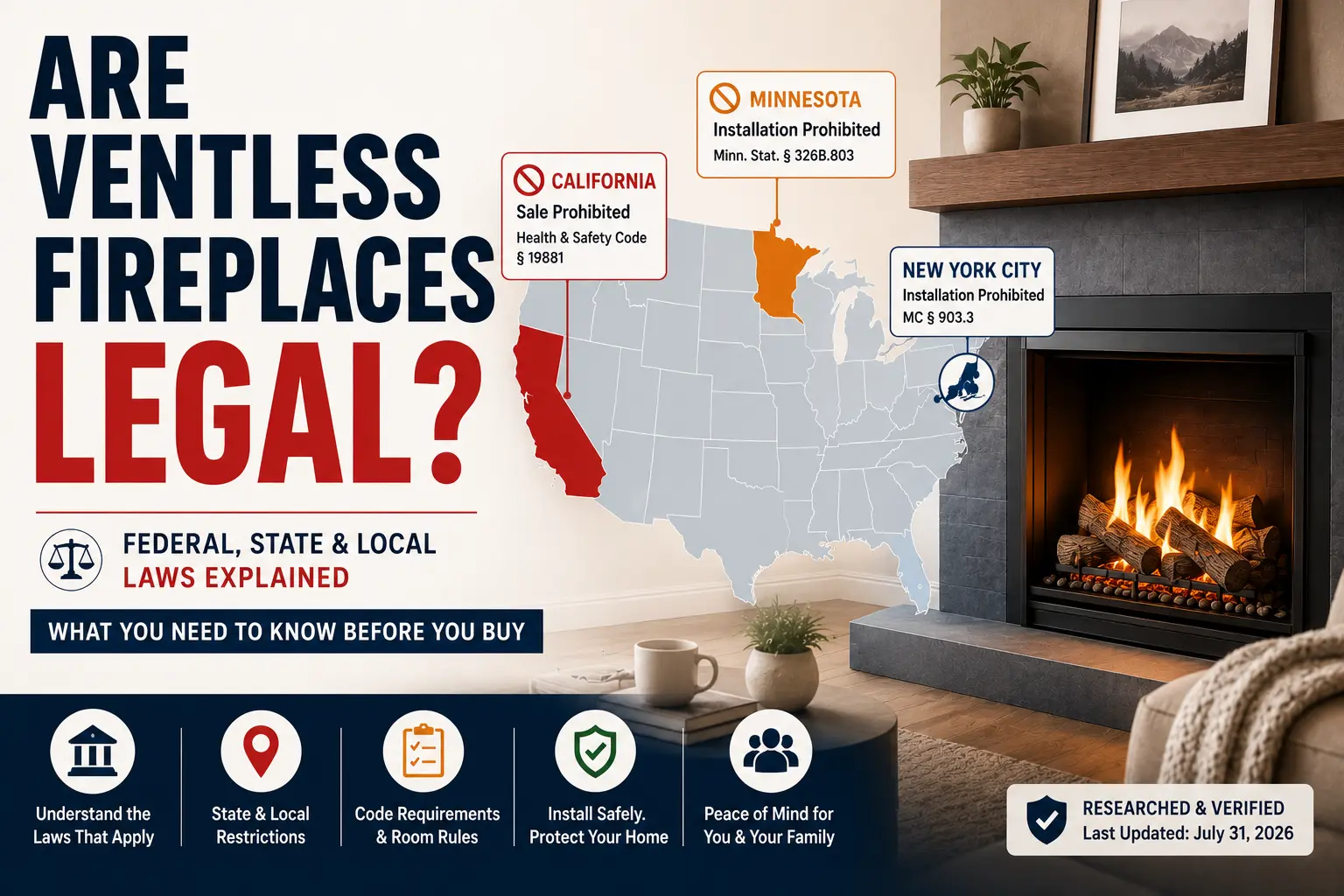
Whether a ventless gas fireplace is legal where you live depends on your country, your state or province, and often your own city or county. There is no single US or Canadian answer. California bans the sale of unvented dwelling heaters by statute. New York City prohibits the installation outright. Most other US jurisdictions allow the appliance under adopted code limits and room restrictions. The only answer that binds you is the one your local building department gives for your address.
Everything below was checked against primary sources on 31 July 2026. Where we could not reach a primary source, we say so rather than repeating what a retailer wrote.
The short answer, and why it is not one word
A ventless fireplace, also sold as a vent-free gas fireplace, gas log set or unvented room heater, burns natural gas or propane indoors with no flue. Every combustion product it makes stays in the room. That single design fact is why the legal answer fragments: jurisdictions do not disagree about how the appliance works, they disagree about whether that trade-off is acceptable inside a home.
So the useful question is not “are ventless fireplaces legal.” It is “is this appliance permitted for installation at my address, in the room I have in mind, under the code edition my jurisdiction has currently adopted.” Those are four separate variables, and a page that answers only the first one has not answered you.
We are not lawyers, and nobody who writes for this site is. This page is a research summary and a method, not legal advice. Anything genuinely contested at your address belongs with your building official, your fire marshal, or an attorney licensed where you live. Our editorial policy sets out how we source pages like this one.
Why there is no single national answer
Legality here is a stack, not a single rule. Four separate authorities can each say no, and each one can be stricter than the one above it. Nothing higher up the stack grants you permission when something lower down forbids it.
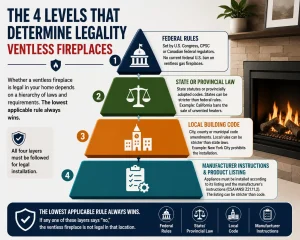
| Layer | Who sets it | Can it be stricter than the layer above it | What we verified at this layer |
|---|---|---|---|
| Federal | US Congress, CPSC, or Canadian federal regulators | n/a | We found no current federal US prohibition on the appliance category |
| State or provincial | State statute, or a provincially adopted code | Yes | California Health and Safety Code section 19881 |
| Local | City, county or municipal code amendments | Yes | New York City Mechanical Code section 903.3 |
| The product itself | The manufacturer’s listing and installation instructions | Yes | CSA/ANSI Z21.11.2, the unvented room heater standard |
The fourth layer is the one readers skip. A code may permit the category in general while your specific unit’s listing forbids the room you want it in. In that case the listing wins, because codes almost universally require appliances to be installed in accordance with their listing and the manufacturer’s instructions.
At the federal US level, the Consumer Product Safety Commission’s own newsroom archive tells a useful story: it lists a 1978 release proposing a ban on unvented gas space heaters, a 1980 release approving a mandatory standard, and a 1984 release revoking that mandatory standard. We could not retrieve the full text of the 1984 release, so we report the titles and dates as published on cpsc.gov and no more. The practical takeaway holds either way: the binding controls today sit at the state, local and product-listing layers, not the federal one.
States and provinces that ban or restrict vent-free gas appliances
There is a list, and this is deliberately not the page that publishes it. Ban lists go stale faster than almost any other kind of home-improvement content, and the ones currently ranking contradict each other in ways their authors do not acknowledge. One page names a state as banned; another names the same state as having repealed its ban; neither dates the claim or cites the regulation it came from.
Our companion article on where ventless fireplaces are banned is the one that carries the jurisdiction list, with a checked-on date attached to each entry and a note where the sources conflict. It is written to be re-verified rather than trusted forever.
What we will say here is the shape of the list, because the shape is stable even when the entries are not. A small number of jurisdictions prohibit the appliance by statute or by adopted code. A larger number of individual cities and counties prohibit it locally, inside states that permit it. The great majority permit it subject to room restrictions, room-volume requirements and the manufacturer’s listing. Assume you are in the third group only after you have checked, not before.
California’s ban, explained
California is the one US jurisdiction with a clean statutory answer, and it is worth reading precisely because the precision matters.
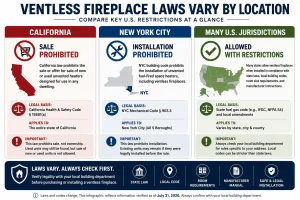
California Health and Safety Code section 19881(a) reads: “No person shall sell, or offer for sale, any new or used unvented heater that is designed to be used inside any dwelling house or unit, with the exception of an electric heater, or decorative gas logs for use in a vented fireplace.” We read that text on FindLaw’s California code library on 31 July 2026, where it is marked current as of 1 January 2026.
Two details get lost in most summaries of this statute. First, the prohibition as written is on selling and offering for sale, not on ownership. Second, subdivision (b) creates a conditional route by which natural-gas-fueled unvented decorative gas logs and fireplaces could be sold, if the Department of Housing and Community Development and the State Department of Health Services develop recommended standards, the products meet them, the California Building Standards Commission adopts them, and the products are listed by an approved agency. We did not find evidence that those standards have been adopted, and we could not confirm the status either way from a state source, so we do not assert it. The full breakdown, including what it means that units still appear for sale online, sits in our article on ventless fireplaces in California.
Canada: why the practical answer is effectively no
Canada is a separate legal system, and almost every page ranking for this question is written for a US reader. Do not port a US answer across the border.
Canadian gas installation is governed by CSA B149.1, the Natural Gas and Propane Installation Code, which provinces and territories adopt by regulation and then vary. British Columbia’s current Gas Safety Regulation (B.C. Reg. 103/2004), which we read on the BC Laws site, adopts CSA B149.1-20 by reference “in whole subject to the variations set out in the Schedule.” An earlier Natural Gas and Propane Code Regulation, which named the 2000 edition of B149.1, is marked on BC Laws as repealed in 2004, which is itself a caution: citing a code number without its edition and its provincial variations tells you very little.
We did not read CSA B149.1 itself. It is a paid standard sold through CSA Group, and we do not restate the contents of documents we have not read. What we can point to is Natural Resources Canada’s regulatory page for gas fireplaces, which describes the regulated venting configurations as natural venting, direct venting and powered venting. Every one of those is a vent. Our working position is that a Canadian reader should treat the answer as no until a provincial gas safety authority tells them otherwise in writing, and the reasoning behind that is set out in our article on ventless fireplaces in Canada.
Your state may allow it, and your city may not
New York is the cleanest illustration in North America of why a state-level answer is not your answer. New York State has no statewide statutory ban of the kind California has. New York City does prohibit these appliances, and it does so in plain language.
Section 903.3 of the New York City Mechanical Code (2022), which we read on 31 July 2026, states: “The installation of unvented gas-fired space heaters, gas stoves, gas logs, gas fireplaces and gas fireplace inserts is prohibited.” A reader in Buffalo and a reader in Brooklyn are in the same state and do not have the same answer.
This pattern repeats wherever a municipality has adopted local amendments, and municipalities amend fuel gas provisions routinely for reasons that have nothing to do with fireplaces. Air quality management districts, historic districts and newer local ordinances restricting gas appliances in new construction can all land on the same appliance from different directions. Our guide to running a local code check on a ventless fireplace walks through finding your own jurisdiction’s adopted code and its amendments.
How to ask your building department the right question
Most readers who call their building department get a vague answer because they ask a vague question. “Are ventless fireplaces allowed here” invites “check your local code,” which is the answer they were already trying to escape.
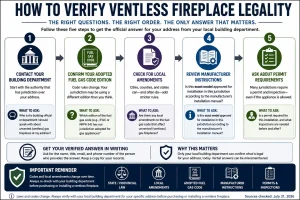
Ask this instead, out loud, in one sentence: “Which edition of the fuel gas code has this jurisdiction adopted, does it carry any local amendment affecting unvented gas-fired room heaters or vent-free gas fireplaces, and does this address require a permit for that installation?”
| Ask this | Why this wording works |
|---|---|
| Which edition of the fuel gas code have you adopted | Pins the answer to a document with a date, so you can look it up yourself |
| Is there a local amendment on unvented gas-fired room heaters | Uses the code’s own term, not the marketing term, so the clerk can search for it |
| Does this address require a permit for that installation | Converts a general question into a decision about your property |
| Can you point me to where that is published | Gives you a citation instead of a recollection |
Ask for the answer in writing, or at least ask where the adopted code is published so you can read the section yourself. Verbal answers from a busy counter are not a defense during an inspection or an insurance claim. If your jurisdiction routes appliance questions to a separate gas or mechanical inspector, ask to be transferred rather than accepting a general answer from the wrong desk.
Why last year’s answer might already be wrong
Codes move on adoption cycles. Model codes are republished on a multi-year schedule, states and provinces adopt new editions at their own pace, and municipalities layer amendments on top whenever a council decides to. Any of those three can change the answer for your address without a single national headline.
Retailer and blog content, by contrast, is almost never revisited. A page written in 2019 that says a state permits or bans these appliances will still say it in 2026, still rank, and still carry no date on the claim itself. That mismatch, between a legal landscape that changes quietly and content that never gets refreshed, is the single biggest reason the search results for this question disagree with each other.
Here is our own ledger, so you can see exactly how far each claim on this page is verified.
| Claim | Jurisdiction | Source we read | Checked | What we could not confirm |
|---|---|---|---|---|
| Sale of unvented dwelling heaters prohibited, with narrow exceptions | California | Health and Safety Code section 19881, via FindLaw, marked current as of 1 Jan 2026 | 2026-07-31 | Whether the subdivision (b) standards were ever adopted |
| Installation of unvented gas logs, fireplaces and inserts prohibited | New York City | NYC Mechanical Code 2022, section 903.3, via UpCodes | 2026-07-31 | Whether any variance process exists |
| Appliances prohibited in sleeping rooms and bathrooms, with narrow exceptions | Massachusetts, as an example of the model-code pattern | Massachusetts Residential Code 10th ed., section G2406.2 (303.3), via UpCodes | 2026-07-31 | Whether 248 CMR amends it; mass.gov blocked our request |
| National gas installation code adopted provincially, with variations | British Columbia | Natural Gas and Propane Code Regulation, BC Laws | 2026-07-31 | The contents of CSA B149.1, a paid standard we did not read |
| Unvented room heaters have a binational US and Canada product standard | US and Canada | CSA/ANSI Z21.11.2 listings on the ANSI Webstore and CSA Group store | 2026-07-31 | The standard’s text, which is paywalled |
| No current federal US prohibition found | United States | CPSC newsroom release titles, 1978, 1980 and 1984 | 2026-07-31 | The full text of the 1984 revocation release |
One claim we deliberately did not repeat: several ranking pages state that Massachusetts lifted a ban on these appliances. We could not confirm or refute that against the Massachusetts regulations themselves, so it is not on this page as a fact.
Legal is not the same as safe
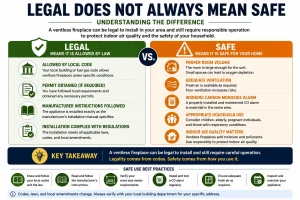
A jurisdiction permitting an appliance is a statement about what it will allow, not a certificate that the appliance is a good idea in your house. Those are different questions decided by different people, and readers routinely collapse them into one.
The appliance is a working combustion device with no flue, which is why it carries an oxygen depletion safety shutoff system, why manufacturers state run-time and room-size limits, and why fire services and the hearth industry have visibly different postures toward it. That disagreement is real, and it is not resolved by your building department saying yes.
There is also a certification trap worth naming. The product standard for these appliances, CSA/ANSI Z21.11.2, “Gas-fired room heaters, volume II, unvented room heaters,” is published as a binational US and Canadian standard. A unit can therefore be certified to a standard both countries recognize and still be an appliance your jurisdiction does not permit you to install. Certification describes the product. Permission describes your address. Never read the first as the second.
Never assume a bedroom or a bathroom
Whatever your state allows in general, sleeping rooms and bathrooms are treated differently by the model codes, and the difference is not a technicality.
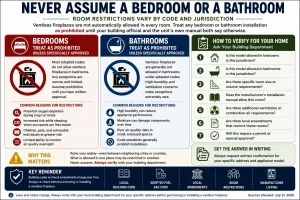
The pattern, using one state’s adopted text as the example: section G2406.2 (303.3) of the Massachusetts Residential Code, 10th edition, provides that appliances shall not be located in sleeping rooms, bathrooms, toilet rooms, storage closets or surgical rooms. It then carries narrow exceptions for a single wall-mounted unvented room heater, each tied to an input-rating cap and a room-volume requirement. We read that section on UpCodes on 31 July 2026.
Two things follow, and both matter more than the numbers. First, the exceptions are exceptions: the default in the adopted text is prohibition, and the exception is drawn tightly enough that most units and most rooms fall outside it. Second, the caps and the room-volume rules differ by code edition and by jurisdiction, which is exactly why we are not publishing figures on this page. Treat any bedroom or bathroom installation as prohibited until your building official and the unit’s own manual both say otherwise, for that room, at that rating.
If your area allows it, here is the review before you buy or keep using one
Permission is the first gate, not the last. If your jurisdiction permits the appliance, the questions that decide whether it belongs in your home are still open, and they are answered by your specific room and your specific unit rather than by any article.
Work through these before money changes hands, or before you light an existing unit for the season:
- Which exact model, and what does its own installation manual say about permitted rooms, minimum room volume and maximum run time
- Does the room have the volume and the combustion air the manual requires, measured rather than estimated
- Is anyone in the household pregnant, elderly, or living with asthma or another respiratory or cardiac condition
- Is the house recently built or recently air-sealed, which changes how the room behaves
- Is there a working carbon monoxide alarm, and does it meet your jurisdiction’s requirements
- Who is legally permitted to connect gas where you live, and is that person licensed
If any of those questions has no clear answer yet, the honest position is that you are not ready to proceed, not that you are fine. And if the answer to the permission question came from a salesperson rather than a building official, go back and run the local code check first.
What this page is not
This page is a research summary. It is not legal advice, it does not create any professional relationship, and it cannot account for your address, your building, your lease, your homeowners association or your insurer.
We have never installed, owned or operated one of these appliances, and we do not claim to have. What we do is read primary sources, cite them with dates, and tell you where our reading stops. That boundary is the point of a page like this one, and the full scope of it is set out in our disclaimer.
Where a genuine dispute exists, three people can settle it and we are none of them: the building official or fire marshal with jurisdiction over your address, a licensed gas fitter in your area, and, if money or liability is on the line, an attorney licensed in your state or province. Codes change. Re-check anything on this page that you are about to act on.
Deep dives on this question
- Where are ventless fireplaces banned: the jurisdiction list, dated, with the source conflicts named.
- Ventless fireplaces in California: what section 19881 does and does not prohibit.
- Ventless fireplaces in Canada: why a US answer does not travel north.
- How to run a local code check: finding your own adopted code and its amendments.
Frequently asked questions
Is my state on the banned list?
That depends on the date of the list you are reading and whether it distinguishes a statewide ban from a city ordinance. Our banned jurisdictions article carries the current entries with a checked-on date on each, and flags where sources conflict. A state absent from every ban list can still contain a city that prohibits the appliance, as New York does.
Did my state’s ban get lifted?
Several widely shared pages assert that particular states repealed bans, and we could not confirm those assertions against the states’ own regulations. Treat any repeal claim without a citation and a date as unverified. The reliable route is to ask your building department which code edition is currently adopted and whether any local amendment applies.
The store sold me one, so it must be legal here, right?
No. Retail availability is not a legal finding, and online sellers do not check the buyer’s local code. California’s statute is aimed at sale specifically, and even there units still surface for sale online. What governs your installation is your jurisdiction’s adopted code plus any local amendment, not the checkout page.
Can my landlord install one in my rental?
Only if it is permitted at that address in that room, and a lease cannot override a code prohibition. If you rent and one is already installed, the questions to raise are whether it was permitted and inspected, and whether the room and the unit’s own listing agree. Raise it with the building department in your municipality rather than only with the landlord.
Do I need a permit?
Frequently yes, and jurisdictions vary on whether the permit attaches to the appliance, the gas connection, or both. Ask the permit question explicitly when you call, because a jurisdiction can permit the appliance and still require an inspected installation by a licensed gas fitter. An uninspected gas installation can also complicate an insurance claim or a future home sale.