
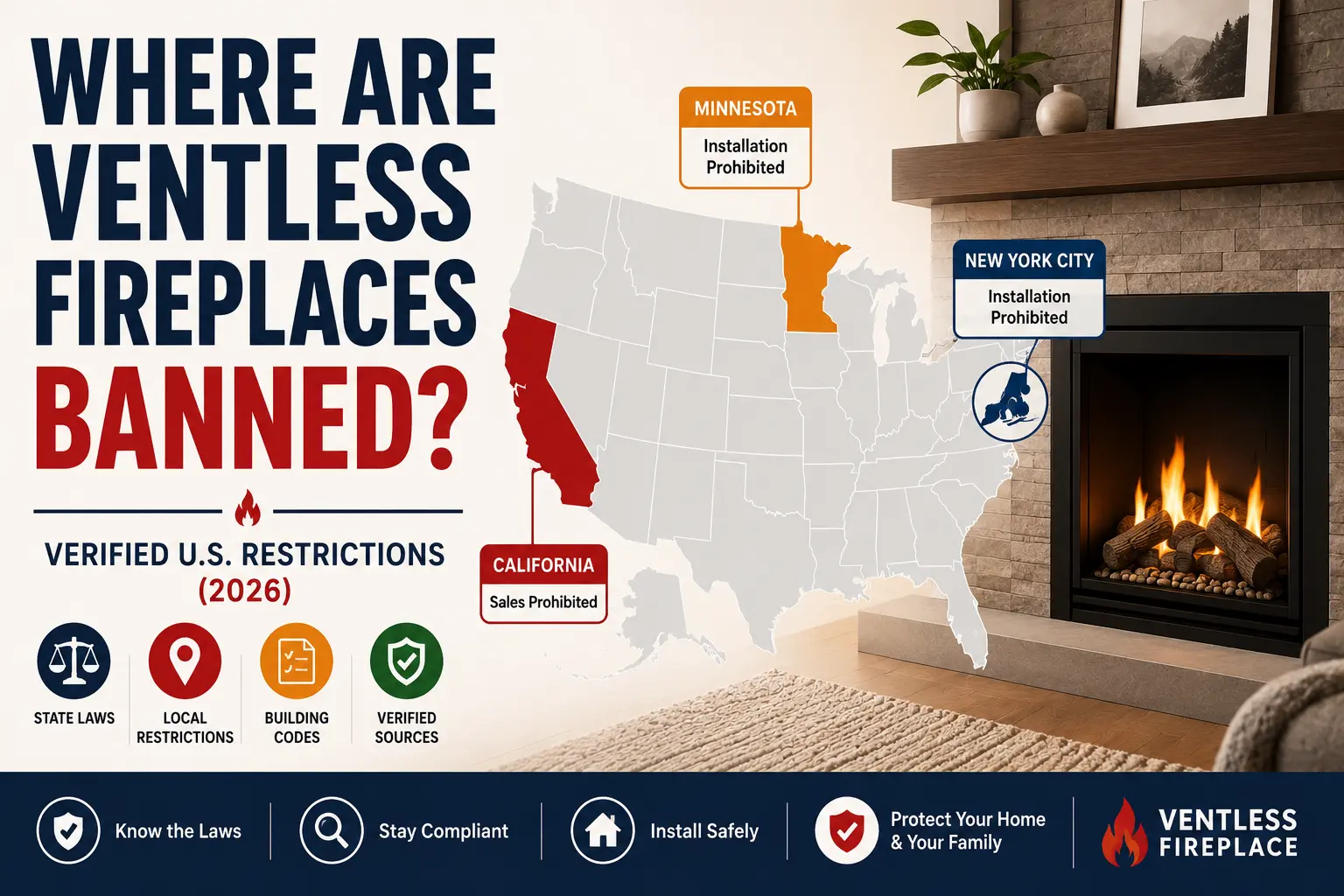
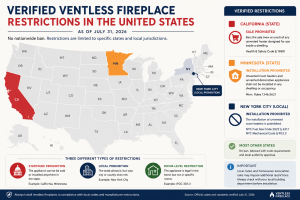
There is no nationwide ban in the United States. As of July 31, 2026, the restrictions that could be read directly against a named statute or code edition are narrow: California prohibits the sale of unvented heaters designed for use inside a dwelling, Minnesota prohibits installing them in any dwelling or occupancy, and New York City prohibits them outright. Most other “banned states” claims circulating online carry no date and no citation, and could not be confirmed. Canada does not publish a ban list at all; it works through appliance certification.
That short answer is deliberately shorter than the lists you will find elsewhere. This page is not legal advice, and it is a starting point rather than a verdict for your specific address. For the method behind it, see are ventless fireplaces legal, the parent guide to this whole question.
What could actually be verified, and what could not
Every row below was read on July 31, 2026 against the source named in the same row. Nothing appears here because another article said it. Where a claim circulates but could not be traced to a code section or statute, it is listed later under what we left out, not smuggled into the table.
| Jurisdiction | What the rule actually does | Source read July 31, 2026 |
|---|---|---|
| California (state) | Bars the sale, new or used, of any unvented heater designed to be used inside a dwelling house or unit. Exceptions are electric heaters and decorative gas logs for use in a vented fireplace. | Health and Safety Code section 19881 |
| Minnesota (state) | “Unvented room heaters and unvented decorative appliances shall not be installed in any dwelling or occupancy.” | Minnesota Rules 1346.5621, Office of the Revisor of Statutes; same wording carried as the Minnesota Fuel Gas Code 2020 amendment to IFGC 621 |
| New York City (local) | “The installation of unvented room heaters is prohibited.” The city’s mechanical code separately prohibits unvented gas-fired space heaters, gas stoves, gas logs, gas fireplaces and gas fireplace inserts. | NYC Fuel Gas Code 2022, section 621.1; NYC Mechanical Code, section 903.3 |
| New York State (state) | Not prohibited. Permitted with conditions: listing to ANSI Z21.11.2, an oxygen-depletion safety shutoff, not the sole source of comfort heating in a dwelling unit, capacity and room-volume limits, and no installation in Group A, E or I occupancies. | Fuel Gas Code of New York State 2020, section 621 |
| Massachusetts (state) | Not a flat ban. Unvented room heaters are installed under M.G.L. c. 148, section 25A and 527 CMR 30.00. Separately, “room heaters shall not be installed in bathrooms, bedrooms, or other sleeping quarters,” with a direct-vent exception. | 248 CMR 5.10, sections 10.23.1 and 10.23.2 |
| Manufactured homes, US-wide (federal) | Fuel-burning appliances must provide “complete separation of the combustion system from the interior atmosphere of the manufactured home,” which an unvented heater by definition does not. | 24 CFR 3280.709 |
| Model code baseline (widely adopted) | Appliances are not permitted in sleeping rooms, bathrooms, toilet rooms, storage closets or surgical rooms, subject to narrow listed exceptions for one small wall-mounted unvented room heater. | International Fuel Gas Code 2021, section 303.3 |
| Canada | No ban list. A gas appliance must be certified by an agency accredited by the Standards Council of Canada to a standard applicable to its intended use, and installed to CSA B149.1. | Technical Safety BC Information Bulletin IB-GA 2017-01 |
Of those eight, only two are outright prohibitions on installing the appliance in a home: Minnesota and New York City. That is the single most useful number on this page, because it means the phrase “banned states” overstates what the adopted codes say almost everywhere it is used.
Three different rules get called “banned,” and they are not the same
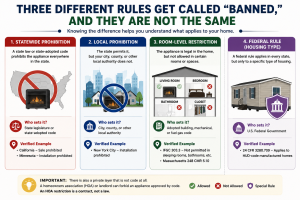
Readers conflate these constantly, and so do the pages that rank for this query. Separating them is most of the work.
| Type | Who sets it | What it looks like in practice | Verified example above |
|---|---|---|---|
| Statewide prohibition | A state legislature or a state-adopted code | The appliance cannot be sold or installed anywhere in the state | California (sale), Minnesota (installation) |
| Local prohibition | A city, county or other adopting authority | The state permits it, your municipality does not | New York City |
| Room-level restriction | The adopted mechanical or fuel-gas code | The appliance is legal in the house but not in a given room | IFGC section 303.3; Massachusetts 248 CMR 5.10 |
A fourth layer sits outside all three: a federal product standard tied to a class of housing rather than a place. The manufactured-home rule at 24 CFR 3280.709 is that kind of rule. It applies in every state, but only to manufactured homes built to the HUD standard.
There is also a private layer that is not code at all. A homeowners association or a landlord can forbid an appliance the building department would approve. An HOA restriction is a contract, not a law. It binds you, but it is not what anyone means by a ban, and no state list will show it.
New York shows why a state-level list misleads
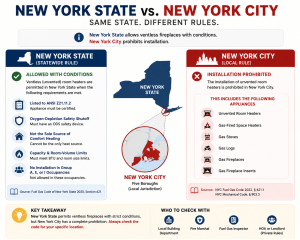
New York is the clearest worked example, and it is the reason competing ban lists contradict each other on this one state. Some list New York as banned. Others say New York lifted its ban. Read against the codes on July 31, 2026, both framings are wrong in the same way: they answer at the wrong level.
The Fuel Gas Code of New York State 2020, section 621, permits unvented room heaters subject to conditions. The New York City Fuel Gas Code 2022, section 621.1, says flatly that installation is prohibited, and the city’s mechanical code section 903.3 extends that to gas logs, gas fireplaces and fireplace inserts by name.
So a reader in Buffalo and a reader in Brooklyn get opposite answers from the same state. A page that prints “New York: banned” is wrong for most of the state’s land area. A page that prints “New York: allowed” is wrong for roughly eight million people. The state row was never the answerable unit. Your city is.
California is the one clean statewide sales prohibition
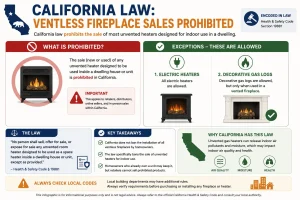
California Health and Safety Code section 19881 is the only statute in this set that reads like the ban people are imagining. It bars selling or offering for sale any new or used unvented heater designed to be used inside a dwelling house or unit, with exceptions for an electric heater and for decorative gas logs intended for a vented fireplace.
Two things make it easy to misread. It is written as a sales prohibition rather than an installation prohibition, and it contains a conditional pathway for certain natural-gas decorative units that depends on standards being developed and adopted. That is why California shoppers still find these units listed online and still see them shipped into the state.
A separate local layer exists in California too. A number of cities adopted “reach codes” restricting new natural gas connections in new construction. That layer has been unsettled since the Ninth Circuit’s decision in California Restaurant Association v. City of Berkeley (decided April 17, 2023), which held Berkeley’s gas piping ordinance preempted by federal law. Treat reach codes as a live question, not a settled list. The full statute, the exceptions and the retailer question are covered on the California page.
Canada is a certification question, not a ban list
Looking for a Canadian province on a ban list is the wrong search. Canada regulates the appliance rather than the map. Technical Safety BC’s Information Bulletin IB-GA 2017-01 states that all gas appliances must be certified, by a certification agency accredited by the Standards Council of Canada, to a standard applicable to their intended use, and that gas-fired appliances generate products of combustion and must be vented to the outdoors. Installations follow CSA B149.1, the natural gas and propane installation code adopted across the provinces and territories.
The practical consequence for a homeowner is that the question is not “is it banned in Ontario,” it is “does this specific model carry a certification mark recognized here, and will a licensed installer connect it.” Those are answerable at the appliance rating plate. The provincial detail lives on the Canada page.
Ventless fireplace ban claims we deliberately left out
A ban list goes stale quietly and then gets copied across the web with the staleness intact. The honest response is to publish the exclusions alongside the inclusions.
- Alaska and Montana, named in several lists as having had or lifted statewide bans. Neither the ban nor the lift could be traced to a statute or code section on July 31, 2026. Not listed.
- “Minnesota bans them in cities over 2,500 people.” Widely repeated. The current state rule text is not population-scoped, so this phrasing appears to describe an older arrangement. Not listed as written.
- “New York lifted its ban.” Addressed above. The state code permits with conditions and the city prohibits, so “lifted” describes neither accurately.
- Massachusetts as banned, or as having lifted a ban. What 248 CMR 5.10 actually does is route unvented room heaters through a separate state process and bar room heaters from bedrooms and bathrooms. That is a restriction, not a prohibition.
- Named city bans in Texas, Illinois, Nebraska and New Hampshire. Plausible, and municipal prohibitions certainly exist, but none was confirmed against an ordinance this session. Not listed.
- “Banned in all HUD housing.” Narrowed to the one federal rule that could be read: the manufactured-home construction standard at 24 CFR 3280.709.
How to check your own state or city today
This list has a date on it because it will be wrong eventually. Codes get amended on multi-year cycles, cities adopt amendments between cycles, and nothing on the open web reliably announces it. The durable skill is checking rather than reading.
Three sources, in order of authority for your address:
- Your local building or code enforcement department. They enforce the code your city actually adopted, including local amendments. This is the only answer that binds your permit.
- Your state’s adopted fuel gas and mechanical code, published by the state agency that adopts it. This tells you the baseline your city started from.
- Your state fire marshal’s office, for anything tied to fire safety rules that sit outside the building code.
The one question to ask, phrased so they can answer it in a sentence: “Which edition of the fuel gas code has this jurisdiction adopted, and has section 621 on unvented room heaters been amended locally?” That names the exact provision, so a plans examiner can check it without interpreting your project. The full script and what to do with the answer are on the local code check page.
Finally, ask the same question about the specific model, not the category. A unit’s listing and its manufacturer instructions are part of what the code enforces, and an appliance that is legal in principle can still be non-compliant in the room you had in mind.
Frequently asked questions
Is my state on the banned list?
Probably not, and that is the honest answer for most of the United States. Only California and Minnesota appear as statewide restrictions in the verified set above, and they work differently from each other. If your state is not listed, it does not mean the appliance is unrestricted; it means no statewide prohibition could be confirmed as of July 31, 2026, and your city and your room still govern.
Did any state actually lift a ban?
Lists naming Alaska, Montana, Minnesota, Massachusetts and New York as having lifted bans are common. None of those lifts could be traced to a statute or code amendment during this check, and Minnesota’s current rule text prohibits installation, which is the opposite of a lift. Treat “lifted” claims as unverified until you can name the amending document.
Does a local ban override my state’s allowance?
Yes, in the direction that restricts you. A municipality that adopts a stricter local amendment is enforcing the code in that jurisdiction, and New York City versus New York State is the clearest verified example. The reverse generally does not work: a city usually cannot permit what the state prohibits.
Is it banned in bedrooms and bathrooms everywhere?
Room-level restriction is the most common rule in the country, and it is separate from any ban. The International Fuel Gas Code section 303.3 excludes appliances from sleeping rooms, bathrooms, toilet rooms, storage closets and surgical rooms, with narrow listed exceptions for one small wall-mounted unvented room heater. Massachusetts bars room heaters from bedrooms and bathrooms under 248 CMR 5.10. Your adopted edition decides which version applies to you.
Why do the ban lists online disagree so much?
Because most of them are undated, uncited, and copied from each other, and because many are published by parties that sell the appliance or sell a vented alternative. When a source names no code section and no year, there is no way to tell whether it was accurate in 2014 and stale now.
Information current as of July 31, 2026. Sources named above were read on that date. This page is a research summary, not legal advice, and it cannot tell you what is permitted at your address. Confirm with your local building department before buying or installing. See our editorial policy for how sources are selected and our disclaimer for the limits of what this site can tell you.