
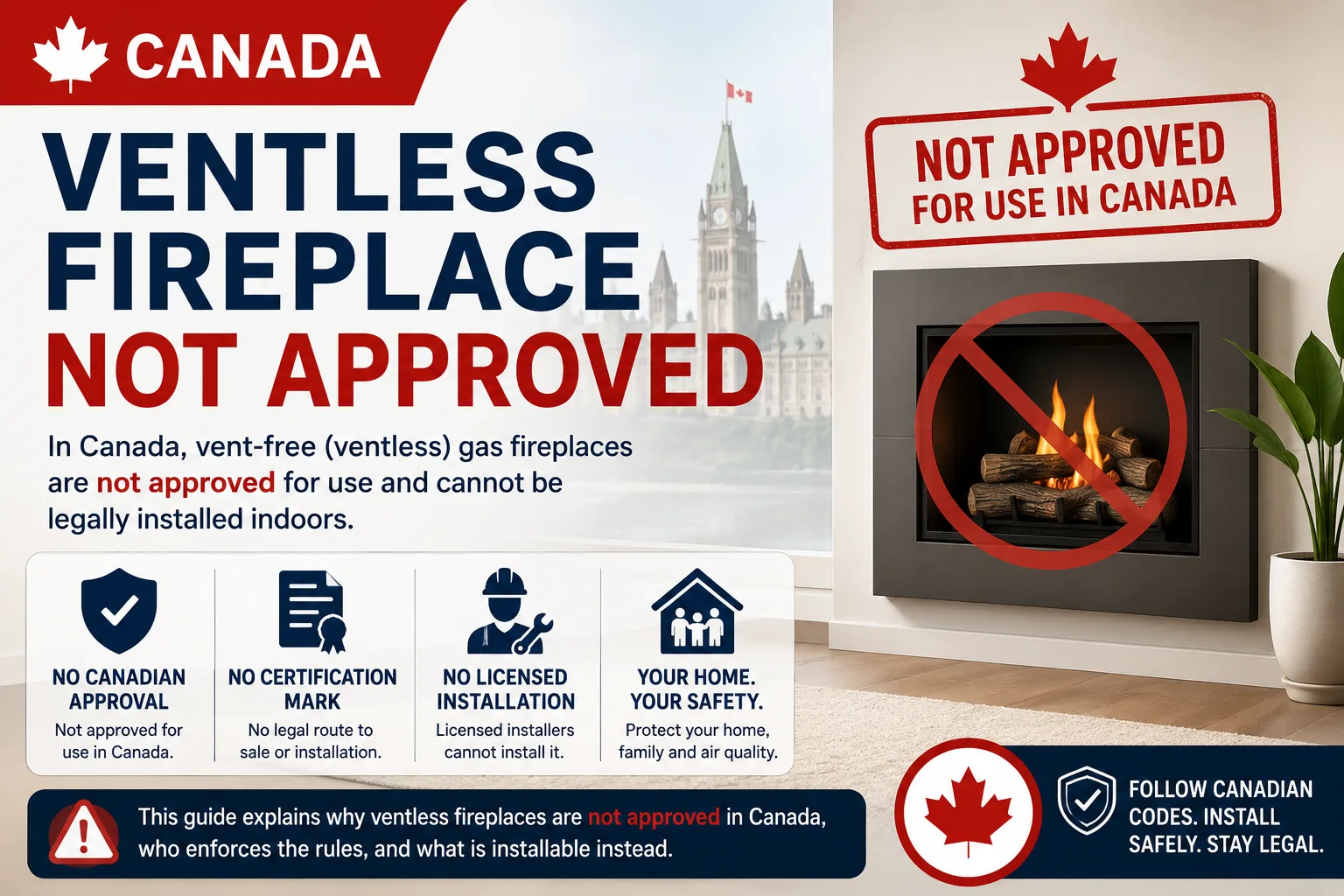
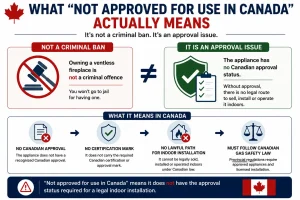
In Canada, a vent-free (ventless) gas fireplace is not an option you can legally buy and have installed indoors, but the mechanism is approval, not a criminal ban. Natural Resources Canada states plainly that vent-free gas fireplaces “are not approved for use in Canada.” Provincial gas safety law then does the enforcing: an appliance has to carry a certification or approval mark before it can be sold, installed or operated. No mark, no legal installation.
Checked on 2026-07-31. We are not lawyers or licensed gas fitters, and this page is not a substitute for either. It is a summary of what Canadian government and regulator sources say, with links so you can read them yourself. For the wider question of where these appliances stand generally, start with our pillar page, are ventless fireplaces legal.
What “not approved for use in Canada” actually means
Most of what a Canadian reader finds on this topic is written for Americans. It talks about state bans, ANSI standards and the National Fuel Gas Code, none of which govern anything in Canada. So the first useful thing to know is that the Canadian answer arrives through a completely different door.
Natural Resources Canada’s Office of Energy Efficiency publishes a consumer guide called All About Gas Fireplaces. Its section on what to avoid names this appliance category directly, describes it as available in the United States, and explains that because the units do not vent outdoors, the combustion gases (carbon monoxide, carbon dioxide, nitrogen oxides and a large volume of water vapor) go straight into the house, causing indoor air quality and moisture problems that are worse in airtight Canadian homes. Its closing sentence on the category is the operative one: “They are not approved for use in Canada.” That page was last modified 2025-01-07.
“Not approved” is a term of art, not a figure of speech. In Canadian gas safety law, approval is the specific status an appliance has to hold before anyone may sell it or connect it. An appliance that never obtained that status is not banned by name in a statute. It simply has no lawful route onto a Canadian gas line.
Who makes this rule: provinces adopt CSA codes, regulators enforce them
There is no single federal statute that answers this question. Gas appliance installation in Canada is provincial jurisdiction, and each province adopts national CSA codes by reference into its own regulation, then hands enforcement to a provincial safety regulator.
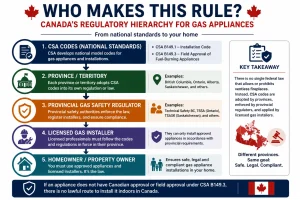
British Columbia is a clean, verifiable example. Section 30 of the Gas Safety Regulation, B.C. Reg. 103/2004, declares in force CSA B149.1, the Natural gas and propane installation code, and CSA B149.3, the Code for the field approval of fuel-burning appliances and equipment, together forming what the regulation calls the B.C. Natural Gas and Propane Code. Enforcement sits with Technical Safety BC under the Safety Standards Act.
Ontario runs the same architecture through different institutions. The Technical Standards and Safety Authority (TSSA) states that “every appliance fueled by natural gas, propane, digester, landfill, biogas or other fuels and is offered for sale, sold, rented, bought or installed must be approved,” under the Technical Standards and Safety Act, 2000.
Other provinces have their own bodies, such as the Technical Safety Authority of Saskatchewan and Alberta’s safety codes system. If you are outside British Columbia or Ontario, the two we verified directly this session, the correct move is to ask your own provincial gas safety authority rather than trust a table on a retail site. Municipal rules can add a further layer on top; our guide to a ventless fireplace local code check covers how to run that question down.
The certification mark is the gate, and field approval is the only other door
Technical Safety BC’s information bulletin on unapproved gas appliances puts the requirement in one sentence: “a gas appliance must display a mark or label indicating that it is certified or approved to be offered for sale, sold, installed, or operated in BC.” That flows from the Safety Standards Act and section 31 of the Gas Safety Regulation, which prohibits installing an appliance unless it displays a certification mark or an approval mark issued under section 10 of the Act.
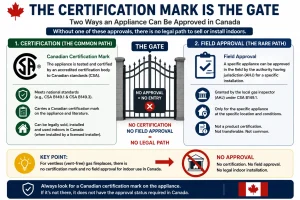
There is exactly one alternative route. An appliance without Canadian certification “must be field approved to the CSA B149.3 code for the field approval of fuel burning appliances” by an inspection body accredited under the Standards Council of Canada. Ontario runs an equivalent Field Approval Program citing CSA B149.3:25.
Field approval is real, and it is worth knowing about. It is also not a loophole a homeowner can drive an unvented appliance through. The inspection body assesses the unit against the codes actually in force in that province, including CSA B149.1, and that body decides, not the owner and not the seller. Given the federal guidance above, a homeowner should expect the answer to be no, and should ask the accredited body directly before spending anything.
That this is enforced rather than theoretical is a matter of record. Technical Safety BC has issued safety orders prohibiting the installation or use of uncertified gas fireplaces in the province, citing the Safety Standards Act, the Gas Safety Regulation and CSA B149.1, and requiring affected units to be removed from operation.
Availability is not approval, and that is what confuses people
Here is the part almost no ranking page explains, and it is the single most useful thing on this page.
You can find vent-free gas fireplaces listed on Canadian retail sites and marketplaces today. Cross-border shipping, third-party marketplace sellers and outdoor-rated products all put these listings in front of Canadian shoppers. A product being purchasable in Canada tells you nothing about whether it may lawfully be connected to gas in your home. Those are two different systems: commerce, and the provincial safety regime.
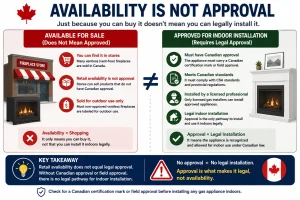
There is a second trap in the same family. The American standard that unvented room heaters are built and tested to, CSA/ANSI Z21.11.2 (Gas-fired room heaters, volume II, unvented room heaters), is co-published by CSA Group. So a US appliance can arrive in a box carrying letters that look reassuringly Canadian. A standard being co-published by CSA Group is not the same as your specific appliance holding a certification or approval mark valid for installation in your province. The mark on the appliance is what a gas fitter and an inspector look at, not the acronym on the manual.
If a seller tells you a unit is “CSA approved,” the question to ask back is this: approved to what standard, by which certification agency accredited by the Standards Council of Canada, and is it listed for indoor residential installation in Canada?
Canada is not California, even though the outcome rhymes
Readers often arrive here after reading about US state bans and assume Canada is the same thing, only bigger. It is not, and the difference matters if you already own an appliance.
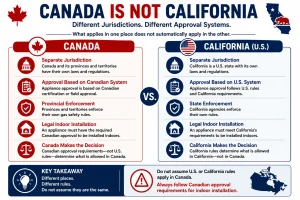
| Canada | California | |
|---|---|---|
| Legal instrument | Provincial gas safety regulations adopting CSA B149.1 and B149.3 | A state statute plus state building code provisions |
| Mechanism | The appliance category holds no approval, so there is no lawful installation route | Named prohibition on unvented indoor heaters |
| Who decides | Provincial regulator plus an SCC-accredited certification or inspection body | State law, applied by local building officials |
| Practical result for a buyer | No licensed installation | No licensed installation |
The outcomes converge. The reasoning does not, and neither does the paperwork you would need to argue your case. We cover the American side separately in where are ventless fireplaces banned and, for the state readers ask about most, ventless fireplace California.
What is installable instead
Natural Resources Canada’s guide describes the gas fireplace types used in Canadian housing, and they share one feature: combustion products leave the building.
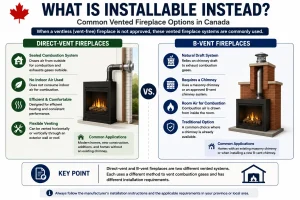
- Direct-vent (sealed combustion). The firebox is sealed from the room. Combustion air is drawn from outside and exhaust goes back outside, usually through a coaxial pipe out a wall. This is the type most commonly specified for tightly built modern homes.
- B-vent (natural draft). The appliance draws combustion air from the room and exhausts vertically through a flue.
Which one suits a given house is a question for a licensed gas fitter or hearth technician who can look at the wall, the roof, the fuel supply and any existing chimney. It is not a decision to make from a product page, and we do not make it for you.
If you already own one, or carried one across the border
This is a genuinely different question from “may I buy one,” and it deserves a different answer.
Do not treat this page as permission to keep running an appliance, and do not treat it as an instruction to disconnect one yourself. Anything involving a gas connection is licensed work in every Canadian province. The correct sequence is: stop using the appliance, then contact a licensed gas fitter and your provincial gas safety authority, and let them tell you what the unit is and what has to happen to it. If it was installed by a previous owner, the regulator has seen that situation before and it is a normal call for them to take.
If the unit is currently connected and has been operating, treat carbon monoxide as a live concern until someone qualified has looked at it. A working carbon monoxide alarm is a condition of running any appliance that burns fuel inside the room you occupy, not an accessory.
Frequently asked questions
Is it illegal to own a ventless fireplace in Canada?
Ownership and installation are different questions. What the sources we checked establish is that the appliance category is not approved for use in Canada, and that provincial regulations prohibit installing, and in the provinces we verified also selling or operating, a gas appliance that does not display a certification or approval mark. Whether possession by itself exposes you to anything is a question for a lawyer in your province, and we are not one.
Could I get one approved through the field approval process?
Field approval exists. CSA B149.3, the Code for the field approval of fuel-burning appliances and equipment, is adopted in provincial regulation, and inspection bodies accredited by the Standards Council of Canada carry it out. But field approval measures an appliance against the codes in force in that province, and the decision belongs to the inspection body. Given that Natural Resources Canada describes this category as not approved for use in Canada, expect no, and ask the accredited body before you buy anything.
Is the rule different in Quebec, Ontario or British Columbia?
The underlying CSA codes are national, so the technical requirements are broadly common. What varies is which edition a province has adopted, which regulator administers it, and how permits and inspections work locally. We verified British Columbia and Ontario directly for this article and did not verify province-specific detail elsewhere, so if you are in another province, ask that province’s gas safety authority rather than assuming BC’s or Ontario’s answer transfers.
The box says CSA. Does that mean it is approved in Canada?
Not necessarily. CSA Group co-publishes the American standard for unvented room heaters, so CSA lettering can appear on a product that holds no Canadian approval for indoor installation. What counts is a certification mark from an agency accredited by the Standards Council of Canada, covering that appliance for that use, in your province.
Sources checked 2026-07-31
- Natural Resources Canada, Office of Energy Efficiency, All About Gas Fireplaces (page last modified 2025-01-07): natural-resources.canada.ca
- Gas Safety Regulation, B.C. Reg. 103/2004, sections 30 and 31: bclaws.gov.bc.ca
- Technical Safety BC, Information Bulletin: Unapproved Gas Appliances: technicalsafetybc.ca
- Technical Safety BC, safety order prohibiting installation or use of uncertified gas fireplaces: technicalsafetybc.ca
- Technical Standards and Safety Authority (Ontario), Field Approval Program: tssa.org
- CSA Group, CSA B149.1 Natural gas and propane installation code and CSA B149.3 Code for the field approval of fuel-burning appliances and equipment. The full code text sits behind CSA Group’s paywall, so what we cite here is what provincial regulation and regulator guidance say about it, not clause-level wording we could read.
Codes get new editions and regulators update their bulletins. If you are reading this well after the checked-on date above, confirm with your provincial authority before acting. How we research and correct pages is set out in our editorial policy, and the limits of what this site can tell you are in our disclaimer.