
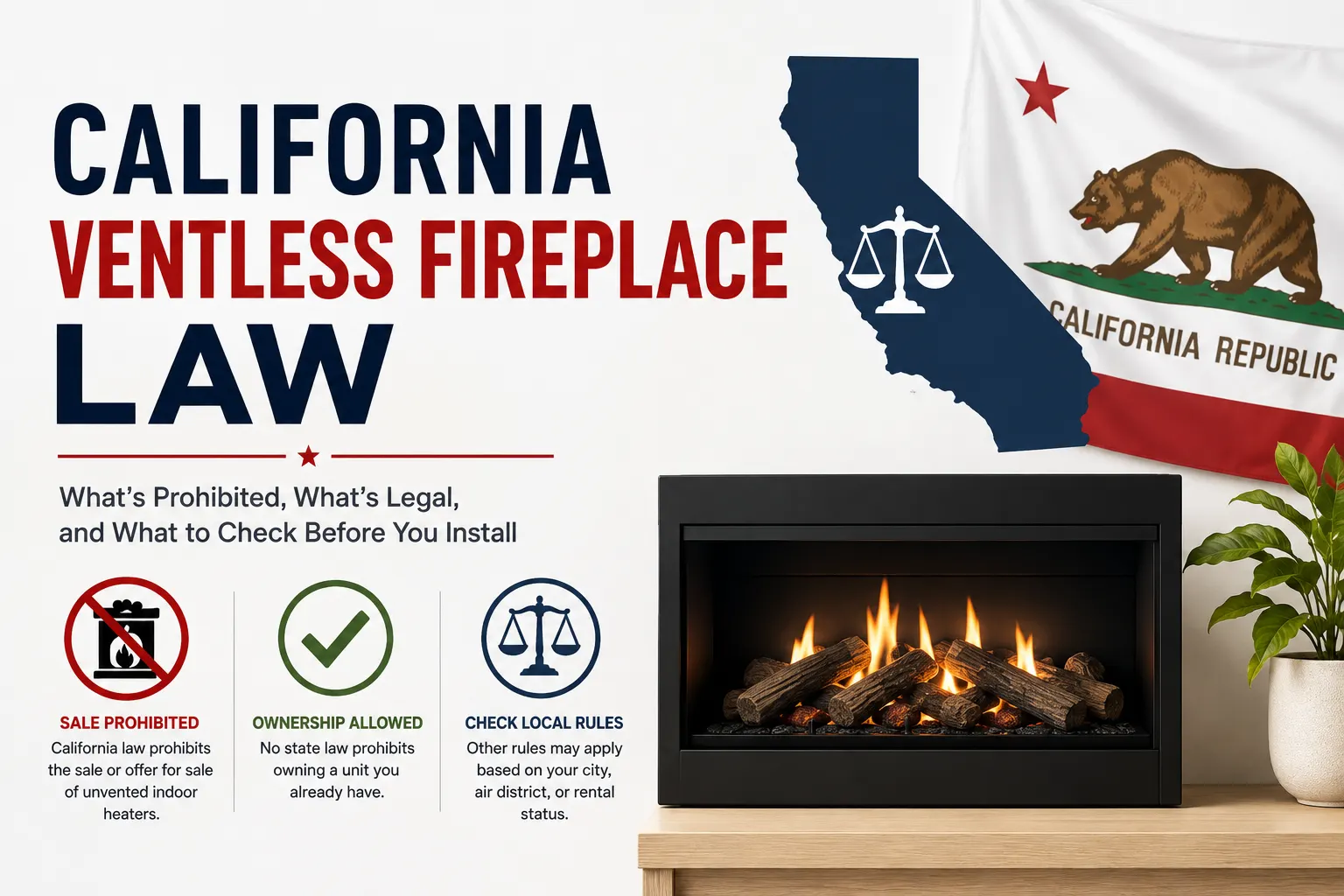
California prohibits the sale of unvented indoor heaters, not the ownership of one. Health and Safety Code section 19881 states that no person shall sell, or offer for sale, any new or used unvented heater designed to be used inside a dwelling house or unit, with exceptions for electric heaters and for decorative gas logs intended for a vented fireplace. Nothing in that chapter bans possessing a unit you already have. Local rules can add more.
That distinction is the whole article. Most pages that rank for this question say “banned in California” and stop, which leaves a reader who already owns one, or who just had one shipped in from out of state, with no idea what their actual position is. Below is what the statute says, what it does not say, and the three separate layers of California rule that people routinely confuse with it.
Checked against California sources on July 31, 2026. We are not lawyers and this page is not legal advice. See our disclaimer and our editorial policy for how we source and review this material. If you are outside California, start with our legality pillar instead.
What Health and Safety Code section 19881 actually prohibits
Section 19881 sits in Division 13 (Housing), Part 3, Chapter 12, titled “Heating Appliances and Installations.” The chapter is short. It contains exactly two sections.
Subdivision (a) is the operative prohibition, and it is written against a seller: no person shall sell, or offer for sale, any new or used unvented heater designed to be used inside any dwelling house or unit. Two exceptions are written into that same sentence: an electric heater, and decorative gas logs for use in a vented fireplace.
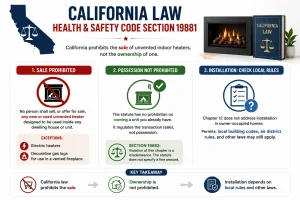
Subdivision (b) creates a conditional route for natural-gas-fueled unvented decorative gas logs and fireplaces. That route only opens if the Department of Housing and Community Development and the State Department of Health Services approve, recommended standards are developed, the California Building Standards Commission adopts them, and the products are listed by an approved agency. Subdivision (c) adds that any such installation must follow the California Building Standards Code.
The version now in force was amended by Stats. 1997, Chapter 17, Section 67, effective January 1, 1998. Pages that describe this as “the 1996 California code” are pointing at an older vintage than the text currently published.
Sale versus possession: what the statute does not say
Chapter 12 has no possession clause. It has no installation clause for owner-occupied homes. It regulates the transaction.
The second section of that chapter, section 19882, is the enforcement provision, and it reads in full: “Any violation of any provision of this chapter shall be a misdemeanor.” It attaches to violating the chapter, and the chapter’s prohibition is on selling or offering to sell. It names no dollar amount. The fine ranges circulating on retailer and aggregator pages for this question do not come from this statute, and we could not trace them to any California source.
What that does not mean is that a vent-free unit already in a California home is fine. It means the state’s sale statute is not the rule that decides it. Permits, rental housing standards, insurance, and your own building department’s reading of the Building Standards Code are separate questions, and they are the ones to ask. This page will not tell you to remove yours or to keep it.
What is still legal in California
The statute’s exceptions describe the appliance classes that remain available, and they are worth naming precisely, because “gas fireplace” and “unvented heater” are not the same category.
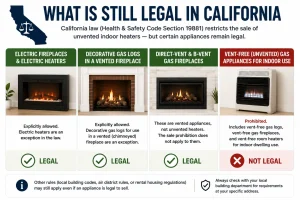
| Appliance class | Position under section 19881 |
|---|---|
| Electric fireplaces and electric heaters | Named exception in subdivision (a) |
| Decorative gas logs for use in a vented (chimneyed) fireplace | Named exception in subdivision (a) |
| Direct-vent and B-vent gas fireplaces | Not unvented heaters, so the sale prohibition does not reach them |
| Vent-free gas logs, vent-free gas fireplaces and vent-free room heaters for indoor dwelling use | The class the prohibition is written against |
Vented gas appliances are a live category in California. So is electric. The restriction is specific to combustion appliances that discharge into the room they heat.
One honest gap: we could not confirm the current status of the subdivision (b) pathway. We found no standards for unvented decorative gas logs published in the California Building Standards Code and no California agency page stating that the Building Standards Commission ever adopted any. Claims online that the pathway was never completed look plausible and match what we could find, but we could not verify them from a California source, so treat subdivision (b) as unexercised unless your building department tells you otherwise.
Rentals carry a separate California rule
If the property is rented or leased, a different body of California regulation applies on top of the statute. Title 25 of the California Code of Regulations, section 34, sets heating requirements for dwelling units and guest rooms offered for rent or lease. Its language on this point is one sentence: no unvented fuel burning heaters shall be permitted.
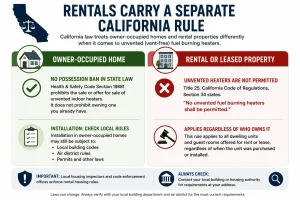
That is a rule about what may be in the unit, not about who sold it, and its scope is defined by tenancy rather than by the appliance’s paperwork. A landlord, a property manager, or a tenant asking whether a vent-free unit can stay in a rental is asking a Title 25 question, not a section 19881 question. Section 34 sits in Housing and Community Development’s housing regulations, and a local code enforcement or housing inspection office is the body that applies it in practice.
We read this section’s text through a legal database mirror of the California Code of Regulations rather than the state’s own regulatory publisher, which we could not reach at the time of checking. The wording is unambiguous, but treat the citation as one to confirm with your local housing authority if it is load-bearing for you.
Air district rules are about wood smoke, not vent-free gas
California is divided into local air districts, and their combustion rules are the layer most often mistaken for a fireplace ban. They are usually about a different fuel.
The Bay Area Air Quality Management District’s Regulation 6, Rule 3 is titled “Wood-Burning Devices.” It makes it illegal to use wood-burning devices such as fireplaces, wood stoves and pellet stoves during a Spare the Air alert. Gas-fueled fireplaces fall outside that rule’s scope, and where the district limits what may be installed in place of a wood-burning device, a gas-fueled or electric unit is among the permitted options. The South Coast Air Quality Management District runs a comparable rule, Rule 445, also titled “Wood-Burning Devices.”
So an air district rule can restrict burning wood on a given winter night without saying anything at all about a vent-free gas log. And a gas appliance an air district would accept as a replacement still has to satisfy section 19881, which for a vent-free unit it does not. Two layers, two different questions, and the answers do not substitute for each other. We read the Bay Area rule on the district’s own site. Rule 445’s title came from South Coast’s published rule documents rather than a live read of the district site, so confirm the current text with your own district.
Your city may add a layer, and one federal ruling reshaped it
California lets local governments adopt energy standards that go beyond the statewide minimum. These are commonly called reach codes, they are reviewed by the California Energy Commission for cost-effectiveness and filed with the Building Standards Commission, and several California cities have used them to push new construction toward all-electric designs. Where that happens, the practical effect can exclude new gas fireplace installations in that city even though the state has not banned vented gas anywhere.
This layer changed. In California Restaurant Association v. City of Berkeley, No. 21-16278, decided April 17, 2023, the Ninth Circuit held that the federal Energy Policy and Conservation Act preempted Berkeley’s ordinance banning natural gas piping in new buildings, reading the preemption clause to reach local standards that interfere with an end user’s ability to use covered appliances. Rehearing was denied and Berkeley subsequently agreed to repeal the ordinance. Since then, California cities have generally moved toward electric-preferred and electric-ready approaches rather than outright gas prohibitions, so the ordinance in force in any one city is a local question with a recent history behind it.
That case concerned a city ordinance about gas infrastructure. It did not address section 19881, which is a state restriction on selling a product class rather than an energy-use standard for a covered appliance, and section 19881 remains published California law. Whether preemption arguments could ever reach a state sale restriction is a legal question this page cannot answer. Our guide to checking your local code covers how to ask a city department this without getting a non-answer.
How to get an answer for your own address
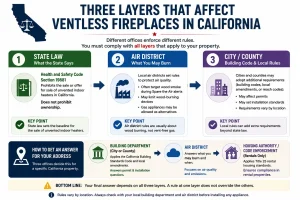
Three offices decide this for a specific California property, and they are not interchangeable.
Your city or county building department applies the California Building Standards Code plus any local amendments, and it is the office that answers permit and installation questions. Your local air district answers what you may burn and when. For a rental, your local code enforcement or housing inspection office applies the Title 25 standard.
Timing matters when you call. The California Building Standards Code is published on a triennial cycle. The Building Standards Commission published the 2025 edition on July 1, 2025, with an effective date of January 1, 2026, following the 2022 edition that took effect January 1, 2023. Any page you read about California fireplace code, including this one, is written against a specific edition, and a page that does not say which one, or when it was checked, is a page you cannot date. That is why the check date sits near the top of this article.
If you are comparing California against other jurisdictions, our state and province roundup covers where else this appliance class is restricted, and our Canada explainer covers the very different mechanism at work north of the border.
Frequently asked questions
Is it illegal to own a ventless fireplace I already have in California?
Health and Safety Code chapter 12 does not prohibit possession. Its two sections cover the sale of unvented indoor heaters and make a violation of the chapter a misdemeanor. Whether an existing installation complies with the Building Standards Code, with a rental housing standard, or with your insurer’s terms is a separate question, and your local building department is the office that answers it.
Why did an online retailer sell and ship one to a California address?
Section 19881 is written against the act of selling or offering for sale. How far a California misdemeanor statute reaches a seller located in another state is a legal question we are not able to answer, and we found no California enforcement data on it. The practical point for a buyer is that a completed purchase does not establish that the appliance may be installed at your address.
Can I put decorative gas logs in my existing fireplace in California?
Subdivision (a) expressly excepts decorative gas logs for use in a vented fireplace. That exception is written around venting, so it turns on the fireplace being a genuine vented, chimneyed one in working order. A chimney professional or your building department can confirm the fireplace’s condition and any permit requirement before anything is installed.
Which California cities restrict gas fireplaces entirely?
There is no reliable statewide list, and any list published before 2023 predates the Ninth Circuit’s Berkeley decision and the repeals that followed it. Ask your own city’s building or planning department directly. Our local code check guide sets out the question to ask so the answer is usable.
Are vented gas fireplaces still allowed in California?
Yes. Direct-vent and B-vent gas appliances are not unvented heaters, so the section 19881 prohibition does not reach them. Individual cities may still restrict new gas connections through local ordinances, and air district rules may apply to what replaces a wood-burning device, so confirm locally before buying.
Sources checked July 31, 2026: California Health and Safety Code sections 19881 and 19882 (California Legislative Information); California Code of Regulations Title 25, section 34; Bay Area Air Quality Management District Regulation 6, Rule 3; California Building Standards Commission, code adoption cycle; California Restaurant Association v. City of Berkeley, 9th Cir. No. 21-16278 (April 17, 2023).