
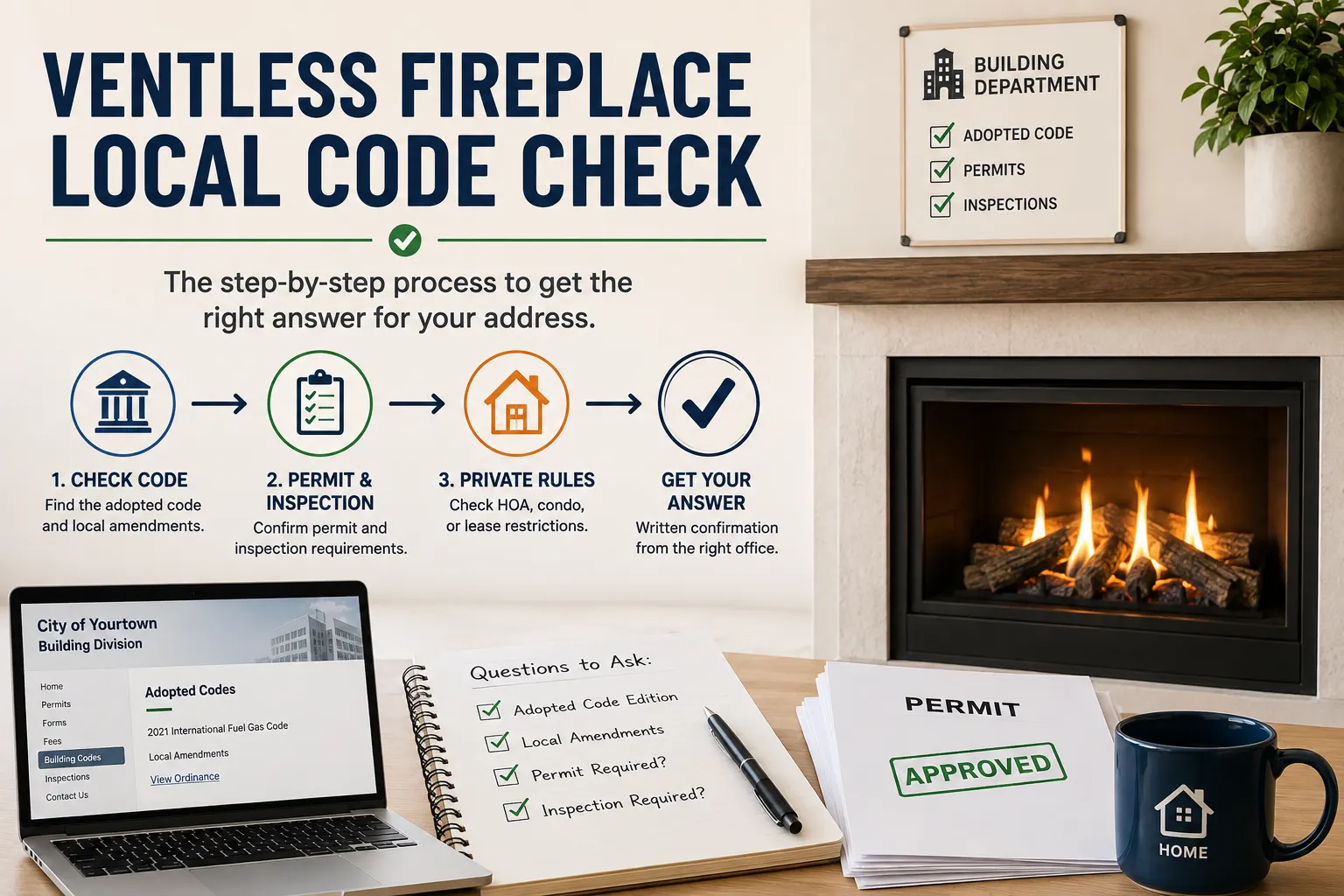
A ventless fireplace local code check has three layers, and only the first two are government. Start with the city or county building department that issues permits for your address, because that office, not your state legislature, is the authority having jurisdiction over your installation. Ask which fuel gas code edition it has adopted and what it amended. Then ask what permit and inspection the work would need. Then, separately, check any HOA, condo or lease rule, which is a private contract rather than code.
This article is a procedure, not an answer. We are not lawyers and not code officials, and no web page can tell you whether a specific appliance is permitted at a specific address. What follows is how to get that answer from the person who is actually allowed to give it.
Your ventless fireplace local code check, in three steps
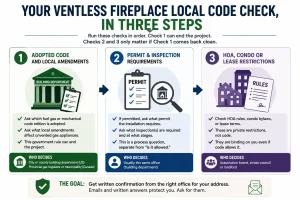
| # | Check | Who decides | What kind of rule |
|---|---|---|---|
| 1 | Adopted code and local amendments | City or county building department (US); provincial gas safety regulator or the municipality (Canada) | Government rule, enforced through permits and inspection |
| 2 | Permit and inspection requirements | Usually the same office | Process, and a separate question from “is it allowed” |
| 3 | HOA, condo or lease restrictions | Association board, strata council or landlord | Private contract, binding on you but not code |
Run them in that order for one reason: check 1 can end the project outright, and it costs a phone call. Checks 2 and 3 only matter if check 1 comes back clean. If you have not yet confirmed the state or provincial picture, start at our pillar on whether ventless fireplaces are legal and the list of places that ban or restrict them, then come back here for the local layer.
Who your authority having jurisdiction actually is
“Authority having jurisdiction” is the term the codes themselves use. The National Fire Protection Association defines it as an organization, office, or individual responsible for enforcing the requirements of a code or standard, or for approving equipment, materials, an installation or a procedure. NFPA notes the AHJ may be a fire chief, a fire marshal, a building official, an electrical inspector or another official with statutory authority, which is a polite way of saying it varies.
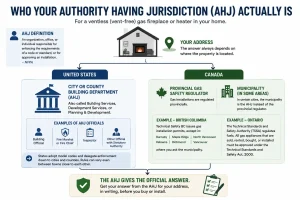
For a gas-burning appliance in a US home, the AHJ is almost always the city or county building department, sometimes called Building Services, Development Services, or Planning and Development. Your state usually adopts a model code and then delegates enforcement downward, and in many places the adoption itself happens at the city or county level. That is why two towns twenty minutes apart can be running different rules.
In Canada the chain is different and worth naming, because most of what you will read online is American. Gas installations are regulated provincially. In British Columbia, Technical Safety BC issues gas installation permits, except in Burnaby, Maple Ridge, North Vancouver, Kelowna, Richmond and Vancouver, where you ask the municipality instead. In Ontario, the Technical Standards and Safety Authority regulates fuels, and every appliance fueled by natural gas or propane that is offered for sale, sold, rented, bought or installed must be approved under the Technical Standards and Safety Act, 2000. Our Canada article covers why that changes the answer so completely.
Find the adopted code edition, then the amendments on top of it
Two model codes govern fuel gas work in the US: the International Fuel Gas Code (IFGC), published by the International Code Council, and NFPA 54, also published as ANSI Z223.1, the National Fuel Gas Code. Some jurisdictions instead reach vent-free appliances through an adopted mechanical or residential code. Your jurisdiction has adopted one of these, in a specific edition year, usually with local amendments written on top.
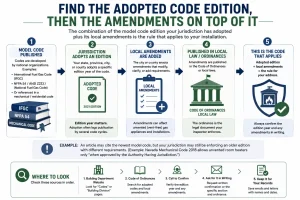
The edition year is the part people skip, and it is the part that decides your answer. The I-Codes are updated on a three-year cycle, with the full set split into Group A and Group B. Adoption lags publication, often by several cycles: code libraries still carry state documents such as a Nevada Mechanical Code 2018, whose section on unvented room heaters allows certain installations only “when approved by the Authority Having Jurisdiction.” An article citing the newest model code may be describing a rule your inspector has never adopted, and the reverse is just as true.
Where to look, in order: the building department’s own “Codes” or “Building Division” page, which usually lists the adopted editions; then the municipality’s Code of Ordinances, which holds the amendments; then a phone call to confirm both. Reach codes and state statutes can sit above all of it, which is exactly what happens in California, where Health and Safety Code section 19881 states that no person shall sell, or offer for sale, any new or used unvented heater designed to be used inside any dwelling house or unit, with narrow exceptions.
What to ask, word for word
Most readers get a vague answer because they ask a vague question. “Are ventless fireplaces allowed here?” invites “you’d have to check.” Give the office enough to look it up.
“I am a homeowner at [address]. I am asking about an unvented, vent-free gas fireplace or room heater in a living space, not a vented or direct-vent appliance. Which fuel gas or mechanical code edition has [jurisdiction] adopted, and are there local amendments that affect unvented gas room heaters? If this appliance is permitted here, what permit and inspection would the installation require? Could you send that to me in writing, or point me to the section and the ordinance?”
Email beats a phone call, because it produces the written answer by itself. If you do call, ask at the end for the same thing in writing and get the name of the person you spoke to.
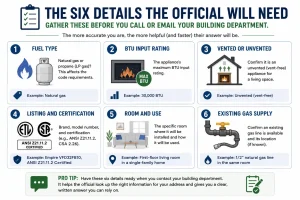
The six details the official will need
| Detail | Why they ask |
|---|---|
| Fuel type: natural gas or propane | Different provisions and different appliance approvals |
| Rated input in Btu per hour | Code and standard limits are written in terms of input rating |
| Vented or unvented | Say “unvented” or “vent-free” explicitly; “ventless fireplace” is a marketing term and gets misheard as a gas log set in a real fireplace |
| Listing and certification | Tells them whether it is a recognized appliance at all |
| The room and how it is used | Rooms are not treated alike, and sleeping rooms and bathrooms are treated most strictly of all |
| Whether the home already has a gas supply at that location | Determines whether licensed gas work is part of the job |
What “listed and certified” means
A listed appliance is one that a recognized testing agency has evaluated against a published standard and that carries a label saying so. The IFGC defines “labeled” as equipment carrying the mark of a nationally recognized testing laboratory or approved agency that maintains periodic inspection of production, and it requires appliances regulated by the code to be listed and labeled for the application in which they are used.
For unvented gas room heaters, the relevant product standard is CSA/ANSI Z21.11.2, “Gas-fired room heaters, volume II, unvented room heaters.” The label matters procedurally: it is the difference between an appliance an inspector can evaluate and an unknown object. The City of San Diego’s fireplace permit bulletin, for instance, requires testing reports from ICC-ES, CSA or UL for prefabricated units. Find the model’s listing before you call, not after.
Permits, inspection, and your insurance
“Allowed” and “no permit needed” are different questions, and people conflate them constantly. San Diego’s Development Services Department publishes a bulletin showing the shape of it: a building or combination permit for masonry and wood-burning prefabricated fireplaces, while some gas-burning decorative units may need only a plumbing or electrical permit, with site, foundation and floor plans submitted. San Diego is in a state that bars the sale of unvented indoor heaters, so treat that as an illustration of process, not of permission.
Ask three permit questions: which permit type applies, whether the permit must be pulled by a licensed contractor rather than by you, and what inspection happens at the end. In British Columbia, gas installation permits are issued to licensed contractors, and gas fitting is licensed work. Any gas line, gas connection or appliance conversion belongs to a licensed professional. We publish no procedure for it.
Insurance is a third thing, and it is a contract question rather than a code question. We cannot tell you how your insurer will treat a vent-free appliance and neither can any other website. The useful move is to ask your own insurer, in writing, two things: whether the appliance must be disclosed, and whether they expect permit and inspection records to exist. Keep the reply with your permit paperwork.
Renters, condo owners and HOAs: a second chain of permission
Most pages on this topic stop at city hall, which leaves out everyone who does not own a detached house outright. If you rent, the decision belongs to your landlord and your lease before it belongs to anyone else, and installing a fuel-burning appliance in someone else’s building without written consent is a lease problem regardless of what the code says.
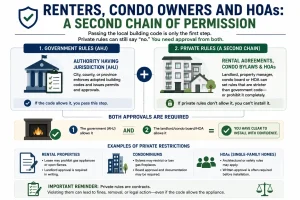
If you own in an HOA or a condominium, the governing documents bind you. Covenants, conditions and restrictions are, as Cornell’s Legal Information Institute puts it, a set of rules governing the use of a piece of real estate, usually enforced by a homeowners’ association and usually recorded in the county clerk’s office so that they run with the land. In Canada, strata or condominium bylaws do the same job. Ask the association for the current recorded documents and any rules on fuel-burning appliances, and ask in writing.
Two things worth being blunt about. An HOA approval cannot make a code-prohibited installation legal; the two rules stack, and you need both. And an HOA can prohibit something the code permits, which is entirely within its power. Check the private layer early, because it is fast and it fails cheap.
Two offices, two answers
It happens. A permit clerk says one thing, an inspector says another, and a retailer says a third. Rank them honestly: a salesperson’s answer is not evidence, an informal verbal answer from the counter is not a guarantee, and the only answer worth relying on is one in writing from the office that will inspect the work.
When answers conflict, go back with specifics rather than with the conflict. Ask which adopted code edition and which section the answer comes from. A citation resolves most disagreements immediately, because it turns a memory into a document that both people can read. If it does not resolve, ask for the building official, the department’s supervisor, or the local fire marshal, and put the two answers you received in the same email.
Keep everything. The written reply, the permit, the inspection sign-off, the appliance listing and the manufacturer’s installation instructions belong in one folder, because that folder is what answers the question again in five years when you sell the house or change insurers. Our editorial policy and disclaimer explain how we source this material and where our limits are.
Frequently asked questions
Does my HOA count as law?
No, and yes in practice. CC&Rs are private, recorded restrictions enforced by the association rather than by government, so they are not building code. They still bind you as an owner, and an association can restrict something your city permits. They cannot work the other way and authorize what the code prohibits.
What if my permit office has never heard of this appliance category?
That is a common outcome, and it usually means you used the wrong words. Say “unvented gas room heater” or “vent-free gas appliance” rather than “ventless fireplace,” give the fuel type and the rated Btu per hour input, and ask which adopted code section covers unvented gas appliances. If the office still cannot answer, ask who in the jurisdiction reviews gas appliance permits.
Is my state’s rule enough to go on?
Only as a first filter. A state rule can prohibit outright, which ends the question, but a state that permits something does not stop a city or county from restricting or amending it. State first, then local, always.
Does the code edition year really matter that much?
Yes. Model codes change on a cycle and jurisdictions adopt them years apart, so an article accurately describing the current model code may not describe the code in force where you live. When you get an answer, ask which edition it comes from and write the year down.
Who is the authority having jurisdiction in Canada?
Usually a provincial gas safety regulator rather than a city building department. In British Columbia that is Technical Safety BC, which issues gas installation permits everywhere except a handful of municipalities that issue their own. In Ontario it is the Technical Standards and Safety Authority. The installation code adopted across the provinces is CSA B149.1, the natural gas and propane installation code.