
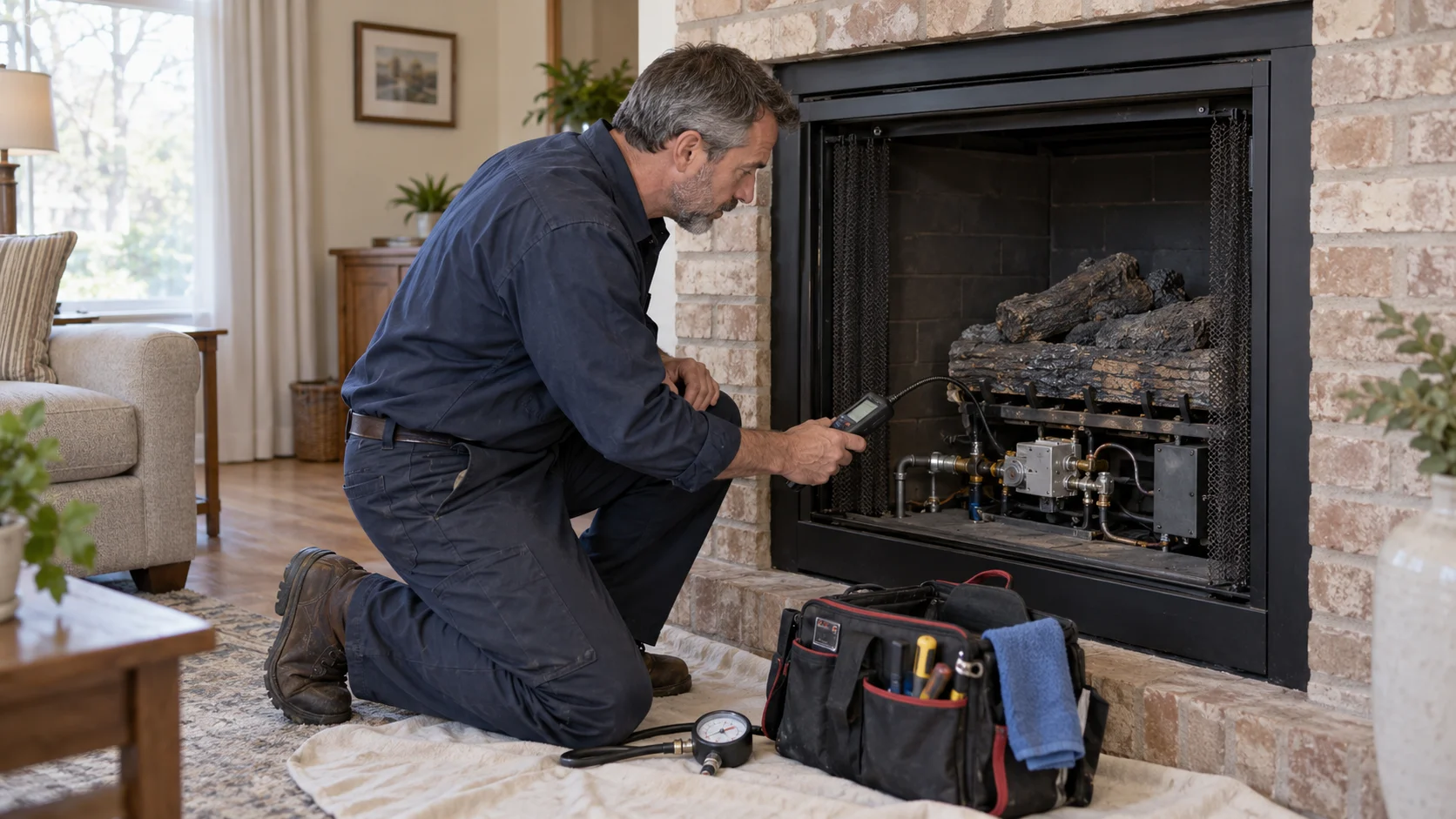
Changing a vent-free appliance between natural gas and propane changes the burner orifice and the gas pressure the appliance runs at. Get either wrong and the burner runs outside the conditions it was certified under, which in an appliance with no flue means the products of bad combustion, including carbon monoxide, go into the room you are sitting in. It is work for a licensed gas fitter or qualified hearth technician, using the manufacturer’s own listed conversion kit for that exact model. This page does not describe the procedure and never will.
That is the whole answer. What follows is what changes, why it is not owner work, and the questions that tell you whether the person quoting you knows what they are doing.
Before any of it, the permission question. Unvented gas appliances are permitted in much of the United States, restricted in some places and prohibited outright in others, and the conversion question only arises if the appliance is allowed at your address in the first place. Our overview of whether vent-free fireplaces are legal and our walkthrough of how to check your local code come before any of this.
We have never installed, lit, converted or burned one of these appliances, and we make no claim to have. This page is built from published code text and from manufacturer documentation.
Why the stakes are different on an unvented appliance
Every gas appliance is set up for one fuel. On a furnace or a water heater, a botched conversion still sends its exhaust up a flue. A vent-free fireplace has no flue at all, so anything the burner produces stays in the room by design.
The US Consumer Product Safety Commission calls carbon monoxide the “Invisible Killer” because it is “a colorless, odorless, poisonous gas”, and reports more than 200 accidental non-fire carbon monoxide deaths a year in the United States associated with consumer products (CPSC Carbon Monoxide Information Center, read September 2, 2026). Our page on vent-free appliances and carbon monoxide sets out how a vent-free burner is supposed to behave and what happens when it does not.
Do not let anyone tell you the oxygen depletion sensor covers this. It does not measure carbon monoxide and makes no claim to, as our page on what the oxygen depletion sensor actually does explains. A working carbon monoxide alarm is a condition of running one of these appliances, before and after any conversion, and our page on carbon monoxide alarms and vent-free fireplaces covers the requirement.
What “dual fuel” actually means on a spec sheet
A unit advertised as dual fuel is not a unit that accepts either fuel at any moment. It is a unit certified to operate on either fuel once it has been set up for one of them, usually shipped configured for one fuel with the maker’s kit for the other in the box or available for the model.
So the buying question is narrower than it looks. Which fuel is the unit configured for as delivered, and who is going to configure it if that is not your fuel? If the answer to the second half is “the customer, it comes with instructions”, you are being told something about the retailer.
What a conversion changes
| What changes | Why it matters |
|---|---|
| The burner orifice, sized for the fuel | The wrong size passes the wrong amount of gas for that fuel |
| The operating gas pressure the appliance requires | The manual states different pressures per fuel, and they are verified with instruments, not by eye |
| The appliance’s control settings, per the manufacturer’s kit | The kit is engineered for one model, and often one model year |
| The information on the appliance | Whoever converts it completes and signs the conversion label, so the next technician and the next inspector know what fuel it is on |
| The status of the listing | A conversion done any other way puts the appliance outside the conditions of its listing |
That last row is the one people miss. Section 621.1 of the 2021 International Fuel Gas Code requires that “unvented room heaters shall be listed in accordance with ANSI Z21.11.2 and shall be installed in accordance with the conditions of the listing and the manufacturer’s instructions” (read September 7, 2026). The listing is not a sticker of approval that survives whatever you do next. It is a statement that this appliance, set up this way, met a defined standard. Convert it with a generic kit, a part from another model or an improvised fix, and the sentence the code relies on stops being true about your appliance.
Why it is not owner work, stated plainly
Gas connection and gas conversion are licensed work in the jurisdictions this site serves. The published conversion kit instructions we surveyed on September 7, 2026 carry two conditions in near-identical words across manufacturers: the conversion is to be performed by a qualified service agency in accordance with the instructions and with the requirements of the authority having jurisdiction, and the conversion label supplied with the kit is to be completed and signed by whoever performed the work.
There is no skill-level threshold that turns this into a homeowner task. The correct setup is confirmed with a pressure gauge and by observing the burner against the manufacturer’s description, and the failure mode is invisible, odorless and in the room with you. Videos exist. So do the incident reports.
What to ask the person doing it
Ask these before anyone touches the appliance, and treat a vague answer as an answer.
- Are you licensed for gas work in this jurisdiction, and what is the license number?
- Is the kit the manufacturer’s own conversion kit for this exact model and serial number? Kits are model-specific, and two units sold under the same name in different production years can differ.
- Will you set and verify the pressures with a gauge after the conversion, and will you show me the readings?
- Will you complete and sign the conversion label and leave me the paperwork?
- Does this jurisdiction require a permit or an inspection for this work, and are you pulling it?
- What is the manufacturer’s position on warranty after conversion by a third party?
If the appliance is second-hand, add a seventh: what fuel is it currently set for, and does its conversion label match. Buying a converted unit with no paperwork means buying an appliance nobody can vouch for.
If you are still choosing, choose the fuel you have
The cheapest way through this is not to need it. Vent-free appliances are sold in fuel-specific versions, and buying the version that matches the gas at your property removes the conversion from the project entirely. Our guide to choosing a vent-free gas fireplace puts the fuel question in the order it belongs, after legality and after the room, and before you have paid for anything.
If a retailer offers you a unit in the wrong fuel with a kit thrown in, price the qualified conversion into the job before you accept, and confirm the model is one your local fitter is willing to work on.
What we checked, and when
2021 International Fuel Gas Code sections 621.1, 621.3, 621.5 and 621.6, as published on UpCodes, read September 2 and September 7, 2026. CSA/ANSI Z21.11.2, “Gas-fired room heaters, volume II, unvented room heaters”, as listed in the ANSI and CSA Group standards catalogues, checked September 7, 2026. CPSC Carbon Monoxide Information Center, read September 2, 2026. Manufacturer conversion kit instructions published online, surveyed September 7, 2026. Codes are adopted and amended locally, so confirm the requirements in force at your address.
Frequently asked questions
Can I convert a ventless gas fireplace from natural gas to propane myself?
No. It is licensed work, done with the manufacturer’s own listed conversion kit for that exact model by a licensed gas fitter or qualified hearth technician, under whatever permit and inspection your jurisdiction requires. We publish no procedure and no parts information for it. The reason is not caution for its own sake: the appliance has no flue, so a burner left outside the conditions of its listing releases the results into your room.
What happens if a ventless fireplace runs on the wrong fuel?
The burner is no longer receiving the amount of gas it was certified for, so combustion is no longer what the appliance was tested to produce. In an unvented appliance that means altered combustion products, including carbon monoxide, released into the room. It also puts the appliance outside the conditions of its listing, which is what the fuel gas code requires it to be installed in accordance with.
Is a dual fuel ventless fireplace as safe as a single fuel one?
A dual fuel unit is certified to run on either fuel once set up correctly for one of them, so the certification is not the difference. The difference is that somebody has to perform the setup correctly, and that person should be a qualified trade with the maker’s own kit. No unit in this category is safe in the general sense: they all burn in the room, they all require a working carbon monoxide alarm, and they are all prohibited in bedrooms and bathrooms except under narrow code exceptions your building official grants.
Do conversion kits from other brands work?
Treat them as unusable. Conversion kits are engineered for a specific model, and manufacturers state that their kits are to be used with their appliances in accordance with their instructions. A kit that is not the maker’s kit for that exact model puts the appliance outside its listing even if the parts physically fit, and physical fit is not evidence of correct gas flow.
Does converting the unit void anything?
It can. Manufacturers set their own warranty terms for conversions performed by third parties, and a conversion done outside the manufacturer’s instructions puts the appliance outside the conditions of the listing the fuel gas code requires. Ask the manufacturer and the installer both, in writing, before the work is booked.