
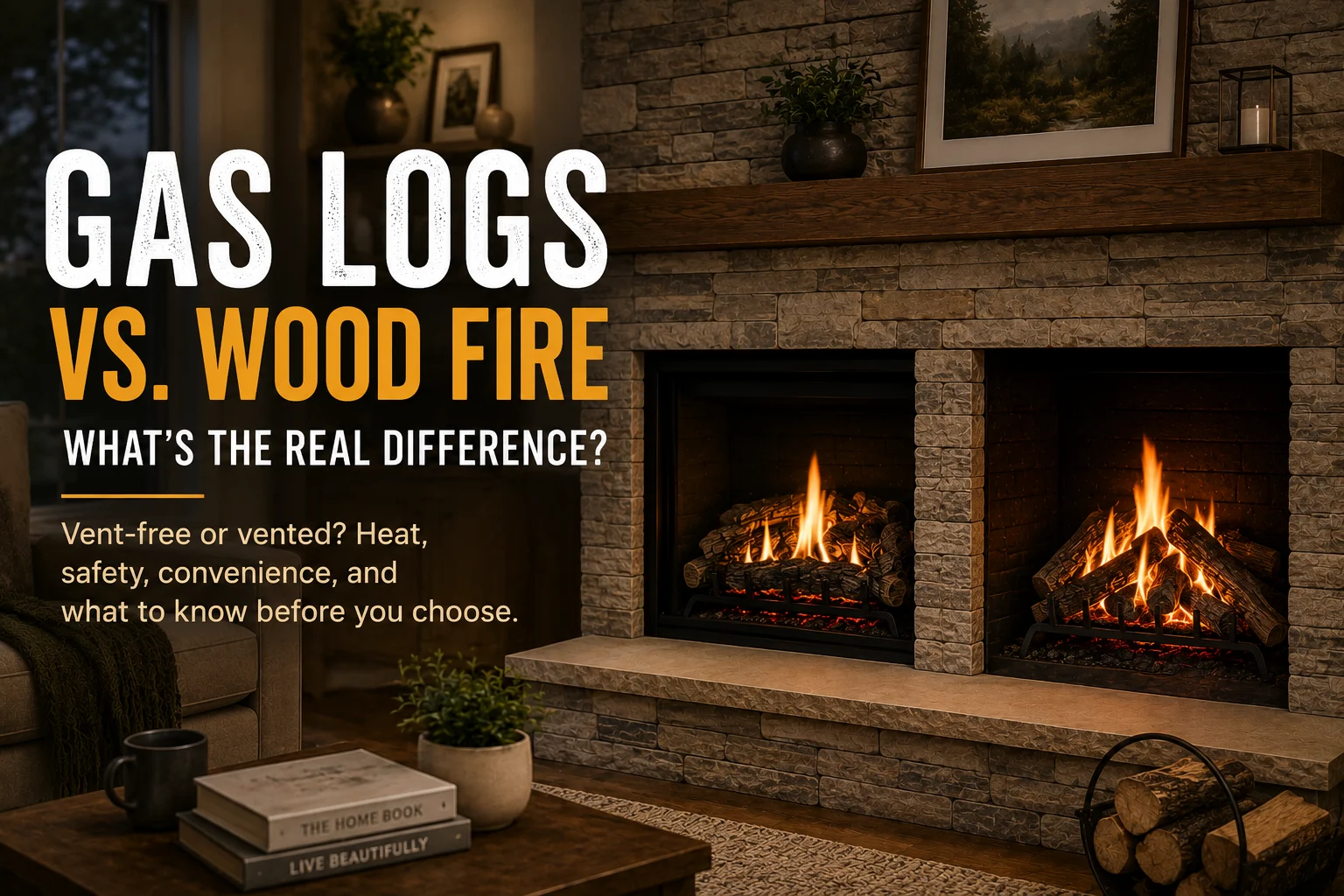
Before you compare anything, know that “gas logs” is two different products. Vented gas log sets burn in your existing fireplace with the damper permanently locked open, so the chimney keeps doing its job and the set is decorative rather than a heater. Vent-free gas log sets do not use the flue at all: they release their combustion products into the room, which is why they produce usable heat and why they carry carbon monoxide risk, room size limits and a legality question that changes by address. Against a wood fire, both gas options win on convenience, mess and control. Only one of them changes what class of appliance is burning in your house.
That is the decision most comparison pages never put in front of you.
Three options, not two
| Wood fire in a masonry fireplace | Vented gas logs | Vent-free gas logs | |
|---|---|---|---|
| Flue in use | Yes | Yes, damper locked open | No |
| Combustion products | Up the chimney | Up the chimney | Into the room |
| Real flame | Yes | Yes | Yes |
| Heat delivered to the room | Modest; an open fireplace also pulls heated room air up the flue | Modest, for the same reason | Substantially more, because nothing leaves |
| Startup and shutdown | Kindling, tending, waiting for burn-out | A switch, valve or remote | A switch, valve or remote |
| Cleanup | Ash, soot, wood storage | Minimal | Minimal |
| Chimney maintenance | Sweeping and inspection for creosote | Annual inspection still required | The flue is no longer the appliance’s path |
| Category legality | Local rules on solid fuel burning may apply | Not generally in question | Restricted or prohibited in some jurisdictions |
| Required in the home | Working carbon monoxide alarm | Working carbon monoxide alarm | Working carbon monoxide alarm, as a condition of operating |
Every row that says “into the room” or “no flue” is describing the same trade from a different angle. That is the trade you are actually making.
What you give up when you stop burning wood
Honest first, because most pages on this topic are published by companies selling gas.
A wood fire gives you the crackle, the smell, the visual movement of real logs breaking down, and the ritual of building it. Gas log sets are shaped and colored to imitate wood convincingly, and the imitation is good enough for most people from across a room. It is not the same experience, and if that experience is why you use the fireplace, no feature list will replace it.
What you give up in the other direction is real: sourcing, splitting, stacking and drying wood, carrying it inside, waiting for the fire to establish, staying until it burns down, and cleaning out ash. You also give up sparks, embers and the ongoing creosote maintenance that comes with solid fuel.
The point nobody makes: vented gas logs do not gain you heat
Homeowners often expect that converting to gas logs turns a decorative fireplace into a heater. With vented logs, it does not, and the reason is a code and manufacturer requirement rather than a design flaw.
Manufacturer installation instructions for vented gas log sets require the fireplace damper to be locked in a fully open position, and a damper clamp is fitted so it cannot be closed. NFPA 211, the standard covering chimneys and fireplaces, states in the same spirit that manually operated dampers are not to be placed in chimneys, vents or connectors of gas-burning appliances. The reason is direct: combustion products including carbon monoxide have to leave through the flue, and a closed damper sends them into the room instead.
A permanently open damper means the chimney keeps carrying heated room air outside, exactly as it did with wood, whether or not anything is burning. So a vented gas log set buys you convenience, controllability and no ash. It does not buy you a warmer room, and any page implying it does has skipped the damper requirement.
This also settles a dangerous misconception. You cannot turn a vented log set into a vent-free one by closing the damper. They are separately listed products with different burner designs and different certifications. Closing the damper on a vented set is not a modification, it is a carbon monoxide hazard.
Vent-free gas logs: the option that changes the appliance class
Vent-free log sets are designed to burn without a flue. They carry a mandatory oxygen depletion safety shutoff, they are certified to the ANSI Z21.11.2 standard for unvented room heaters, and they are the reason this website exists.
Installing one in your existing fireplace converts an opening that used to send combustion products outside into an appliance that sends them into your living room. That is not a small change to a fireplace. It is a change in what your house contains.
The conditions that come with it:
- The category may not be permitted where you live. Vent-free gas appliances are restricted or prohibited in some states, provinces and municipalities and permitted with conditions in others. We will not tell you it is legal in general, because that statement is wrong for a large share of readers. The relevant bodies are the National Fuel Gas Code (NFPA 54 / ANSI Z223.1), the International Residential Code and International Fuel Gas Code as adopted and amended locally, and in Canada CSA B149.1 through the provincial authority. Your building department and gas authority decide for your address. Start with are ventless fireplaces legal where you live and the sourced, dated account of where the category is banned or restricted.
- A working carbon monoxide alarm is a condition of operating one, not an accessory. Carbon monoxide is colorless and odorless, and your senses will not warn you. The oxygen depletion sensor on the unit is not a carbon monoxide detector: it monitors oxygen in the room and shuts the gas off at the manufacturer’s threshold. It is not measuring carbon monoxide and it is not a substitute for the alarm.
- Room volume minimums apply, tied to the set’s input rating, and they come from the installation manual and your adopted code rather than from a rule of thumb.
- Not in a bedroom or a bathroom. Adopted codes prohibit unvented room heaters in those rooms by default, and the narrow exceptions in the model text are written around small low-input heaters with local approval. They do not describe a decorative log set.
- Supplemental heat only. Model code language states unvented room heaters shall not be used as the sole source of comfort heating in a dwelling unit.
- Water vapor stays in the room. Combustion produces it, and with no flue it condenses on cold glass and exterior walls.
The full safety picture is in are ventless gas fireplaces safe, an honest answer.
Both fuels produce carbon monoxide. The difference is the flue
This is worth stating flatly, because the wood-versus-gas argument is often framed as though only one side has a combustion hazard.
Burning wood produces carbon monoxide. Burning natural gas or propane produces carbon monoxide when combustion is incomplete, and carbon dioxide and water vapor even when it is complete. In a wood fireplace and in a vented gas log set, the flue is the mitigation, and the characteristic danger is the flue failing: a blocked chimney, a damaged liner, a closed or restricted damper, a creosote fire, or house depressurization pulling exhaust back down. With vent-free logs there is no flue to fail, because the products are already in the room, and the mitigations are the conditions listed above.
A working carbon monoxide alarm belongs in every one of these three scenarios. With wood and vented gas it is watching for a fault. With vent-free it is watching a normal operating mode. Test it, keep batteries in it, and if it sounds, get everyone out and call emergency services from outside.
None of this is DIY
Whichever direction you go, the work is licensed work.
- Have the chimney inspected first, by a qualified chimney professional, before any conversion. A flue that has been burning wood may need sweeping, repair or a listed liner, and a gas appliance has its own sizing requirements. If you are moving to vented logs, the flue is now part of the appliance system.
- Gas connection is for a licensed gas fitter, and so is any conversion between natural gas and propane. A log set certified for one fuel is not to be used on the other without a manufacturer-approved conversion performed by a qualified professional.
- The damper clamp on a vented set is fitted by the installer, not improvised.
- Read the specific set’s installation manual before purchase, and confirm the room and the fireplace against it.
This site publishes no gas line, venting or installation procedure, and it never will. Our disclaimer sets out the limits of general guidance like this page.
Frequently asked questions
Are gas logs better than a wood-burning fireplace?
Better at convenience, control, cleanup and consistency. Not better at the sensory experience of a wood fire, and vented gas logs are not better at heating, because the damper stays locked open. Vent-free logs do deliver more heat to the room, and they do it by keeping the combustion products in the room, which is a trade rather than an upgrade.
Can I put gas logs in my existing wood-burning fireplace?
Often yes, with the right product and the right preparation. The fireplace must be suitable, the flue should be inspected first, the set must be listed for the application, and installation belongs to a qualified professional. If you are considering a vent-free set, confirm with your building department that the category is permitted at your address before you buy anything.
Do vented gas logs keep my house warmer than wood?
Not meaningfully. The damper has to stay locked open, so the chimney continues to carry heated room air outside. Vented log sets are chosen for the look and convenience of a real flame without wood handling, not for heat output.
Are vent-free gas logs safe in an old fireplace?
The age of the fireplace is not the main question. The main questions are whether the category is permitted where you live, whether the room meets the volume requirement in the manual, whether the room is a bedroom or bathroom (never), whether the installation is done by a licensed professional, and whether a working carbon monoxide alarm is in service. Answer those before considering the appliance at all.
Do I still need chimney sweeping if I switch to gas?
Yes, inspection continues. With vented logs the flue remains an active part of the appliance system and needs annual inspection. Even after a vent-free installation, the chimney is still a building component that can deteriorate, admit water or house animals. A qualified chimney professional should look at it on a regular schedule.
Which is cheaper to run?
It depends on your local prices for gas, propane and firewood, and on how you get your wood. We do not publish cost comparisons for this reason. Compare your own utility rate against your own wood cost, and count the time and storage that wood requires as part of its price.