
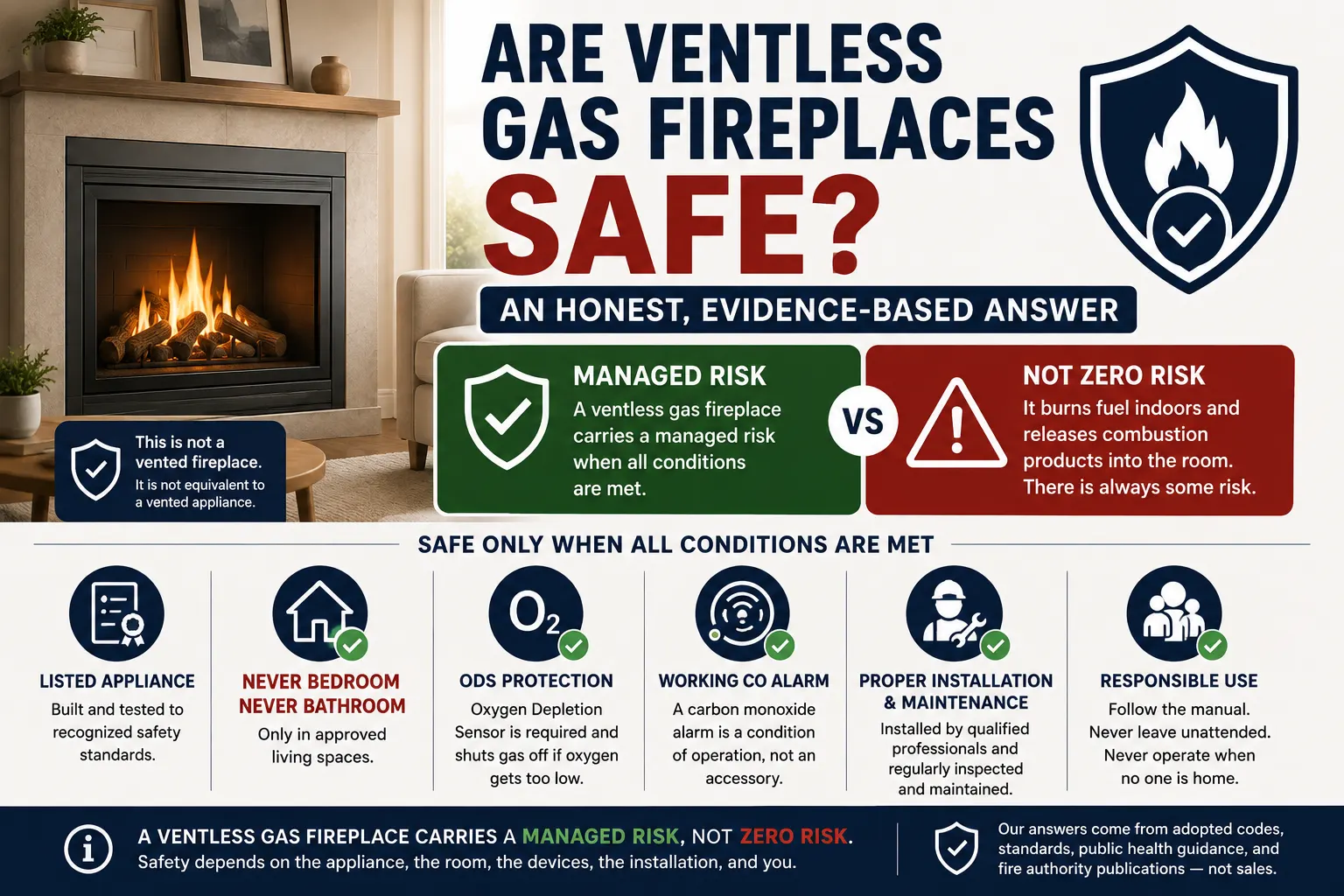
A vent-free gas fireplace carries a managed risk, not a zero risk. It burns fuel in your living space and releases the combustion products into that same space, because it has no flue. The listing standard and the adopted codes build in mitigations, and within its listed limits, in an appropriate room, with a working carbon monoxide alarm and a maintained appliance, that risk is bounded. It is never appropriate in a bedroom or a bathroom, and it is not equivalent to a vented appliance.
That is the whole answer. The rest of this page is why we can say it without hedging, and why almost nobody else ranking for this question can.
Why nearly every answer you find is compromised
Look at who publishes on this topic. Manufacturers and retailers rank at the top, and they sell the appliance. Chimney and hearth service companies rank right behind them, and they sell the vented alternative. Both are giving you a real answer filtered through a commercial interest that points in a specific direction.
The tell is what each side leaves out. A retailer page tends to lead with the oxygen depletion sensor and treat the category as solved. A chimney company page tends to lead with carbon monoxide and treat the category as reckless. Neither usually tells you that the codes themselves take a middle position: the appliance is a recognized, listed product category with conditions attached, and the conditions are the whole point.
We have never operated one of these units, and we say so. Everything here comes from adopted code text, the product listing standard, federal indoor air guidance and fire authority publications, which are documents you can open yourself. We do not sell fireplaces, and we do not sell chimneys. If our position on this appliance category changes, it will change because a source did.
What actually comes out of the burner
Combustion of natural gas or propane produces carbon dioxide and water vapor when it is complete, and carbon monoxide when it is not. Nitrogen dioxide forms as well. In a vented appliance those products go up a flue. In a vent-free appliance there is no flue, so they go into the room.
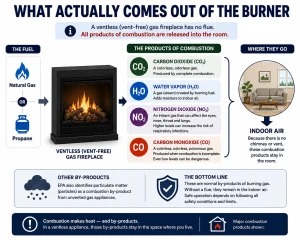
The US Environmental Protection Agency lists unvented gas space heaters among its sources of combustion products, and names the major pollutants released as carbon monoxide, nitrogen dioxide and particles. On carbon monoxide, EPA notes that at high concentrations it can cause a range of symptoms including headaches, dizziness, weakness, nausea, confusion, disorientation and fatigue in healthy people, and episodes of increased chest pain in people with chronic heart disease. On nitrogen dioxide, EPA states that it irritates the mucous membranes in the eye, nose and throat, causes shortness of breath after exposure to high concentrations, and increases the risk of respiratory infection.
EPA’s own operating guidance for this appliance class is a single sentence worth reading twice: “Take special precautions when operating fuel-burning unvented space heaters.” That is not a ban and it is not reassurance. It is a conditions statement, and the conditions are what this whole cluster is about. The carbon monoxide mechanism has its own page: what carbon monoxide comes out of a vent-free burner, and when.
What the oxygen depletion sensor does, and what it does not
Every unvented room heater in this category is required to carry an oxygen-depletion-sensitive safety shutoff system. The model code language is direct: the system “shall shut off the gas supply to the main and pilot burners when the oxygen in the surrounding atmosphere is depleted to the percent concentration specified by the manufacturer.” The device is real, it is mandatory, and it is the single biggest reason this appliance category exists at all in adopted code.
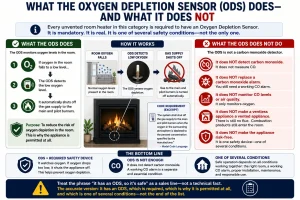
Now the part the retail pages skip. An ODS is not a carbon monoxide detector. It watches oxygen falling in the room and shuts the gas off at a threshold. It is not measuring carbon monoxide, it does not respond to carbon monoxide directly, and the two are different quantities that do not move in lockstep. A functioning ODS reduces the risk of the specific failure mode it was designed for. It does not make the appliance a vented appliance, and it does not substitute for the alarm.
Treat the phrase “it has an ODS, so it’s safe” as a sales sentence rather than a technical one. The accurate version is: it has an ODS, which is required, which is why it is permitted at all, and which is one of several conditions rather than the end of the list.
A carbon monoxide alarm is a condition, not an accessory
This is a standing rule on this site and it does not soften. A working carbon monoxide alarm is a condition of operating a vent-free gas appliance. Not a recommendation, not an upgrade, not something to get around to. If there is no working alarm in service, the appliance should not be running.
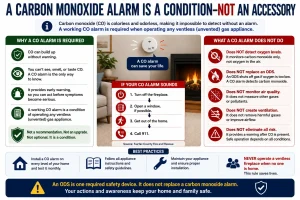
The reasoning is not complicated. Carbon monoxide is colorless and odorless. Your senses will not warn you, and the appliance’s own safety device is watching a different variable. The alarm is the only thing in the room that is actually looking for the hazard.
Fairfax County Fire and Rescue publishes the response procedure plainly: “If your carbon monoxide or ODS alarm sounds, shut down the fireplace, open a window, if possible, get out of the home, and call 911.” The same department’s guidance includes a rule that gets ignored constantly: “Never operate a ventless fireplace when no one is home.”
For where to place alarms and how many you need, follow the alarm manufacturer’s instructions and your local fire department’s guidance. That is a household alarm question rather than an appliance question, and we do not publish a placement rule here.
Never a bedroom, never a bathroom
The adopted codes treat sleeping rooms and bathrooms as prohibited locations for fuel-burning appliances by default, subject to narrowly written exceptions. Some state adaptations say it outright before listing anything else. The Nevada Mechanical Code 2018, at Section 916.2.1.1, opens with: “Unvented room heaters shall not be installed in bathrooms or bedrooms.”
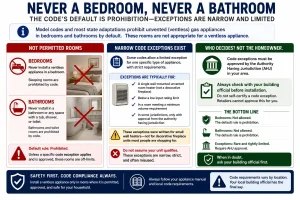
Exceptions do exist in the model code text, and they are the single most misused paragraph in this subject. They describe one wall-mounted unvented room heater, with an oxygen depletion shutoff, below a low input rating, in a room meeting a minimum volume, and in some adaptations only where the authority having jurisdiction approves it. They were written for small wall heaters. They are not a description of the decorative fireplace unit most readers of this page are shopping for.
Nothing on this site will tell you a bedroom or bathroom installation is safe, and no exception in a code book is something you can self-certify. If your intended room is one of those two, that is a question for your building official before it is a question for a retailer.
The other conditions people skip
Three more rules ride along with this appliance category, and they get left out of buying guides because none of them help sell one.
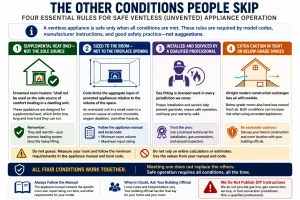
| Condition | Where it comes from | Why it exists |
|---|---|---|
| Not the sole source of heat | Model code: unvented room heaters “shall not be used as the sole source of comfort heating in a dwelling unit” | The appliance is designed as supplemental heat, which caps how long and how hard it is expected to run |
| Sized to the room, not to the fireplace opening | Code limits the aggregate input of unvented appliances relative to the volume of the space | An oversized unit in a small room is the classic path to the failure modes above |
| Installed and serviced by a qualified professional | Gas fitting is licensed work in every jurisdiction we cover | We publish no gas line, gas connection or fuel conversion procedure, and you should distrust anyone who does |
Airtight modern construction and below-grade rooms deserve their own caution here. A tighter house exchanges less air with outside, which changes the picture for any unvented combustion appliance in it. If that describes your home, raise it specifically with your building official rather than assuming the general answer applies.
Who should think twice, and what “safe” cannot mean
EPA identifies groups who are especially sensitive to carbon monoxide exposure: fetuses, infants, elderly people, and people with anemia or a history of heart or respiratory disease. Nitrogen dioxide’s documented effects on the airways add a second reason for households with asthma or other respiratory conditions to weigh this appliance differently from a household without.
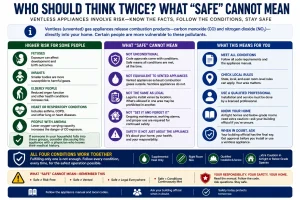
We are not going to convert that into a medical rule, because we are not qualified to and because the honest version is a conversation with a physician who knows the person, not a line on a web page.
What we can say is what “safe” cannot mean. It cannot mean unconditional, because the codes attach conditions. It cannot mean equivalent to a vented appliance, because the defining difference is where the combustion products go. And it cannot mean legal, which is a separate question with a separate answer that varies by address: see are ventless fireplaces legal, the sourced list of where they are banned or restricted, and the script for asking your building department. Our disclaimer sets out the limits of everything published here.
Frequently asked questions
Is the oxygen depletion sensor enough on its own?
No. It is required, it addresses one specific failure mode, and it is not a carbon monoxide detector. It watches oxygen, not carbon monoxide. A working CO alarm remains a condition of operating the appliance regardless of what safety devices the unit carries.
Is a vent-free unit safer than a wood-burning fireplace?
They fail differently, so a single ranking is misleading. A wood fireplace has a flue carrying combustion products out, and its characteristic hazards involve that flue, the chimney and the fire itself. A vent-free gas unit has no flue, so its characteristic hazards are what the burner puts into the room air. Comparing them usefully means comparing specific risks, not a single safety score.
Do I still need a CO alarm if the room has windows?
Yes. A window is not a flue and it is not a detector, and its effect depends entirely on whether it is open, how much, and what the weather is doing. Ventilation is one of the conditions, not a replacement for the alarm.
Does a brand new, high-end unit remove the risk?
It removes some of it. A new, correctly sized, correctly installed, listed appliance in good condition is the best case for this category, and the conditions on this page still apply to it. Condition and correct installation matter as much as age, which is why a maintained older unit can be in better shape than a neglected new one.
Our house is very airtight. Does that change the answer?
It changes the inputs, so raise it explicitly. Reduced air exchange with outside is directly relevant to any unvented combustion appliance, and it is exactly the kind of site-specific factor a building official or a licensed installer should weigh for your home rather than a general article.
We think our legality answer is current. Is that enough?
Legality and safety are independent. A jurisdiction permitting the appliance says nothing about the conditions in your particular room, and legality itself shifts over time, which is covered in why the legality answer you read last year may be wrong now.