
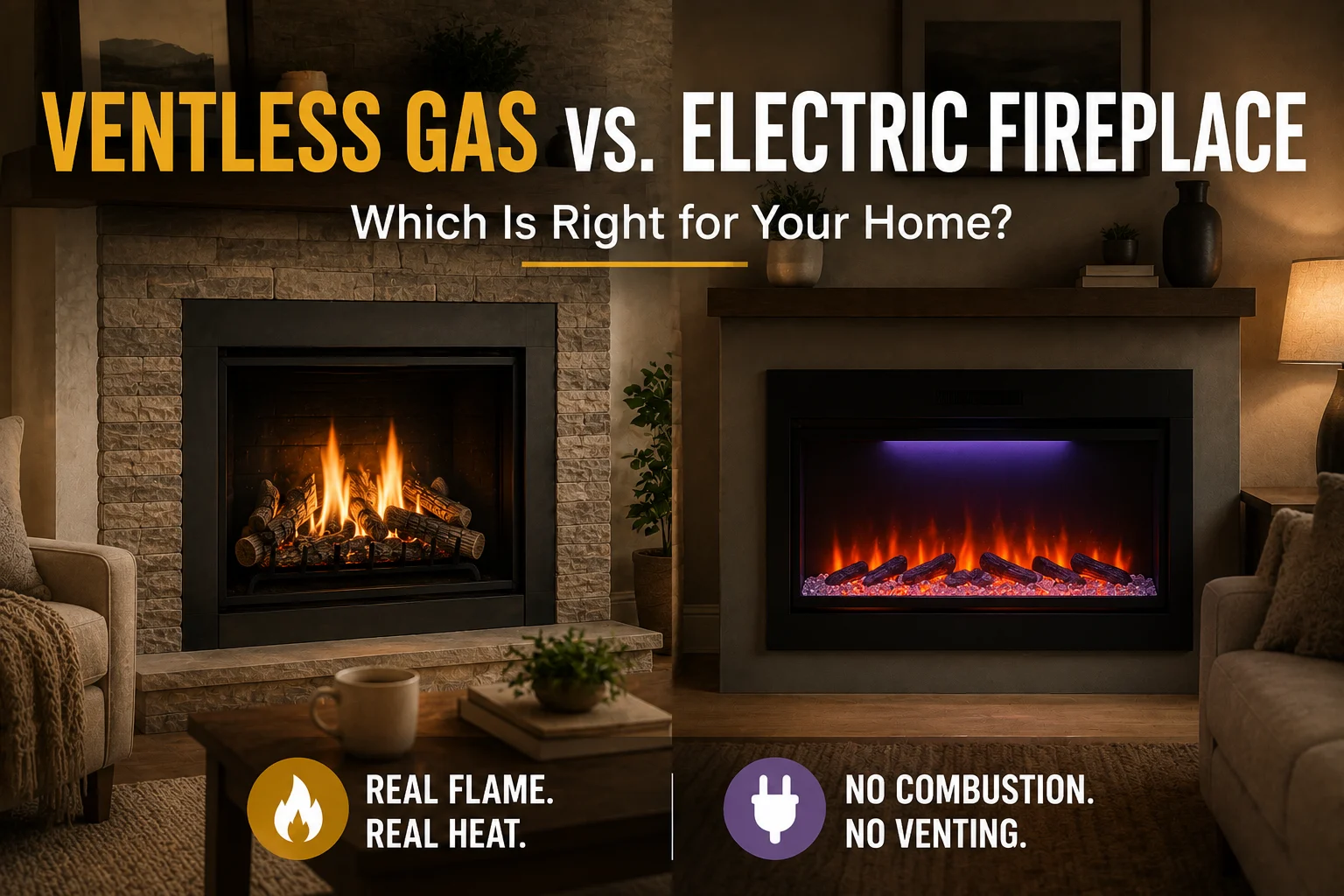
If you want the look of a fire with no combustion, no venting question and no local code gate, choose electric. If you want meaningful heat in a room with no vent path, and your jurisdiction permits the category, ventless gas is the option with the output. They are not competitors on a single scale. A ventless (vent-free) gas unit burns fuel in your living space and releases the combustion products there, which is why it can produce serious heat and why it carries carbon monoxide risk, room restrictions and a legality question that changes by address. An electric fireplace burns nothing, so it has none of those problems, and its heat output is capped by the circuit it plugs into.
Work out which of those two sentences describes your problem and the decision is mostly made.
The honest comparison table
| Vent-free gas | Electric | |
|---|---|---|
| Flame | Real combustion flame | Simulated, using LED, projection or water vapor |
| Heat source | Burning natural gas or propane | Resistance heating, sometimes with a fan |
| Combustion products in the room | Yes, by design | None |
| Carbon monoxide risk | Yes, managed by conditions | None from the appliance |
| Oxygen depletion sensor | Required | Not applicable |
| Venting | None required | None required |
| Legality of the category | Restricted or prohibited in some jurisdictions | Not in question |
| Room restrictions | Room volume minimums, no bedrooms or bathrooms, not sole heat | Standard appliance and circuit rules |
| Installation | Licensed gas work | Often plug-in; hardwired models need an electrician |
| Works in a power outage | Depends on the model’s valve and ignition | No |
| Purchase tier | Mid-range to premium, plus installation | Entry level to premium, often no installation |
We do not publish price figures for either category. Regional labor rates, gas line work, permits and model tier move the number too much for a national estimate to mean anything. Get written quotes.
The information gain: electric heat is capped by the circuit, not by the product
Every comparison page says electric fireplaces “produce less heat.” Almost none says why, or by how much, and the reason is worth a paragraph because it is a hard ceiling rather than a design choice.
A standard North American plug-in appliance runs on a 120-volt branch circuit, and plug-in heating appliances are commonly rated at a maximum of 1,500 watts. Watts convert to heat at a fixed rate: 1 watt equals about 3.412 BTU per hour. So a 1,500-watt electric fireplace delivers roughly 5,100 BTU per hour, and that is the ceiling for any unit you can plug into an ordinary outlet, regardless of brand, price or how large the firebox looks.
Now look at the other column. Vent-free gas fireplaces and log sets are commonly rated well into the tens of thousands of BTU per hour on their input rating plates. That is a different output class, not a slightly better one.
Two qualifications keep this honest. Hardwired 240-volt electric units exist and can exceed the plug-in ceiling, and they require an electrician and a dedicated circuit. And a vent-free unit’s input rating is what it consumes, with the room volume the manual permits limiting which model you may install in the first place. Check the nameplate on the specific unit rather than trusting a marketing claim in either column.
The practical version: an electric fireplace takes the chill off one room. A vent-free gas appliance can genuinely heat one, which is exactly why it carries the conditions it does.
The gate that applies to only one of them
Vent-free gas is the category whose availability changes by address. Vent-free gas appliances are restricted or prohibited in some states, provinces and municipalities, and permitted with conditions in others. We will not tell you the category is legal or illegal as a general fact.
The documents your local rule descends from have names, and using them makes the phone call short: the National Fuel Gas Code (NFPA 54, also published as ANSI Z223.1), the International Residential Code and International Fuel Gas Code as adopted and amended by your state or city, and in Canada CSA B149.1 through your provincial authority. Vent-free room heaters are certified to the ANSI Z21.11.2 product standard. Your building department and gas authority decide. That a store in your area sells the unit proves nothing about whether it may be installed at your address.
Start with are ventless fireplaces legal where you live, then the dated, sourced account of where vent-free appliances are banned or restricted. If the answer comes back no, electric is not a consolation prize. It is the category that solves the same room problem without the gate.
An electric fireplace has no equivalent question. It has electrical requirements, and a hardwired model needs an electrician and possibly a permit, but nobody is going to tell you the category is not allowed in your municipality.
What vent-free gas costs you beyond the purchase
If your jurisdiction does permit it, the conditions come attached to the appliance permanently:
- A working carbon monoxide alarm is a condition of operating it, not an accessory. Carbon monoxide is colorless and odorless, and the appliance’s mandatory oxygen depletion safety shutoff is not a carbon monoxide detector. That device monitors oxygen in the room and shuts the gas off at the manufacturer’s threshold. It is not looking for carbon monoxide. The alarm is.
- Never a bedroom or a bathroom. Adopted codes prohibit unvented room heaters in those rooms by default. Narrow exceptions in the model text are written around small heaters with low input ratings and local approval, and they are not a description of a decorative fireplace.
- Supplemental heat only. Model code language states that unvented room heaters shall not be used as the sole source of comfort heating in a dwelling unit.
- Sized to the room, per the manual and your adopted code. Room volume minimums exist for air quality reasons, not comfort.
- Water vapor stays in the room. Combustion produces it, and with no flue it condenses on cold windows and walls.
- Licensed installation. Gas connection and any conversion between natural gas and propane are jobs for a licensed gas fitter or qualified hearth technician. This is not a DIY category, and we publish no procedure for it.
The full safety picture is in are ventless gas fireplaces safe, an honest answer. Households with asthma or other respiratory conditions have a real reason to weigh this category differently, and that is a conversation with a physician rather than a rule we can write.
Where electric genuinely loses
We are not going to sell electric as a free win. Three honest limitations:
No real flame. Simulation has improved, and it is still simulation. If the appeal is a live fire, electric does not deliver it and no feature list changes that.
It stops in a power outage. This is the one argument for vent-free gas that holds up without qualification. Some vent-free units use a millivolt valve and standing pilot and can operate with no electricity, which is why the category is genuinely useful during outages. Others use electronic ignition or a fan and will not run without power, so confirm the specific model rather than assuming. An electric fireplace, by definition, is off exactly when you need it most.
Running cost depends on your utility rates. In many regions natural gas costs less per unit of delivered heat than electricity, so an electric unit that is cheap to install can cost more to run. Compare your own gas and electricity rates rather than a national claim.
How to decide in one pass
- Call your building department and ask whether unvented gas room heaters and decorative appliances are permitted at your address. If no, the decision is made.
- Decide whether you need heat or ambiance. If ambiance, electric wins on cost, safety and simplicity.
- If you need heat, check whether the room qualifies for the vent-free model you want, per its installation manual, and confirm it is not a bedroom or bathroom.
- If outage resilience is the driver, look at vent-free units with a millivolt valve, and put a working carbon monoxide alarm in service before the first burn.
- If you rent, or cannot alter the property, electric is usually the only category that survives.
Our disclaimer sets out the limits of what general guidance can do for a specific home.
Frequently asked questions
Which produces more heat, a ventless gas or an electric fireplace?
Ventless gas, by a wide margin in the typical case. A plug-in electric unit is limited by a standard 120-volt circuit, commonly to 1,500 watts, which is roughly 5,100 BTU per hour. Vent-free gas appliances are commonly rated well into the tens of thousands of BTU per hour. Check the rating plate on the specific model in both cases.
Is an electric fireplace safer than a ventless gas one?
On the specific hazards of combustion, yes. An electric fireplace produces no carbon monoxide, no nitrogen dioxide and no water vapor, so it has no oxygen depletion sensor, no room volume minimum for air quality and no bedroom prohibition. It is still an electrical heating appliance with its own fire and circuit-overload precautions, and it should be used per its manual.
Do electric fireplaces need venting or a permit?
No venting. A plug-in model usually needs nothing but an appropriate outlet and a circuit that can carry it. A hardwired or 240-volt model needs an electrician and may need a permit, which your building department will confirm.
Can I put an electric fireplace in a bedroom?
Electric fireplaces are not subject to the code prohibition that applies to unvented fuel-burning room heaters in sleeping rooms and bathrooms, which is one of the clearest practical differences between the categories. Follow the manufacturer’s clearance, placement and circuit instructions, and never run any heating appliance on an extension cord.
Will a ventless gas fireplace work when the power is out?
Some will. A unit with a millivolt gas valve and a standing pilot does not need household electricity, which is the strongest argument in this category’s favor. Models with electronic ignition or a circulating fan may not operate, or may operate without the fan. Confirm with the specific model’s manual before relying on it, and keep the carbon monoxide alarm in service, including its batteries.