
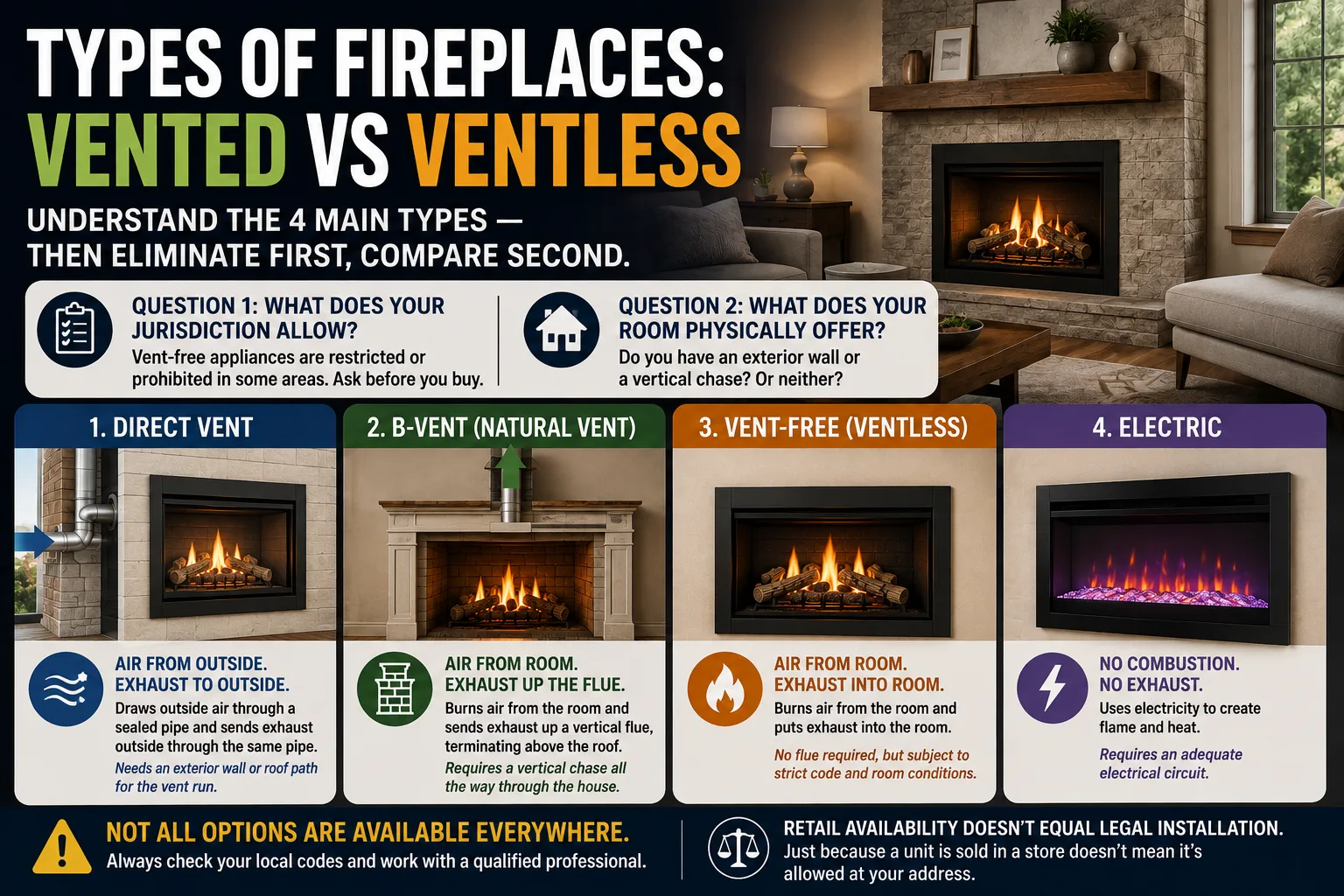
There are four categories a homeowner is realistically choosing between, and they differ by one thing: where the combustion air comes from and where the exhaust goes. Direct vent draws outside air and sends exhaust outside through a sealed pipe. B-vent (natural vent) burns room air and sends exhaust up a vertical flue. Vent-free burns room air and puts the exhaust into the room, because it has no flue. Electric burns nothing at all. Two questions eliminate categories before preference does: what your local code permits, and whether your room has an exterior wall or a vertical chase.
Everything after this is how to run those two questions in the right order.
Why the usual comparison table misleads
Search this topic and you get a features grid: efficiency, cost, flame realism, installation. Every page publishing that grid sells at least one column of it. Retailers and hearth dealers dominate this result set, and their grids are built to move a reader toward a purchase, not to rule categories out.
The problem is that the grid assumes all four options are available to you. For a large share of readers, at least one is not, and one may be illegal at their address. A feature comparison you are not allowed to act on is not a comparison. We do not sell fireplaces, vents or chimneys, and this page is built to eliminate first and compare second.
Types of gas fireplaces, vented vs ventless: the four categories by where the exhaust goes
| Category | Combustion air | Exhaust | Needs from the building |
|---|---|---|---|
| Direct vent | Outside, through a sealed pipe | Outside, through the same pipe assembly | An exterior wall or a roof path for the vent run |
| B-vent (natural vent) | The room it sits in | Up a vertical flue, terminating above the roof | A vertical chase all the way through the house |
| Vent-free | The room it sits in | Into the room it sits in | Nothing structural, but the strictest code and room conditions |
| Electric | None (no combustion) | None (no combustion) | An adequate electrical circuit |
Two labels cause most of the confusion. First, “vented” is used loosely in the trade to mean two appliances that behave very differently: a sealed direct vent unit and an open-front B-vent unit are both “vented,” and only one of them keeps the room air out of the burner. Second, “ventless” and “vent-free” are the same category, and so are the vent-free log sets sold to drop into an existing fireplace.
Question one: what does your jurisdiction allow?
Vent-free gas appliances are the only category in this list whose availability changes by address. They are restricted or prohibited in some states, provinces and municipalities, and permitted with conditions in others. Nothing on this site will tell you vent-free is legal or illegal as a general fact, because that statement is false in one direction or the other for most readers.
The governing documents have names, and knowing them makes the phone call easier. In the United States, the National Fuel Gas Code (NFPA 54, also published as ANSI Z223.1) and the International Residential Code and International Fuel Gas Code carry the model language, and your state or city adopts, amends or replaces it. Vent-free room heaters are certified to the ANSI Z21.11.2 product standard. In Canada, installation falls under CSA B149.1 and the provincial authority that adopts it. The decision that binds you is your local adoption, not the model text.
Ask before you buy, not after. We publish the full picture in are ventless fireplaces legal where you live and a sourced, dated account of where vent-free appliances are banned or restricted. Retail availability proves nothing: a unit can be sold in a store in a jurisdiction that will not permit its installation.
Direct vent, B-vent and electric are not subject to this particular gate. They still require permits and code-compliant installation, but the category itself is not the thing in question.
Question two: what does your room physically offer?
This is the question that quietly decides most projects.
- You have an exterior wall behind or beside the fireplace location. Direct vent is open to you, and it is the category most new gas fireplace installations use.
- You have a vertical path from the room through the roof. B-vent becomes possible, and an existing masonry chimney may serve as the chase, subject to a listed liner sized for the appliance.
- You have neither. An interior wall on a lower floor with finished space above, in a condo, or in a room in the middle of the house, leaves vent-free and electric as the realistic candidates. This is the situation that drives most vent-free interest, and it is a legitimate constraint rather than a shortcut.
- You are renting, or you cannot make a permanent alteration. Electric is usually the only category that survives this filter.
Where the vent can run is not a preference. It is a construction fact, and a hearth professional or gas fitter can confirm it in a site visit faster than any article can.
What each category costs you in something other than money
Every category gives something up. The honest version:
Direct vent gives up flame appearance to some buyers, because the firebox is sealed behind fixed glass that gets hot, and it gives up installation simplicity and cost, because a vent run has to be built. In exchange, the burner never touches your room air and the exhaust never enters the room in normal operation.
B-vent gives up efficiency, because it burns air you already paid to heat and loses it up the flue, and it gives up independence from your building’s air pressure. A natural draft vent relies on buoyancy, so exhaust fans, a tight building envelope or a stack effect can interfere with it. Its appeal is a traditional open-front flame at a lower vent cost than direct vent. Fewer models are offered than in the direct vent category, though the manufacturers still list them.
Vent-free gives up the flue, which is the entire trade. Because there is no flue, there is no flue heat loss, and also no path out of the room for the water vapor, carbon dioxide, nitrogen dioxide and any carbon monoxide the burner produces. It carries conditions the other categories do not: a mandatory oxygen depletion safety shutoff, sizing rules tied to the volume of the room, prohibitions on bedrooms and bathrooms, and a code limit against using it as the sole source of heating in a dwelling. We cover the full picture in are ventless gas fireplaces safe, an honest answer.
Electric gives up real flame and, in most plug-in units, gives up meaningful heat output, because the appliance is limited by the circuit it is plugged into. It also gives up operation during a power outage. What it gives you is a category with no combustion, no venting question and no jurisdiction gate.
The two rules that apply no matter which category you pick
A working carbon monoxide alarm belongs in any home with a fuel-burning appliance, and with a vent-free unit it is a condition of operating the appliance at all, not an accessory. Carbon monoxide is colorless and odorless, and the appliance’s own oxygen depletion sensor is not a carbon monoxide detector. The sensor watches oxygen falling in the room and shuts the gas off at a threshold set by the manufacturer. It does not measure carbon monoxide. Anyone telling you the sensor makes an alarm unnecessary is describing a product, not a hazard.
Gas work is licensed work. Connecting a gas appliance, converting one between natural gas and propane, and building or altering a vent are jobs for a licensed gas fitter or a qualified hearth technician. This site publishes no gas line or installation procedure and never will. Distrust any page that does.
How to reach a decision this week
- Call your local building department or your gas authority and ask whether unvented (vent-free) gas room heaters and decorative appliances are permitted at your address, and what permit the installation you want requires. Write the answer down with the date.
- Have a hearth professional confirm what vent path your room offers.
- Only then compare models, and read the manufacturer’s installation manual for the specific unit before you buy it. Room volume minimums, input ratings and clearances live in that manual and in your adopted code, not in a retailer’s blog post.
- Whatever you install, put a working carbon monoxide alarm in service and keep it that way.
The order matters because steps one and two can remove categories from the list, and no amount of comparison shopping restores them. Our disclaimer sets out the limits of what any general guidance, including this page, can do for a specific home.
Frequently asked questions
Is a vent-free fireplace the same as a ventless one?
Yes. “Vent-free,” “ventless” and “unvented” describe the same category: a gas appliance with no flue that releases its combustion products into the room it heats. Vent-free gas log sets sold for existing fireplaces are in the same category.
What is the difference between B-vent and direct vent?
Direct vent is a sealed system: it draws combustion air from outside and expels exhaust outside through the same pipe assembly, with the firebox closed off from the room by fixed glass. B-vent takes its combustion air from the room and relies on natural draft to carry exhaust up a vertical flue through the roof. Direct vent does not depend on your building’s air pressure to vent correctly. B-vent does.
Can I install a gas fireplace without a chimney?
Often, yes, but the answer depends on the category. Direct vent can terminate through an exterior wall in many configurations, so no traditional chimney is required. Vent-free requires no vent at all, subject to whether your jurisdiction permits the category. B-vent does require a vertical flue. The specific configuration allowed for your home is a question for your installer and building official.
Which type of gas fireplace is most efficient?
Vent-free appliances carry the highest efficiency figures because nothing goes up a flue, but that number describes heat retention, not the whole trade. Nothing going up the flue is the same fact as the combustion products staying in the room, and the ventilation these appliances require works against the figure. Efficiency alone should not decide the category.
Do I need a permit?
Assume yes and confirm locally. Gas appliance installation and venting are permitted work in most jurisdictions, and an unpermitted gas installation can surface later at a home inspection or with your insurer. Your building department will tell you in one phone call.