
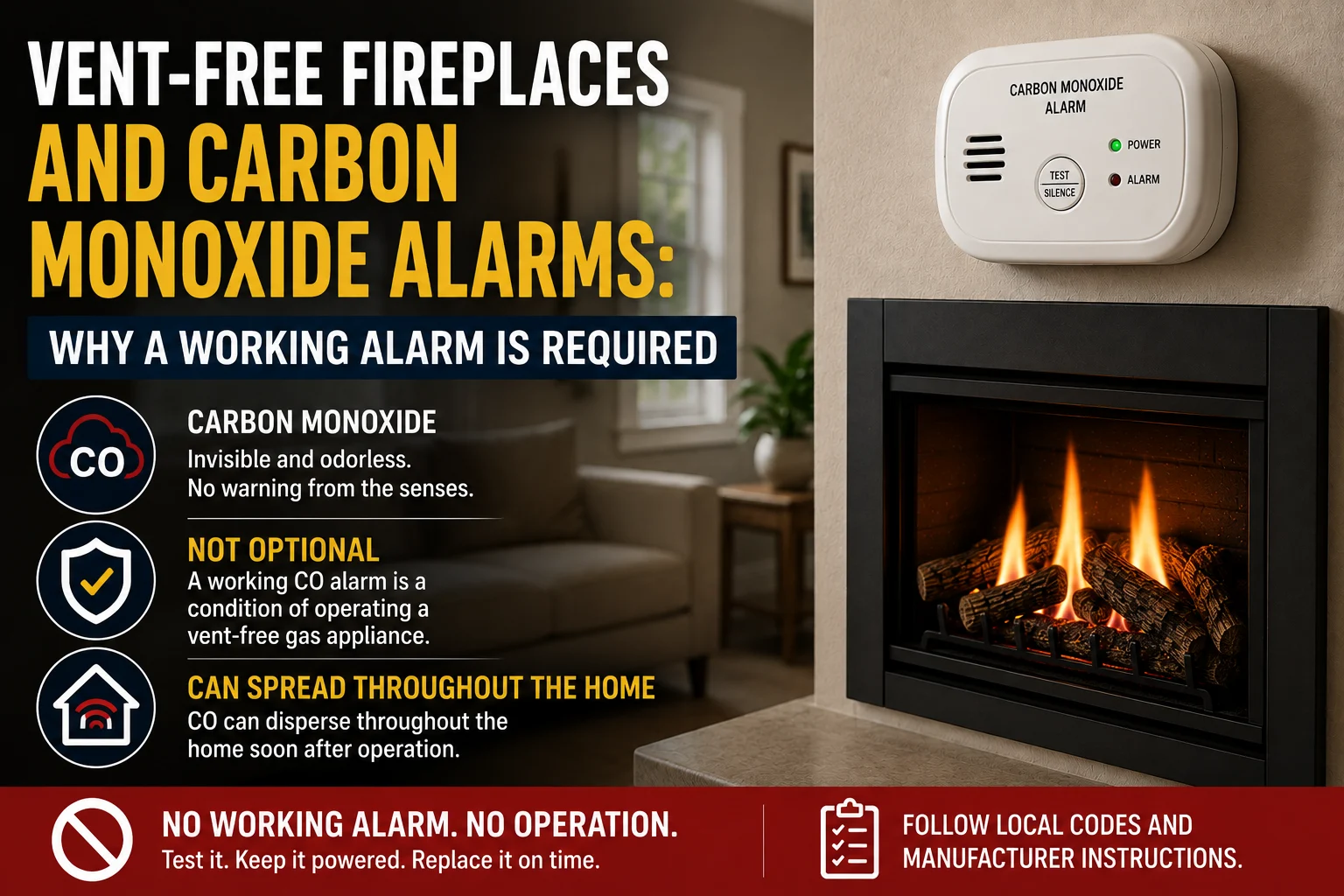
A working carbon monoxide alarm is a condition of operating a vent-free gas appliance, not a recommendation attached to the end of a safety list. If there is no working alarm in service, the appliance should not be running. That holds regardless of the unit’s age, price, brand, or how many safety features its brochure lists, and it holds specifically because the appliance’s own required safety device is watching something else.
This site does not sell, review, compare, or recommend detectors. There is no product being pointed at here, which is exactly why the statement is worth making.
Why this appliance category, specifically
A vent-free appliance has no flue. Whatever the flame produces enters the room, because there is nowhere else for it to go. That is not a defect; it is the definition of the category, and it is what separates this appliance from a vented one that produces the same chemistry and sends it outside.
Carbon monoxide forms when combustion runs incomplete. A well-maintained, correctly sized, listed unit is engineered to burn close to completely, and the conditions that push it away from that are covered in detail on what carbon monoxide comes out of a vent-free burner.
The gas gives no sensory warning at all, and its early effects are not distinctive. The US Environmental Protection Agency’s indoor air quality material lists unvented gas space heaters among indoor sources of carbon monoxide, and describes effects at low concentrations as “fatigue in healthy people” and “chest pain in people with heart disease,” with moderate concentrations bringing “angina,” “impaired vision,” and “reduced brain function” (verified 2026-08-10). Nothing in that list announces itself as a gas problem.
The appliance’s own safety device is not the alarm
This is the part that gets misunderstood, and it is the reason the alarm is framed here as a condition.
Every unvented room heater in this category is required to carry an oxygen-depletion-sensitive shutoff. The 2021 International Fuel Gas Code, Section 621.6, states that the system “shall shut off the gas supply to the main and pilot burners when the oxygen in the surrounding atmosphere is depleted to the percent concentration specified by the manufacturer, but not lower than 18 percent” (verified 2026-08-10).
Read what is being measured. Oxygen. The device is a low-oxygen gas shutoff. It is not a carbon monoxide detector, it does not respond to carbon monoxide, and it does not warn anybody of anything; it stops the fire. That distinction has its own page, because a great deal of retail copy blurs it.
So the required device covers one pathway. A burner degraded into incomplete combustion in a room with perfectly normal oxygen is a different pathway, and nothing built into the appliance is looking for it. In a room with no alarm, nothing at all is.
What the measurement record supports
The concern is not theoretical. Francisco, Gordon and Rose measured combustion products in 30 homes using unvented gas fireplaces, sampling at one minute intervals over three to four days per home, published in Indoor Air in 2010 (volume 20, issue 5, pages 370 to 379; abstract verified 2026-08-10).
Two of their findings bear directly on this page. Carbon monoxide “exceeded the U.S. EPA 8-h average standard of 9 ppm in 20% of the sample.” And on distribution, the authors reported that carbon monoxide “is dispersed throughout the home almost immediately upon operation of the fireplace and that the concentrations throughout the home away from the immediate vicinity of the fireplace are 70-80% of the level near the fireplace.”
That second finding matters more than it looks. Whatever the appliance produces does not stay in the room with the appliance. It is a house-wide event within minutes. One study of 30 homes is not a statement about your house, but it is measured data rather than a claim from either the industry or its critics.
What “working” has to mean
An alarm that is present is not the same as an alarm that is working, and the word doing the work in this page’s rule is working.
Test it on the schedule its own manufacturer specifies, using the method in its own instructions. Keep it powered, which for a battery unit means treating a low-battery chirp as an immediate task rather than something to silence. Replace the unit when it reaches the end-of-life its manufacturer states; alarms expire, and the expiry is per that device’s documentation rather than a number this site is going to invent. And if it has been triggered, or is behaving oddly, follow the manufacturer’s guidance on whether it can stay in service.
Some jurisdictions attach carbon monoxide detection to this appliance in the code itself. One municipal ordinance reviewed for this site adopts the fuel gas code’s bathroom and bedroom exceptions for wall-mounted unvented room heaters and adds a carbon monoxide detection requirement referencing the residential code. Whether your jurisdiction does the same is a question for your local building department, which is what the building department script is for.
What this site does not publish about alarms
Where to put an alarm, how many to have, which type to buy, how they interconnect, and how they compare as products are all genuine questions, and none of them is answered here.
That is a deliberate scope boundary rather than an oversight. This site covers the appliance as a source of carbon monoxide. It does not review detection devices and does not publish a placement rule, because a placement rule written by a site that cannot see your building is not worth the space it takes.
For those questions, use the instructions that came with the alarm itself, which are written for that specific device and are the authority on it, and your local fire department, which can answer for your building and your jurisdiction. If you want a general household treatment of carbon monoxide beyond this one appliance, that too is outside what this site covers.
If an alarm sounds
Do not investigate first. Fairfax County Fire and Rescue’s ventless fireplace safety guidance states the sequence directly: “If your carbon monoxide or ODS alarm sounds, shut down the fireplace, open a window, if possible, get out of the home, and call 911” (verified 2026-08-10).
The same guidance carries two operating rules worth repeating here. “Never operate a ventless fireplace when no one is home.” And “Ventless fireplaces should only be used for six hours or less a day or whatever is recommended by the manufacturer,” with your own unit’s manual governing and the stricter of the two applying.
Seek medical attention if anyone has symptoms. This site is not clinical and this is not medical advice; our disclaimer sets out the limits.
What the condition means in practice
Stated as plainly as it can be: do not operate a vent-free gas appliance in a building without a working carbon monoxide alarm in service.
That is not a hedge against liability and it is not a sales line, because nothing is being sold. It follows from three facts on this page. The appliance discharges its combustion products into the occupied space by design. Its required safety device measures oxygen rather than carbon monoxide. And carbon monoxide is undetectable by the people in the room.
Two prior gates still come first. Whether the appliance is permitted at your address is covered on are ventless fireplaces legal, and the honest verdict on the category is on are ventless gas fireplaces safe. An alarm does not change either answer.
Frequently asked questions
Does the oxygen depletion sensor replace the need for an alarm?
No. The ODS responds to oxygen concentration and shuts off the gas at a set point the code floors at 18 percent; the alarm responds to carbon monoxide and warns people. Different inputs, different outputs, neither substituting for the other. The full explanation is on the oxygen depletion sensor page.
How many alarms do I need, and where do they go?
This site does not publish placement or count rules. Follow the instructions supplied with the alarm, which are specific to that device, and ask your local fire department, which can answer for your building and your local requirements.
Which detector should I buy?
This site does not review, compare or recommend detection devices, and it is not going to start in a category where it also covers the appliance that creates the hazard. Choose a listed alarm and follow its own documentation.
Does an alarm make a bedroom installation acceptable?
No. A working alarm is a condition of operating the appliance anywhere, not permission for a location the code prohibits. The prohibition and its one narrow exception are covered on ventless fireplace in a bedroom.
My alarm has never gone off. Does that prove the unit is fine?
It proves the alarm has not reached its trigger threshold while powered and working. It is not a certificate on the appliance’s combustion, and it says nothing about the other byproducts, which do not trigger a CO alarm at all. An annual service by a qualified professional is what evaluates the appliance.
Is an alarm enough on its own?
No. It is a condition, not a solution. It sits alongside a listed and correctly sized appliance, an installation that meets local code, annual professional service, no modifications of any kind, and the operating limits in your own manual.