
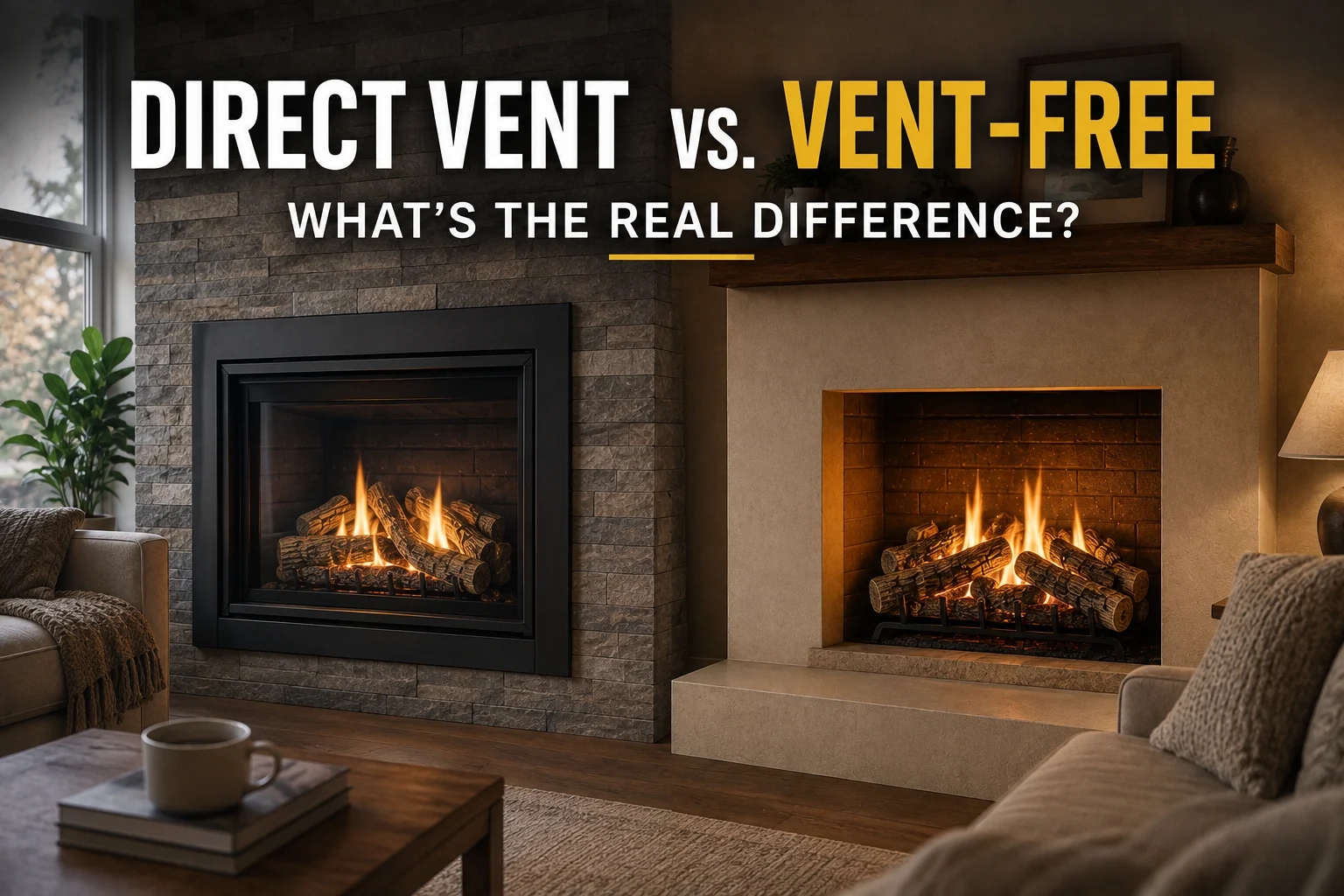
The difference is not efficiency, price or flame appearance. It is this: a direct vent fireplace is sealed, so its burner never touches your room air and its exhaust never enters your room in normal operation. A ventless (vent-free) fireplace burns the air in your room and releases the combustion products back into that same room, by design. Direct vent costs more to install because a vent has to be built. Vent-free costs less and goes almost anywhere, and in exchange the room becomes the flue. If combustion products end up in your living space with a direct vent unit, something has failed. With a vent-free unit, that is the appliance working as intended.
One question comes before either of them: vent-free is the only side of this comparison whose legality changes by address. It is restricted or prohibited in some states, provinces and municipalities, and your building department or gas authority gives the binding answer, not a retailer. Settle that first, then read the rest.
Who is telling you this, and why that matters here
Nearly every page ranking for this comparison is published by a company that sells at least one side of it: hearth retailers, gas utilities and propane suppliers, chimney and venting contractors. None of them are lying, and all of them have a direction they would prefer you go. A retailer emphasizes vent-free flexibility and the efficiency number. A chimney company emphasizes carbon monoxide. The reader gets two half arguments and no way to weigh them.
We sell neither. We have never installed or operated one of these appliances, and we do not claim to have. What follows comes from adopted code language, product listing standards, manufacturer installation manuals and public safety authorities, which are documents you can open yourself. Our editorial policy states that position in full.
Side by side, on the things that actually differ
| Direct vent | Ventless (vent-free) | |
|---|---|---|
| Combustion air | Drawn from outside through a sealed pipe | Taken from the room |
| Exhaust path | Outside, through the same coaxial pipe assembly | Into the room |
| Firebox | Sealed behind fixed glass | Typically open front |
| Combustion products in the room | A failure state | Normal operation |
| Building requirement | An exterior wall or roof path for the vent run | None structural |
| Required safety device | Standard appliance controls | Oxygen depletion safety shutoff, mandatory |
| Room restrictions | Per manual and code | Room volume minimums, bedroom and bathroom prohibitions, sole-heat limits |
| Legality of the category | Not in question | Restricted or prohibited in some jurisdictions |
| Efficiency claim | Lower, because some heat leaves with the exhaust | Very high, because nothing leaves |
Read the last two rows together with the row above them, because that is where the honest comparison lives. Vent-free’s efficiency advantage and vent-free’s air quality problem are the same physical fact stated twice.
The information gain: same alarm, opposite meaning
Here is the framing no ranking page states plainly.
Put a carbon monoxide alarm in a room with a direct vent fireplace and it is watching for a fault: a cracked heat exchanger, a damaged or disconnected vent, a compromised gasket or glass seal. In a correctly installed, undamaged direct vent appliance, the combustion path and your breathing air are two separate systems. The alarm exists because equipment fails.
Put the same alarm in a room with a vent-free fireplace and it is watching a system that is designed to put its combustion products where you are sitting. The appliance is engineered and listed so that, within its tested conditions, what it releases stays within limits. The alarm is there because those conditions are not guaranteed to hold in your house: room volume, correct sizing, correct fuel type, a clean and unobstructed burner, a working shutoff, and no competing exhaust appliance depressurizing the space.
Same device, two different jobs. For direct vent it is a fault detector. For vent-free it is the last line of defense on a normal operating mode. That is why a working carbon monoxide alarm is a condition of running a vent-free appliance, not an accessory to it, and why “it has never alarmed” is not evidence that either installation is fine.
What the oxygen depletion sensor does, and what it does not
Every vent-free appliance in this category carries an oxygen-depletion-sensitive safety shutoff system. The model code language is direct: the system shall shut off the gas supply to the main and pilot burners when the oxygen in the surrounding atmosphere is depleted to the percent concentration specified by the manufacturer. It is mandatory, it works, and it is the reason the category is recognized in code at all.
It is not a carbon monoxide detector. It monitors oxygen concentration in the room and shuts the gas off at a threshold. It does not measure carbon monoxide, and oxygen depletion and carbon monoxide production are not the same quantity moving together in every scenario. A direct vent appliance does not need an oxygen depletion sensor because it does not use your room’s oxygen in the first place.
If a salesperson answers your carbon monoxide question with “it has an ODS,” you have been given a product feature in place of an answer. The full mechanism is covered in are ventless gas fireplaces safe, an honest answer.
Cost: the part where we will not give you a number
Direct vent costs more to install than vent-free, consistently, and the reason is structural rather than a market quirk: a vent assembly has to be specified, routed, penetrated through the building envelope, flashed and terminated to the appliance manufacturer’s listed configuration. That is materials and skilled labor that a vent-free installation does not require.
We do not publish price ranges for these installations. Any figure depends on your region, the length and geometry of the vent run, whether the wall is masonry or frame, what the gas line requires, and your permit fees. A number from a national blog post is not a quote. Get two or three written quotes from licensed installers in your area and compare those.
What is worth saying about money is the shape of the trade rather than the size of it. Direct vent front-loads its cost into the installation. Vent-free front-loads its cost into the conditions you have to keep meeting for as long as you own it: correct room, correct size, ventilation, alarm in service, run-time discipline, and the restriction against relying on it as your only heat.
The legality gate applies to one column only
Direct vent is a category question nowhere. Vent-free is a category question in many places. Vent-free gas appliances are restricted or prohibited in some states, provinces and municipalities, and permitted with conditions elsewhere, and we will not tell you which case applies to you.
The bodies whose text your local rule is built from are the National Fuel Gas Code (NFPA 54 / ANSI Z223.1), the International Residential Code and International Fuel Gas Code, and in Canada CSA B149.1 through the provincial authority. The vent-free product standard is ANSI Z21.11.2. Your building department and gas authority decide, and they decide for your address. Start with are ventless fireplaces legal where you live and the dated account of where the category is banned or restricted, then make the call before you spend anything.
One more thing the codes settle rather than leave to preference: a vent-free unit is prohibited in bedrooms and bathrooms by default. Narrow exceptions for small unvented heaters exist in the model text, they are written around low input ratings and local approval, and they are not a description of the decorative fireplace most readers of this page are shopping for. Nothing here will tell you a bedroom installation is fine.
Which one is right for you
Choose direct vent if you have an exterior wall or a roof path, you want the appliance to be a real heat source you can run for hours, anyone in the household has asthma or another respiratory condition, the house is tightly built, or you simply do not want combustion products in your living space as a design feature.
Consider vent-free only if your jurisdiction permits it, no vent path exists and cannot be created, the room is large enough for the model you are looking at per its manual, the room is not a bedroom or bathroom, you accept it as supplemental heat rather than primary heat, and a working carbon monoxide alarm will be in service whenever it runs.
Consider neither if both of those lists have a problem in them. An electric fireplace has no combustion, no vent and no jurisdiction gate, and it is a legitimate answer for a room that cannot take a vent and a household that does not want unvented combustion.
Whichever way you go: gas connection, fuel conversion between natural gas and propane, and any venting work belong to a licensed gas fitter or qualified hearth technician. This is not a DIY category. Our disclaimer covers the limits of general guidance like this page.
Frequently asked questions
Is a direct vent gas fireplace safer than a ventless one?
On the specific question of combustion products entering your living space, yes, and the reason is design rather than build quality: direct vent isolates the burner from the room. Both appliance types need correct installation, servicing and a working carbon monoxide alarm. Neither is risk-free, and a neglected direct vent unit is not automatically safer than a well-maintained vent-free one in the correct room.
Do ventless fireplaces really produce carbon monoxide?
Any fuel-burning appliance produces carbon monoxide when combustion is incomplete, and complete combustion still produces carbon dioxide and water vapor. Vent-free units are listed and tested to keep output within limits under their tested conditions. The difference from a vented appliance is not that nothing is produced, it is that there is no flue to take it away.
Can a direct vent fireplace be installed without an exterior wall?
Sometimes, through a roof termination or an approved vent run, depending on the model’s listed configurations and the distances involved. This is a site-specific question for a hearth professional. Vent configurations are set by the manufacturer’s installation manual and your local code, not by general rules.
Which produces more heat in the room?
Vent-free retains more of the fuel’s heat energy in the room, because nothing goes up a flue. A direct vent unit loses some heat with its exhaust. That comparison ignores the ventilation a vent-free appliance requires and the run-time limits attached to it, so more heat retained per hour does not automatically mean a warmer house across an evening.
Can I convert my existing fireplace to either one?
Both vented and vent-free gas log sets exist for masonry fireplaces, and they are very different products with opposite relationships to your chimney. That decision has its own requirements, including what condition the flue is in, and it belongs with a qualified hearth technician who has looked at your fireplace.