
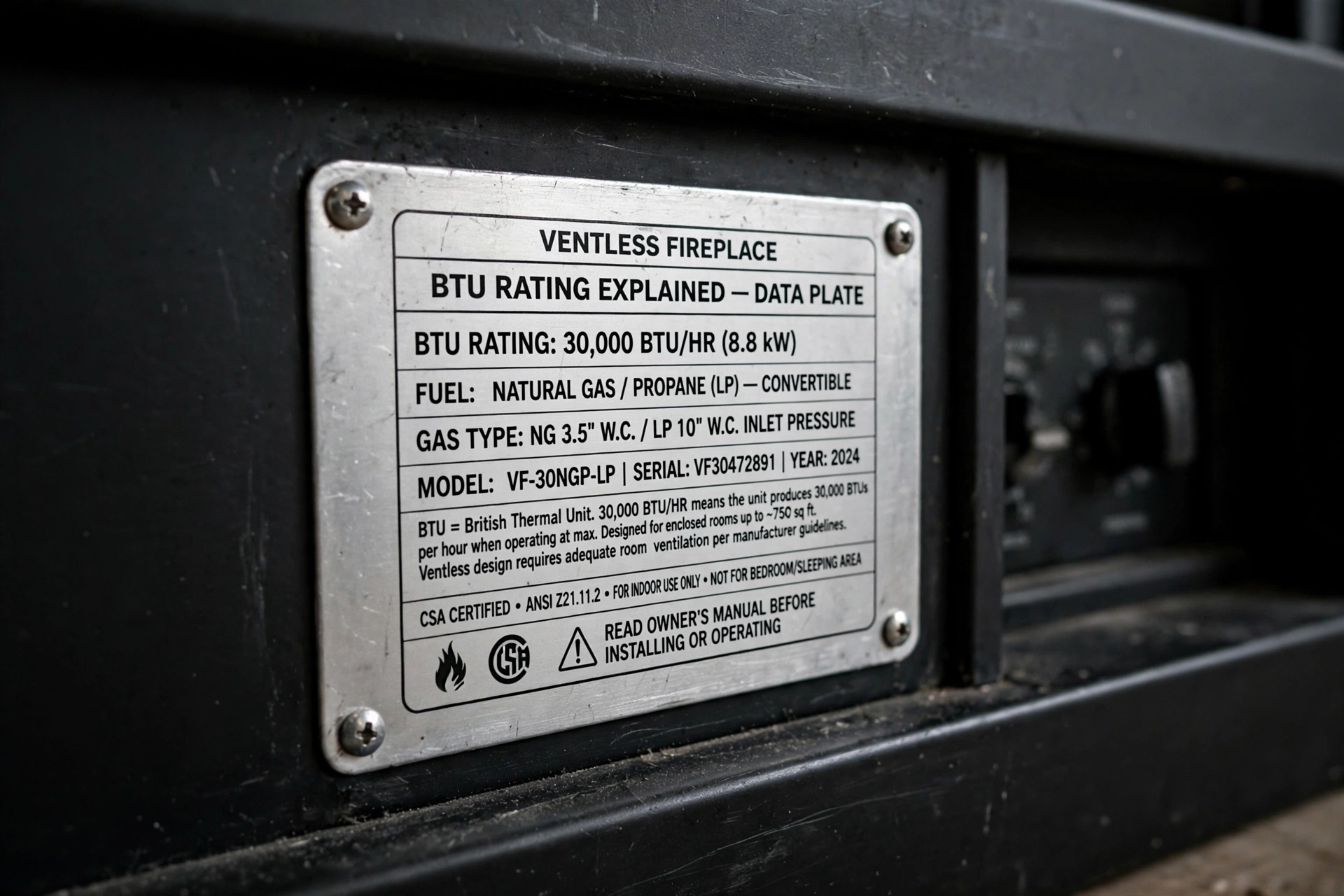
The Btu number on a vent-free appliance is an input rating: the rate at which the appliance burns fuel, in British thermal units per hour, when it is set up correctly on the fuel named beside it. It is not a measure of how warm a room will get, and it is not a quality score. It is, however, the number your fuel gas code writes its limits against, so it is the number to read off the data plate rather than off a product listing.
That plate is a permanent label on the appliance itself. Manufacturers commonly place it where it survives installation and stays legible to a technician: inside the control compartment, on a side panel, behind a lower louver, or on the back of the unit. The installation manual says where.
Whether you may install the appliance at all is a separate and earlier question, decided by your jurisdiction rather than by the plate. Our overview of whether vent-free fireplaces are legal and our walkthrough of how to check your local code cover it. A high or low Btu rating never makes a prohibited appliance permitted.
We have never installed, lit or burned one of these appliances. This page is built from published code text and published federal agency documents, named where used.
Input, not output
Every gas appliance has both figures and they are not interchangeable. Input is the fuel energy going in per hour. Output is the useful heat delivered into the space. In a vented appliance the difference leaves up the flue, which is why vented products publish both and why an efficiency percentage exists to link them.
Vent-free products are marketed differently, because with no flue the manufacturer can claim that almost all the fuel energy stays in the room. That claim is about where the heat goes, not about what else stays in the room with it, and we take it apart in our page on the 99 percent efficiency figure. For reading a data plate, the practical point is narrower: the plate’s Btu/h figure is an input rate, and when a retailer’s comparison chart presents it as “heat output”, the chart has quietly changed the meaning of the number.
What else is on the plate, and why each line matters
| On the plate | Why you read it |
|---|---|
| Input rating in Btu/h | The figure the code’s limits are applied to, and the figure that governs fuel consumption |
| Fuel type, natural gas or propane | The appliance is orificed and certified for one fuel, and only that fuel |
| Model and serial number | What a technician needs to order the correct parts, and what a conversion kit is matched to |
| Manufacturer and date | Establishes which manual and which standard edition apply |
| Certification marks and the standard | Names the organization that certified the unit and the standard it was listed to |
| Any elevation statement | Some appliances state the elevation range they are certified for |
If any of that is missing, unreadable or painted over on a second-hand unit, you are looking at an appliance nobody can verify. That is a reason to walk away rather than a paperwork inconvenience.
What the number actually predicts: fuel use
Because it is an input rate, the Btu/h figure converts directly into gas consumption. The US Energy Information Administration publishes a conversion factor of 1,036 Btu per cubic foot of natural gas (EIA, British Thermal Units, read September 7, 2026).
So an appliance with a 30,000 Btu/h input rating running at full rate consumes roughly 29 cubic feet of natural gas an hour, because 30,000 divided by 1,036 is about 29. That is arithmetic on a published figure, not a bill estimate. Your actual cost depends on your rate, your gas quality and how long the appliance actually runs at full rate, and we publish no price figures.
The same input figure predicts something less pleasant. The US Department of Energy’s Building America Solution Center states that unvented combustion products “produce 1 gallon of water vapor for every 100,000 Btus, so a 30,000-Btu appliance would release nearly 1 gallon of water vapor for every 3 hours of operation” (read September 2, 2026). Water is a combustion product like any other, and with no flue it stays where the heat does.
The number the code counts is this one
Two limits in the 2021 International Fuel Gas Code are written directly against the plate figure, both read on UpCodes on September 2 and September 7, 2026. Section 621.3 states that “unvented room heaters shall not have an input rating in excess of 40,000 Btu/h (11.7 kW)”. Section 621.5 states that “the aggregate input rating of all unvented appliances installed in a room or space shall not exceed 20 Btu/h per cubic foot (207 W/m3) of volume of such room or space”.
Read those with a data plate in your hand and the practical consequence is clear. A unit rated at 32,000 Btu/h input sits below the product cap, and under the volume limit it would require a room of at least 1,600 cubic feet before any other unvented appliance in that space is counted, because 32,000 divided by 20 is 1,600. That is a threshold arithmetic exercise, not a recommendation and not permission. Your locally adopted code, the model’s own manual and your code official decide, and any of the three can be stricter.
Section 621.2 adds the limit people forget when they read a large number as reassurance: “one or more unvented room heaters shall not be used as the sole source of comfort heating in a dwelling unit”. A bigger plate figure does not turn the appliance into a furnace, which is the subject of our page on vent-free appliances as primary heat.
Two things that change what the plate figure means
Turndown. Many units run at more than one rate, and some have a variable control. The plate carries the maximum input, which is the figure the code limits apply to, but the appliance may spend most of its life below it. That affects your fuel use and your comfort. It does not lower the number your building department works from.
Elevation. Gas appliance ratings are stated for a range of altitudes and reduced above it. The provision appears in adopted mechanical and fuel gas codes in wording like this, from the Nevada Mechanical Code 2018, section B 101.2 High Altitude, read September 7, 2026: “Gas input ratings of appliances shall be used for elevations up to 2000 feet (610 m). The input rating of appliances operating at elevations above 2000 feet (610 m), shall be reduced in accordance with one of the following methods”, the methods being a stated percentage reduction per thousand feet, an approval by the authority having jurisdiction, or the manufacturer’s instructions. If you live at altitude, the plate figure is not the end of the conversation, and the manual and your code official settle it. Almost nothing written about vent-free appliances mentions this at all.
What to do with the plate before you buy
Ask the retailer for a photograph of the data plate and a link to the installation manual for that exact model, then check three things against each other: the input rating, the fuel, and the standard named on the certification mark. If the listing, the plate and the manual do not agree, believe the plate and the manual.
Then take the input rating and your room’s dimensions to your building department, because the plate tells you what the appliance does and only they can tell you what your room permits. Our guide to choosing a vent-free gas fireplace puts those steps in order. Installation itself remains work for a licensed gas fitter or qualified hearth technician, under whatever permit and inspection your jurisdiction requires.
What we checked, and when
2021 International Fuel Gas Code sections 621.1, 621.2, 621.3 and 621.5, as published on UpCodes, read September 2 and September 7, 2026. Nevada Mechanical Code 2018 section B 101.2, as published on UpCodes, read September 7, 2026. US Energy Information Administration, British Thermal Units, read September 7, 2026. US Department of Energy, Building America Solution Center, Unvented Combustion Appliances, read September 2, 2026. Codes are adopted and amended locally, so verify what is in force where you live.
Frequently asked questions
Is 32,000 BTU a lot for a ventless fireplace?
It is near the top of what the model code allows for this appliance class, since section 621.3 of the 2021 International Fuel Gas Code caps unvented room heaters at 40,000 Btu/h input. Whether it is a lot for your room is a different question with a code answer: at the model code’s limit of 20 Btu/h per cubic foot, a 32,000 Btu/h aggregate needs at least 1,600 cubic feet of room volume. Your adopted code, the model’s manual and your code official decide, and other unvented appliances in the same space count too.
Is the BTU rating on a ventless fireplace input or output?
Input. It states the rate at which the appliance consumes fuel energy in British thermal units per hour on the fuel named on the plate. Vent-free marketing often blurs input and output because there is no flue carrying heat away, but the code’s limits and a technician’s checks are written against input, so that is the figure to compare between models.
Where is the data plate on a gas fireplace?
It is a permanent label on the appliance, commonly inside the control compartment, on a side panel, behind a lower louver or on the back of the unit. The installation manual for the model says where. If you cannot find it on a unit you already own, do not dismantle anything to look. Ask a qualified hearth technician during a service visit.
Does a higher BTU rating mean a better fireplace?
No. It means the appliance burns more fuel per hour, which raises what your room has to be able to accommodate under the code’s volume limit and raises the water vapor released with it. The model code also forbids using unvented room heaters as the sole source of comfort heating in a dwelling unit, so a larger figure is not a route to heating the house.
Can I use the BTU rating to compare a vent-free unit with a vented one?
Not directly. A vented appliance sends part of its input up the flue, so its output figure and its efficiency rating carry information that an input figure alone does not. Comparing a vent-free unit’s input rating against a vented unit’s output rating flatters the vent-free unit and tells you nothing about air quality, which is the difference that actually separates the two categories.