
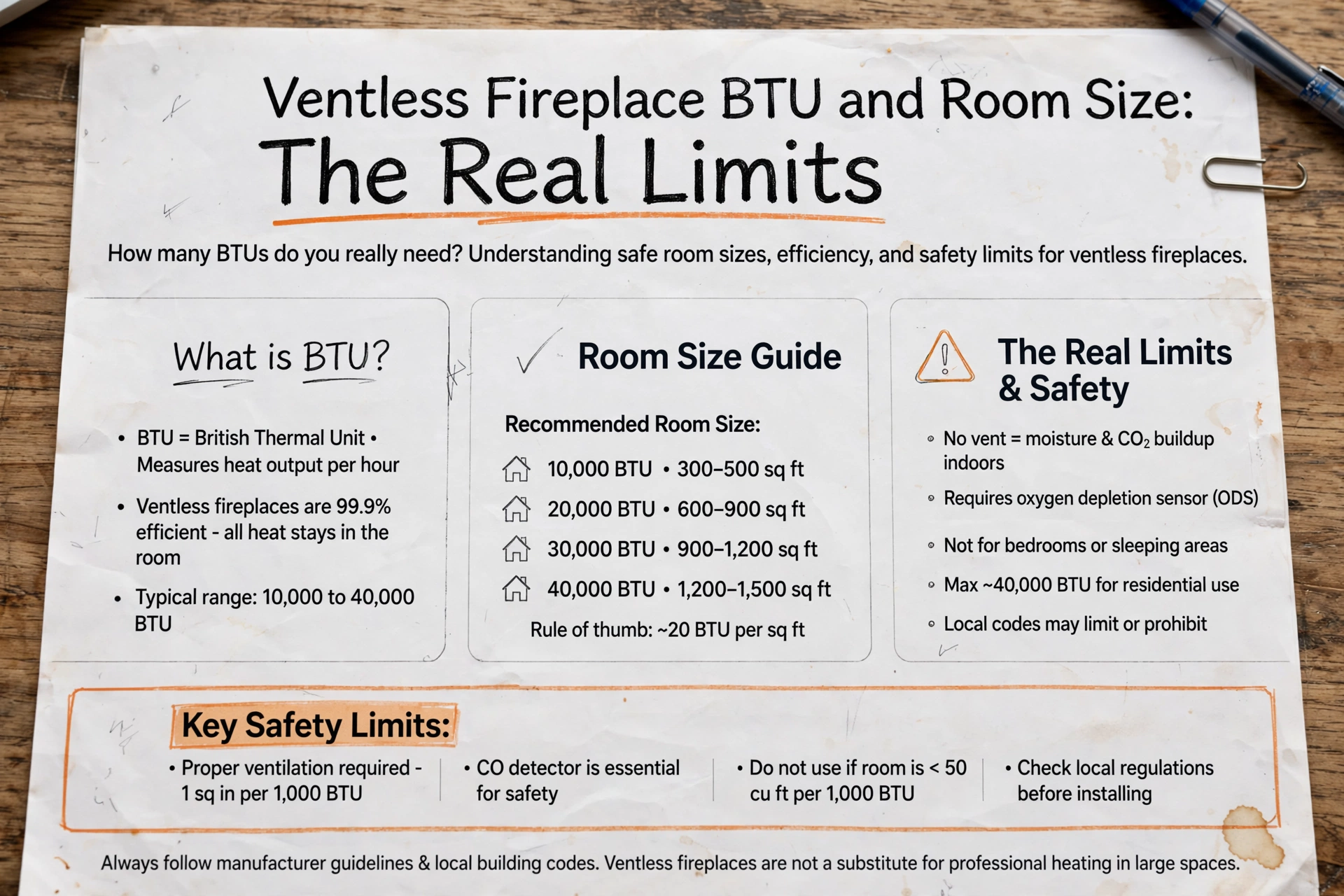
There are three places the number can honestly come from: the appliance’s own data plate and installation manual, the room volume limits in the fuel gas code as your jurisdiction adopted it, and the code official who applies both to your actual room. There is no fourth place, and a Btu-per-square-foot rule of thumb is not one of them. Sizing an unvented appliance is a maximum-permitted question before it is a comfort question, and the room is measured in cubic feet, not square feet.
This matters more here than in any other heating category. An oversized unit in a small or tightly sealed room is the failure mode that hurts people, because everything the burner produces stays in that room.
Before the arithmetic, the permission question. Unvented gas appliances are permitted in much of the United States, restricted in some places and prohibited outright in others. Read whether vent-free fireplaces are legal and ask your building department what applies at your address before you shop for a size at all.
We have never installed, lit or burned one of these appliances. Everything below is published code text and published agency documents, named where used.
Why we will not print a Btu-per-square-foot number
Search this question and you will be handed a formula within seconds. In our own search of the ranking pages on September 7, 2026, the advice on offer included 20 to 30 Btu per square foot for supplemental heat, 30 to 40 for primary heat or cold climates, and 40 to 50 or more for very cold or poorly insulated spaces, plus assorted calculators built on the same idea.
None of the pages carrying those numbers named a standard, a code section or a test they come from. That is the entire reason we will not repeat one. A rule of thumb is a comfort estimate borrowed from vented and electric heating, where the products of combustion leave the building or never exist. Applied to an appliance that exhausts into the room, it silently answers the wrong question: it tells you what might feel warm, not what you are permitted to install, and the second number is smaller than the first more often than the guides admit.
Number one: the code sets a ceiling, and it is a volume
The model code limits are published, quotable and specific. All three below are from the 2021 International Fuel Gas Code as published on UpCodes, read September 2 and September 7, 2026.
| Section | What it says |
|---|---|
| 621.3 Input rating | “Unvented room heaters shall not have an input rating in excess of 40,000 Btu/h (11.7 kW).” |
| 621.5 Room or space volume | “The aggregate input rating of all unvented appliances installed in a room or space shall not exceed 20 Btu/h per cubic foot (207 W/m3) of volume of such room or space.” |
| 304.5.1 Standard method | Indoor combustion air volume of “50 cubic feet per 1,000 Btu/h” of appliance input rating. |
The last two are the same ratio written two ways: 50 cubic feet per 1,000 Btu/h is 20 Btu/h per cubic foot. The room’s volume, not its floor area, is what caps the appliance, which is why a 300 square foot room with an 8 foot ceiling and a 300 square foot room with a 12 foot ceiling are not the same problem.
Note the word “aggregate”. The limit counts every unvented appliance in the space, so an existing unvented heater in the same room is part of your arithmetic, not a separate matter.
Doing the arithmetic honestly
Length times width times ceiling height gives the volume in cubic feet. A room 14 feet by 16 feet with a 9 foot ceiling holds 2,016 cubic feet. At 20 Btu/h per cubic foot, the aggregate ceiling for all unvented appliances in that room is 40,320 Btu/h, which lands just above the 40,000 Btu/h product cap in section 621.3, so in that room the product cap binds first. Shrink the same room to a 7 foot ceiling and the volume is 1,568 cubic feet, the aggregate ceiling falls to 31,360 Btu/h, and now the room binds.
That arithmetic is arithmetic, not a recommendation, and it is where a homeowner’s part ends. Two things stop it from being the answer. Whether volume from an adjoining space may be counted, and on what conditions, is a determination for the installer and the code official. And the standard method above assumes a building that is not unusually tight. A newer, well-sealed house may need a different method entirely, which again is not a calculation to run off a web page.
Number two: the appliance’s own documents, which can be stricter
Section 621.1 of the same code requires unvented room heaters to be “installed in accordance with the conditions of the listing and the manufacturer’s instructions”. That sentence puts the manual above any general figure, including the ones quoted above.
So the data plate on the unit gives you its input rating in Btu/h, and the installation manual gives you the room and clearance conditions that specific model was listed under. If the manual states a minimum room volume, that is your number. If it states something stricter than your local code, the stricter one governs. If a product page and the manual disagree, the manual is the document with the listing behind it.
Number three: the code official, who is the only one who can say yes
Your jurisdiction adopts a code edition, amends it, and applies it to your room through a person. That person is the authority having jurisdiction, and their answer is the one that determines whether the installation passes.
Bring four things to that conversation: the room’s length, width and ceiling height, the model you intend to buy, its input rating from the data plate, and its installation manual. Ask for the permitted aggregate input rating for that room in writing, and ask whether a permit and inspection are required. Our guide to choosing a vent-free gas fireplace sets out where in the sequence that conversation belongs, which is before the purchase.
Why oversizing is the dangerous error, not the wasteful one
In a vented or electric appliance, too much output means discomfort and a wasted bill. Here it means more combustion in a fixed volume of air that nothing is exhausting.
Two consequences follow. The first is oxygen depletion in the room, which is what the required shutoff device exists to interrupt and which our page on oxygen depletion and vent-free fireplaces explains. The second is moisture. The US Department of Energy’s Building America Solution Center states that unvented combustion products “produce 1 gallon of water vapor for every 100,000 Btus, so a 30,000-Btu appliance would release nearly 1 gallon of water vapor for every 3 hours of operation” (read September 2, 2026). Size up, and both numbers go up with it.
The code also removes the reason people oversize in the first place. Section 621.2 states that “one or more unvented room heaters shall not be used as the sole source of comfort heating in a dwelling unit”, which is the subject of our page on vent-free appliances as primary heat. This appliance is not supposed to be carrying the house.
The rooms where the answer is no whatever the size
Section 303.3 prohibits appliances in “sleeping rooms, bathrooms, toilet rooms, storage closets or surgical rooms, or in a space that opens only into such rooms or spaces”, subject to narrow exceptions covering a single wall-mounted unvented room heater at not more than 6,000 Btu/h in a bathroom and not more than 10,000 Btu/h in a bedroom, each subject to volume criteria and the approval of the code official.
Those exceptions are not a sizing tip. They describe small heaters approved case by case, not the decorative appliance most people are shopping for, and no homeowner self-certifies into them. Our page on vent-free appliances in bedrooms covers it fully.
Finally, the stop condition that applies to all of this: connecting the appliance is licensed work for a licensed gas fitter or qualified hearth technician, under whatever permit and inspection your jurisdiction requires. We publish no installation procedure at any level of detail.
What we checked, and when
2021 International Fuel Gas Code sections 303.3, 304.5.1, 621.1, 621.2, 621.3 and 621.5, as published on UpCodes, read September 2 and September 7, 2026. US Department of Energy, Building America Solution Center, Unvented Combustion Appliances, read September 2, 2026. Search of ranking pages for this question, September 7, 2026. Codes are adopted and amended locally, so verify the edition in force where you live.
Frequently asked questions
What size ventless fireplace do I need for a 300 square foot room?
Square feet cannot answer it. Measure the room’s volume, which is length times width times ceiling height, then apply the limits your jurisdiction has adopted: the model code caps the aggregate input rating of all unvented appliances in a space at 20 Btu/h per cubic foot and caps any single unvented room heater at 40,000 Btu/h. Then check the specific model’s installation manual, which can be stricter, and confirm the result with your building department before buying.
Is 20 Btu per square foot a safe rule for a ventless fireplace?
No, and it is not the same thing as the code figure that looks like it. The code limit is 20 Btu/h per cubic foot of room volume, and it is a maximum permitted aggregate input, not a comfort recommendation. A per-square-foot rule ignores ceiling height entirely and comes from heating guidance written for appliances that vent their combustion products outside. Do not substitute one for the other.
Does the room size limit count other appliances?
Yes. The model code limit applies to “the aggregate input rating of all unvented appliances installed in a room or space”. If there is already an unvented heater in the room, its input rating counts against the same ceiling, and so does any second unit you are considering. This is one of the details a code official checks and a homeowner calculation often misses.
Can I use a bigger unit if the room is drafty?
That reasoning is backwards for this category, and it is not yours to apply. Air leakage is not a permission to add combustion, the code’s volume limit does not have a draftiness discount, and how a tight or leaky building is assessed is a determination for the installer and the code official using the methods in the code. Take the room’s dimensions and the model’s manual to them and let them answer it.
Where do I find the appliance’s Btu rating?
On the data plate attached to the appliance, which states the input rating in Btu/h along with the fuel it is built for, and in the installation manual for that model. That input figure is the one the code’s limits are written against. Treat marketing copy, a retailer listing or a comparison chart as unverified until the data plate agrees with it.