
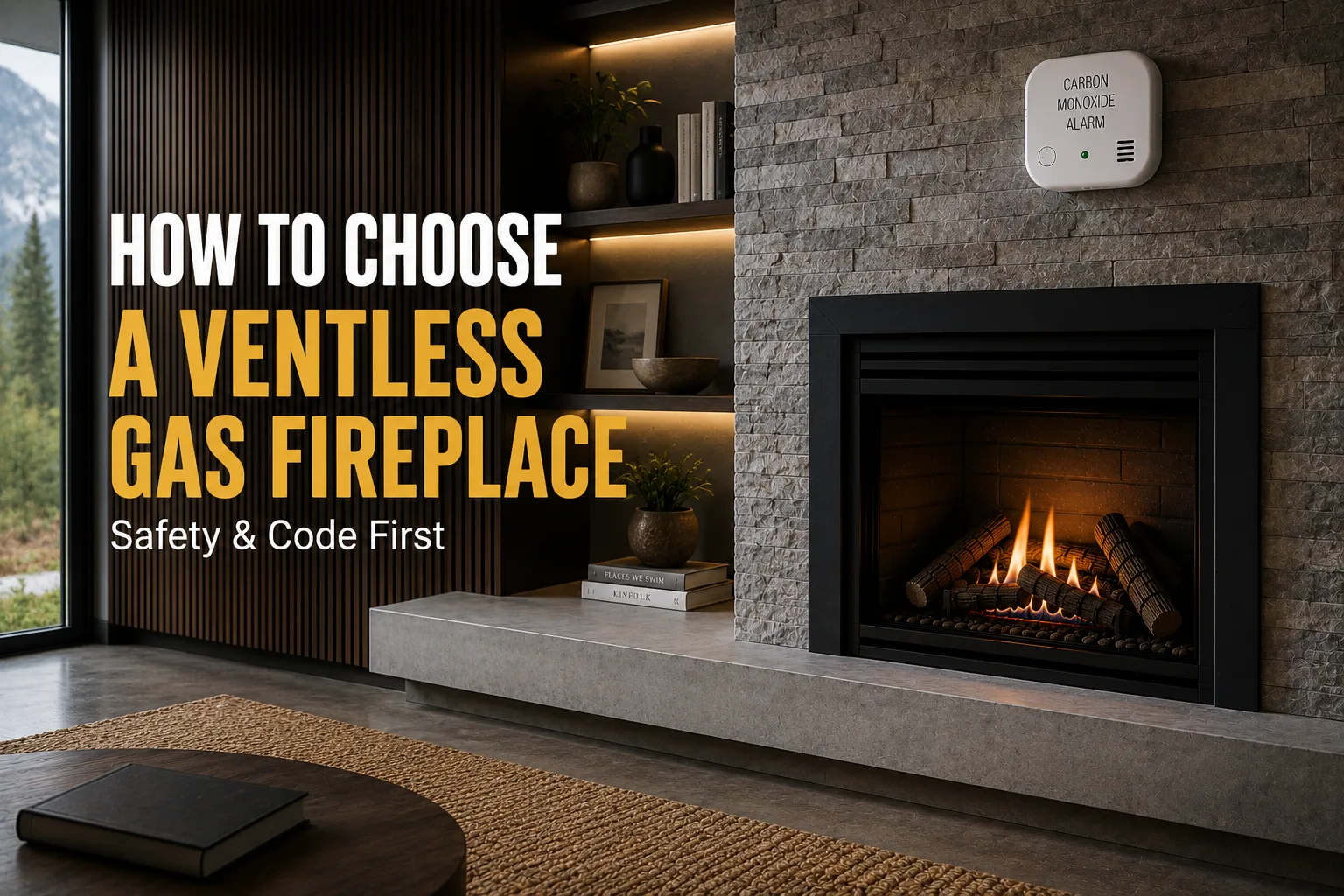
Choose in this order, because the first steps can end the search before you look at a single product page. Find out whether unvented gas appliances are permitted at your address. Let the room’s volume set the maximum input rating you are allowed to install. Confirm the unit is listed to ANSI Z21.11.2 and carries an oxygen depletion safety shutoff. Settle natural gas or propane. Then hire a licensed gas fitter. Knowing how to choose a ventless gas fireplace is mostly knowing which parts of the decision are already made for you. A working carbon monoxide alarm is a condition of running one, not an accessory.
This page assumes you have already decided the category. If you are still weighing a burning appliance against a plug-in one, read our comparison of ventless gas against electric fireplaces first, because that decision changes everything below it.
We have never installed, lit or burned one of these appliances, and we do not claim to have. Everything here comes from published code text, product standards and government agency documents, each named where it is used, with the date we read it. We publish no rankings, no picks and no prices on this subject.
Step 1: legality, before anything else
Vent-free gas appliances are not a nationally uniform product. They are permitted in much of the United States, restricted in some places and prohibited outright in others, and the answer is set by the code your state, county or city has adopted and amended, not by whether a retailer will ship to your ZIP code.
Two concrete examples, both read on September 2, 2026. California Health and Safety Code section 19881 states that “no person shall sell, or offer for sale, any new or used unvented heater that is designed to be used inside any dwelling house or unit, with the exception of an electric heater, or decorative gas logs for use in a vented fireplace.” New York City is stricter still at the installation end: section 621.1 of the New York City Fuel Gas Code 2022 reads “the installation of unvented room heaters is prohibited,” and section 903.3 of the New York City Mechanical Code 2022 reads “the installation of unvented gas-fired space heaters, gas stoves, gas logs, gas fireplaces and gas fireplace inserts is prohibited.”
Neither of those tells you anything about your own address. A statewide rule in one state says nothing about the next state, a city can be stricter than the state around it, and a state can amend a model code in either direction. Your building department and the authority having jurisdiction decide, and they are the only source that counts. Start with our overview of where vent-free appliances are banned or restricted, then follow the process in how to check your local code before you buy. Buying an appliance your jurisdiction prohibits is how a purchase turns into a failed inspection and an order to remove it.
Carbon monoxide comes before the shopping list
A vent-free appliance burns fuel in the room and releases the products of that combustion into the same room. That is the definition of the category, not a defect.
The US Consumer Product Safety Commission describes carbon monoxide as the “Invisible Killer” because it is “a colorless, odorless, poisonous gas,” and reports that more than 200 people in the United States die every year from accidental non-fire carbon monoxide poisoning associated with consumer products (CPSC Carbon Monoxide Information Center, read September 2, 2026). The Environmental Protection Agency lists “unvented kerosene and gas space heaters, woodstoves, fireplaces, gas stoves” as sources of combustion products, and names “carbon monoxide, nitrogen dioxide, particles” among what they release (EPA, Sources of Combustion Products, read September 2, 2026).
A working carbon monoxide alarm is a condition of operating this appliance. Put it in service before the first burn, keep it powered, and follow the alarm manufacturer’s instructions and CPSC guidance for where alarms belong in a home. Our page on carbon monoxide alarms and vent-free fireplaces covers the requirement in full.
The oxygen depletion sensor is not a carbon monoxide detector
This is the most misrepresented component in the category, and the code text settles it.
Section 621.6 of the 2021 International Fuel Gas Code reads: “Unvented room heaters shall be equipped with an oxygen-depletion-sensitive safety shutoff system. The system shall shut off the gas supply to the main and pilot burners when the oxygen in the surrounding atmosphere is depleted to the percent concentration specified by the manufacturer, but not lower than 18 percent” (read on UpCodes, September 2, 2026).
Read what that device measures. It measures oxygen in the room and closes the gas valve at a set point. It is not looking for carbon monoxide, it does not measure carbon monoxide, and it will not alert you to carbon monoxide. The only claim it makes is the one in its listing.
The set point is worth sitting with. For context, OSHA’s respiratory protection standard, 29 CFR 1910.134(b), defines an oxygen deficient atmosphere as “an atmosphere with an oxygen content below 19.5% by volume” (read September 2, 2026). That is a workplace rule and not a residential requirement, and we are not presenting it as one. It does show that the floor the code sets for a shutoff sits below a threshold another federal agency already calls deficient. The sensor is a last-line device, not a ventilation strategy. There is more detail in our page on what the oxygen depletion sensor actually does.
Step 2: the room sets the maximum unit, and the number is in the code
Here is the part the buying guides skip. Sizing advice circulates in this category as a rule of thumb, usually some quantity of BTU per square foot, and in our search of the ranking pages on September 2, 2026 we could not find one that named the standard or code section it came from. The real constraint is not a rule of thumb, and it is not measured in square feet.
Three published limits do the work, all from the 2021 International Fuel Gas Code as read on UpCodes on September 2, 2026:
| Code section | What it says |
|---|---|
| 621.3 Input rating | “Unvented room heaters shall not have an input rating in excess of 40,000 Btu/h (11.7 kW).” |
| 621.5 Room or space volume | “The aggregate input rating of all unvented appliances installed in a room or space shall not exceed 20 Btu/h per cubic foot (207 W/m3) of volume of such room or space.” |
| 304.5.1 Standard method | Indoor combustion air volume of “50 cubic feet per 1,000 Btu/h” of appliance input rating. |
Notice that the last two are the same ratio written two ways. Fifty cubic feet per 1,000 Btu/h is 20 Btu/h per cubic foot. The room’s volume, not its floor area, is what caps the appliance.
The arithmetic that follows is arithmetic, not a recommendation. A room measuring 12 feet by 15 feet with an 8 foot ceiling holds 1,440 cubic feet. At 20 Btu/h per cubic foot that room’s aggregate ceiling is 28,800 Btu/h for all unvented appliances in it, which is below the 40,000 Btu/h product cap. So in a room that size the room is the binding limit, not the standard.
Two things keep that honest. The manufacturer’s installation manual for the specific model, and your locally adopted and amended code, govern over any general figure, and either can be stricter. And how volume may be counted when a room opens into another space is a determination for the installer and the code official, not a calculation to make from a web page. Take your dimensions to the dealer and to your building department, and ask them to confirm the permitted input rating in writing.
Step 3: read the listing, not the marketing
Section 621.1 of the same code requires that “unvented room heaters shall be listed in accordance with ANSI Z21.11.2 and shall be installed in accordance with the conditions of the listing and the manufacturer’s instructions.”
That gives you a specific question for any unit you are considering: is it listed to ANSI Z21.11.2, and does its manual describe your intended installation? A listing is a statement that the appliance met a defined test standard. It is not a statement that the appliance is suitable for every room, that the air in your home will be fine, or that your jurisdiction permits it. Any safety claim beyond what the listing and the manual state is a marketing claim. If a product page tells you an appliance is safe for continuous or unattended use and the manual does not say so, believe the manual.
Bedrooms and bathrooms: the answer is no, and the exception is not yours to grant
Section 303.3 of the 2021 International Fuel Gas Code prohibits appliances in “sleeping rooms, bathrooms, toilet rooms, storage closets or surgical rooms, or in a space that opens only into such rooms or spaces,” subject to a short list of exceptions. Two of those exceptions cover a single wall-mounted unvented room heater with an input rating not greater than 6,000 Btu/h in a bathroom, and not greater than 10,000 Btu/h in a bedroom, each subject to volume criteria (read September 2, 2026).
Those exceptions describe small wall-mounted heaters approved by a code official. They are not a description of the decorative fireplace most people are shopping for, and they are not something a homeowner self-certifies. We do not tell readers a vent-free unit is safe in a bedroom or a bathroom. Our page on vent-free fireplaces in bedrooms sets out the prohibition and the narrow exception in full.
Step 4: fuel, conversion, and where this stops being your job
Natural gas and propane units are built and orificed differently, and the fuel available at your property narrows the model list before anything else about the product does. Some units are sold as dual fuel or with a conversion kit.
Stop here. Connecting an appliance to a gas supply, and converting an appliance between natural gas and propane, is licensed work. It is done by a licensed gas fitter or a qualified hearth technician, working to the manufacturer’s instructions, under whatever permit and inspection your jurisdiction requires. We publish no gas connection procedure, no conversion procedure and no installation walkthrough, at any level of detail, and a retailer who implies this is a homeowner job is telling you something about the retailer. Ask your building department whether the installation needs a permit and an inspection, and get the installer’s license number before work starts.
What water vapor does to the room
Combustion produces water, and with no flue that water stays indoors. The US Department of Energy’s Building America Solution Center guide on unvented combustion appliances states that “these products produce 1 gallon of water vapor for every 100,000 Btus, so a 30,000-Btu appliance would release nearly 1 gallon of water vapor for every 3 hours of operation” (read September 2, 2026). The same guide notes that “the National Fuel Gas Code prohibits the installation of ventless combustion heaters in bathrooms or bedrooms,” and records that building scientists recommend unvented appliances never be installed in homes.
We are quoting that last position because leaving it out would misrepresent the state of expert opinion. It is a real and well-supported view, it is not the same thing as a code prohibition, and readers deciding on this category deserve to know it exists.
What nobody selling one will tell you
It cannot be your only heat. Section 621.2 of the 2021 International Fuel Gas Code reads: “One or more unvented room heaters shall not be used as the sole source of comfort heating in a dwelling unit.”
The ventilation standard your house is designed around has been moving against the category. In 2021, an ASHRAE committee released for public review a proposed addendum to Standard 62.2 that would prohibit the installation of unvented combustion space heaters within dwelling units, on the stated basis that unacceptable concentrations of combustion products can be generated at the ventilation rates the standard allows. We could not confirm the final approval status of that addendum as of September 2, 2026, so treat it as a proposal under review rather than a rule. It is still worth knowing which direction the technical committees are moving.
The efficiency figure is a fuel figure, not an air-quality figure. A vent-free burner keeps its heat in the room because it keeps everything else in the room too.
Nobody can tell you your house is tight or leaky from a distance. The same appliance in the same size room behaves differently in a newly built airtight house than in an old drafty one, which is exactly why the code defers to the installation manual and the code official.
How to choose a ventless gas fireplace, in order
- Ask your building department whether unvented gas room heaters and decorative appliances are permitted at your address, and whether a permit and inspection are required. If the answer is no, stop. There is nothing further to choose.
- Measure the room’s volume in cubic feet and take that number, with your local code, to the dealer and the building department to confirm the permitted input rating.
- Rule out any bedroom, bathroom, toilet room or storage closet, and any room that opens only into one of those.
- Shortlist only units listed to ANSI Z21.11.2 whose manuals cover the installation you intend.
- Confirm the fuel at your property, and never plan a fuel conversion as a homeowner task.
- Put a working carbon monoxide alarm in service before the first burn.
- Book a licensed gas fitter or a qualified hearth technician, and confirm the permit and inspection.
What we checked, and when
All read September 2, 2026: 2021 International Fuel Gas Code sections 303.3, 304.5.1, 621.1, 621.2, 621.3, 621.5 and 621.6, as published on UpCodes; California Health and Safety Code section 19881, via California Legislative Information; New York City Fuel Gas Code 2022 section 621.1 and New York City Mechanical Code 2022 section 903.3, as published on UpCodes; CPSC Carbon Monoxide Information Center; EPA, Sources of Combustion Products; OSHA 29 CFR 1910.134(b); US Department of Energy Building America Solution Center, Unvented Combustion Appliances. Codes are amended and adopted locally, so verify the edition in force where you live.
Frequently asked questions
Is a ventless gas fireplace legal where I live?
It depends entirely on your address. California Health and Safety Code section 19881 prohibits the sale of unvented heaters for use inside a dwelling, with narrow exceptions, and the New York City Fuel Gas Code section 621.1 states that the installation of unvented room heaters is prohibited. Other jurisdictions permit them under the model code with conditions. Your building department and the authority having jurisdiction are the only reliable answer, and a retailer shipping to your area proves nothing.
Does the oxygen depletion sensor mean I do not need a carbon monoxide alarm?
No. The oxygen depletion safety shutoff required by section 621.6 of the International Fuel Gas Code monitors oxygen concentration in the room and shuts off the gas at the manufacturer’s set point, which may not be lower than 18 percent. It does not measure carbon monoxide and makes no claim to. A working carbon monoxide alarm is a separate device and a condition of operating the appliance.
What size vent-free unit can I put in a 300 square foot room?
Square feet is the wrong unit. Section 621.5 of the 2021 International Fuel Gas Code limits the aggregate input rating of all unvented appliances in a room to 20 Btu/h per cubic foot of that room’s volume, and section 621.3 caps any unvented room heater at 40,000 Btu/h. Multiply length by width by ceiling height, then confirm the result against the specific model’s installation manual and your locally adopted code with your building department.
Can I install a vent-free fireplace or convert it to propane myself?
No. Gas connection and fuel conversion are licensed work for a licensed gas fitter or a qualified hearth technician, performed to the manufacturer’s instructions and under any permit and inspection your jurisdiction requires. We publish no procedure for either, and we do not treat this as a homeowner task at any skill level.
Can a vent-free fireplace be the only heat in the house?
Not under the model code. Section 621.2 of the 2021 International Fuel Gas Code states that one or more unvented room heaters shall not be used as the sole source of comfort heating in a dwelling unit. Treat the appliance as supplemental heat for one room, and design your heating around something else.