
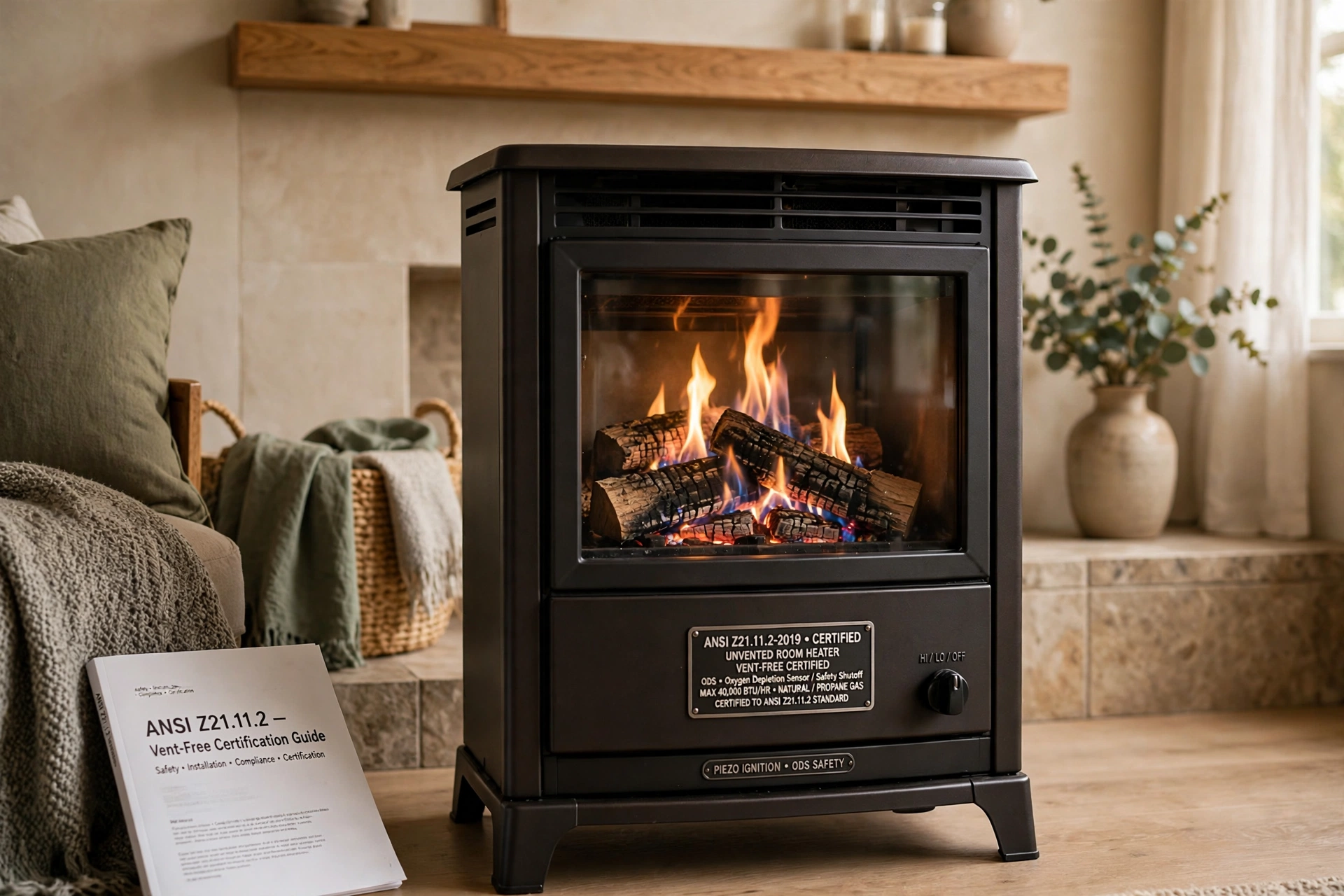
A certification mark on a vent-free appliance means one thing: a certification organization tested that product against a named standard and publishes it as meeting that standard, with periodic inspection of production. For unvented gas room heaters the standard is CSA/ANSI Z21.11.2, “Gas-fired room heaters, volume II, unvented room heaters”. It is a statement about a tested appliance. It is not a statement that the appliance is legal at your address, suitable for your room, or safe to run wherever you like.
Those last three are decided by your jurisdiction, your room’s volume and the manufacturer’s installation manual. A listing that says nothing about them is not a weak listing. It is a listing being read for something it never claimed.
Legality comes first and is local. Read our overview of whether vent-free fireplaces are legal and take the question to your own building department before you weigh any label. A certified appliance is still an appliance your city can prohibit.
We have never installed, lit or burned one of these appliances. This page is built from published code text, standards catalogue records and federal agency documents, named where used. The standard itself is sold rather than published free, and we have not read its clauses. Where a detail lives inside the standard, we say that the label and the manual carry it and that yours is the copy to read.
Why the code cares about the label
Section 621.1 of the 2021 International Fuel Gas Code states that “unvented room heaters shall be listed in accordance with ANSI Z21.11.2 and shall be installed in accordance with the conditions of the listing and the manufacturer’s instructions” (read September 7, 2026).
Read the second half as carefully as the first. The code does not simply require a certified appliance. It requires the appliance to be installed within the conditions its certification was granted under, which is why the manual is a legal document here and not a suggestion. A listed appliance installed outside its listed conditions is not a listed installation, and that is the sentence an inspector applies.
What the standard is, and which edition
| Designation | CSA/ANSI Z21.11.2 |
| Title | Gas-fired room heaters, volume II, unvented room heaters |
| Edition current in the publishers’ catalogues when we checked | 2019, the twenty-ninth edition, listed by CSA Group as Z21.11.2:19 with a 2024 reaffirmation |
| Published by | CSA Group, as an American National Standard |
| Scope, as summarized in those catalogue records | Newly produced gas-fired unvented room heaters for connection to the house fuel supply, with input ratings up to and including 40,000 Btu/hr, with bedroom-suitable heaters at 10,000 Btu/hr or less and bathroom-suitable heaters at 6,000 Btu/hr or less |
Two cautions on that table. It is drawn from the ANSI and CSA Group catalogue records checked on September 7, 2026, not from the standard’s own text. And the edition your jurisdiction enforces may not be the current one, because a code adopts a standard by reference at a point in time. Standards editions and adopted codes both move, which is why our page on how vent-free law and code change exists and why a certification claim needs a date attached.
What “listed” and “labeled” mean in code language
The model codes define both words, and the definitions are less impressive than the marketing use of them. A labeled product carries “a label, seal, symbol or other identifying mark of a nationally recognized testing laboratory, approved agency or other organization concerned with product evaluation that maintains periodic inspection of the production” of those products, “and whose labeling indicates either that the equipment, material or product meets identified standards or has been tested and found suitable for a specified purpose”. A listed product is one “included in a list published by an organization acceptable to the building official”, where that organization maintains periodic inspection of production and states that the product meets identified standards or has been tested for a specified purpose. Both definitions were read in a section 202 definitions chapter on UpCodes on September 7, 2026.
Notice what carries the weight: a named organization, a named standard, and ongoing inspection of production. Nothing in either definition is an opinion about your home.
Who does the certifying
The organizations whose marks appear on gas appliances sold in the United States operate under a federal recognition scheme. The Occupational Safety and Health Administration runs the Nationally Recognized Testing Laboratory program and publishes a page for each recognized laboratory, including CSA Group, Intertek Testing Services NA and UL (OSHA NRTL program pages, read September 7, 2026).
For your purposes, the mark on the plate should name an organization you can look up, next to a standard you can look up. If a product page says “ANSI certified” with no organization named, that is a claim with nothing behind it until the plate confirms it. Certification organizations publish directories of the products they certify, and a manufacturer can tell you which organization holds the listing for a specific model.
What the listing does not certify
- That the appliance is legal where you live. Some states, counties and cities restrict or prohibit unvented gas appliances outright, and the rules for Canada differ from the United States entirely, which our page on vent-free fireplaces in Canada covers.
- That it is right for your room. The code’s room volume limit and the manual’s conditions decide that, not the mark.
- That your indoor air will be fine. A listing is a product test, not an air quality measurement in your living room.
- That a bedroom or bathroom installation is available to you. Those locations are prohibited by the code subject to narrow exceptions granted by a code official for small wall-mounted heaters, and a certification mark does not grant them.
- That the oxygen depletion safety shutoff watches for carbon monoxide. It does not, as our page on what the oxygen depletion sensor does explains. A working carbon monoxide alarm is a condition of operating one of these appliances.
- That the appliance still matches its listing after someone modified it. A fuel conversion performed with anything other than the manufacturer’s own listed kit, by anyone other than a qualified trade, puts the appliance outside the conditions the code requires it to be installed under.
How to check a specific unit before you buy
- Ask the retailer for a photograph of the data plate and the installation manual for that exact model.
- On the plate, find the standard named and the certification organization. Both should be there, and both should be legible.
- Confirm the fuel on the plate matches the gas at your property.
- Confirm the input rating on the plate against the room volume limit your jurisdiction has adopted, with your building department.
- Read the manual’s conditions of installation, because those conditions are part of what was certified.
Our guide to choosing a vent-free gas fireplace sets those steps in the order that avoids wasted money. Installation itself is licensed work for a licensed gas fitter or a qualified hearth technician, under whatever permit and inspection your jurisdiction requires, and we publish no installation or conversion procedure at any level of detail.
What we checked, and when
2021 International Fuel Gas Code section 621.1, as published on UpCodes, read September 7, 2026, together with sections 303.3, 621.2, 621.3, 621.5 and 621.6 read September 2, 2026. Model code section 202 definitions of “listed” and “labeled”, as published on UpCodes, read September 7, 2026. CSA/ANSI Z21.11.2 catalogue records at ANSI and CSA Group, checked September 7, 2026; the standard text itself is paywalled and was not read. OSHA Nationally Recognized Testing Laboratory program pages for CSA, Intertek Testing Services and UL, read September 7, 2026. Standards editions and adopted codes change, so confirm the edition in force where you live.
Frequently asked questions
What is ANSI Z21.11.2?
It is the American National Standard for gas-fired unvented room heaters, published by CSA Group under the title “Gas-fired room heaters, volume II, unvented room heaters”. The catalogue records we checked on September 7, 2026 list the 2019 edition, the twenty-ninth, as current, with a 2024 reaffirmation. The fuel gas code requires unvented room heaters to be listed in accordance with it and installed within the conditions of that listing.
Does an ANSI Z21.11.2 certification mean a ventless fireplace is safe?
It means the product was tested against that standard and is published as meeting it, with periodic inspection of production. It is not a finding about your room, your ventilation, your jurisdiction or your household. Every unit in this category burns fuel in the room with no flue, which is why the code still limits input rating, still limits input per cubic foot of room volume, still requires an oxygen depletion safety shutoff, and still prohibits these appliances in bedrooms and bathrooms except under narrow exceptions.
Where do I find the certification on a ventless fireplace?
On the appliance’s data plate, which is a permanent label commonly placed inside the control compartment, on a side panel, behind a lower louver or on the back of the unit. It should name the certification organization and the standard. The installation manual repeats the information and states the conditions the appliance was listed under.
Is a unit listed to an older edition of the standard a problem?
Not automatically, and it is not yours to judge. Codes adopt standards by reference at a point in time, so the edition your jurisdiction enforces may be older than the current one. What matters is that the appliance is listed, that the listing is current for that model, and that your building department accepts it. Ask them directly rather than reasoning from an edition year.
What if a seller cannot show me the label?
Treat that as a missing answer rather than a formality. A vent-free appliance whose plate is missing, painted over or illegible cannot be matched to a manual, a standard, a fuel or a conversion history, and none of those can be inferred from the way the unit looks. That is a particular risk with second-hand units and with listings that show only staged photographs.
1 thought on “ANSI Z21.11.2: What a Vent-Free Certification Covers”