
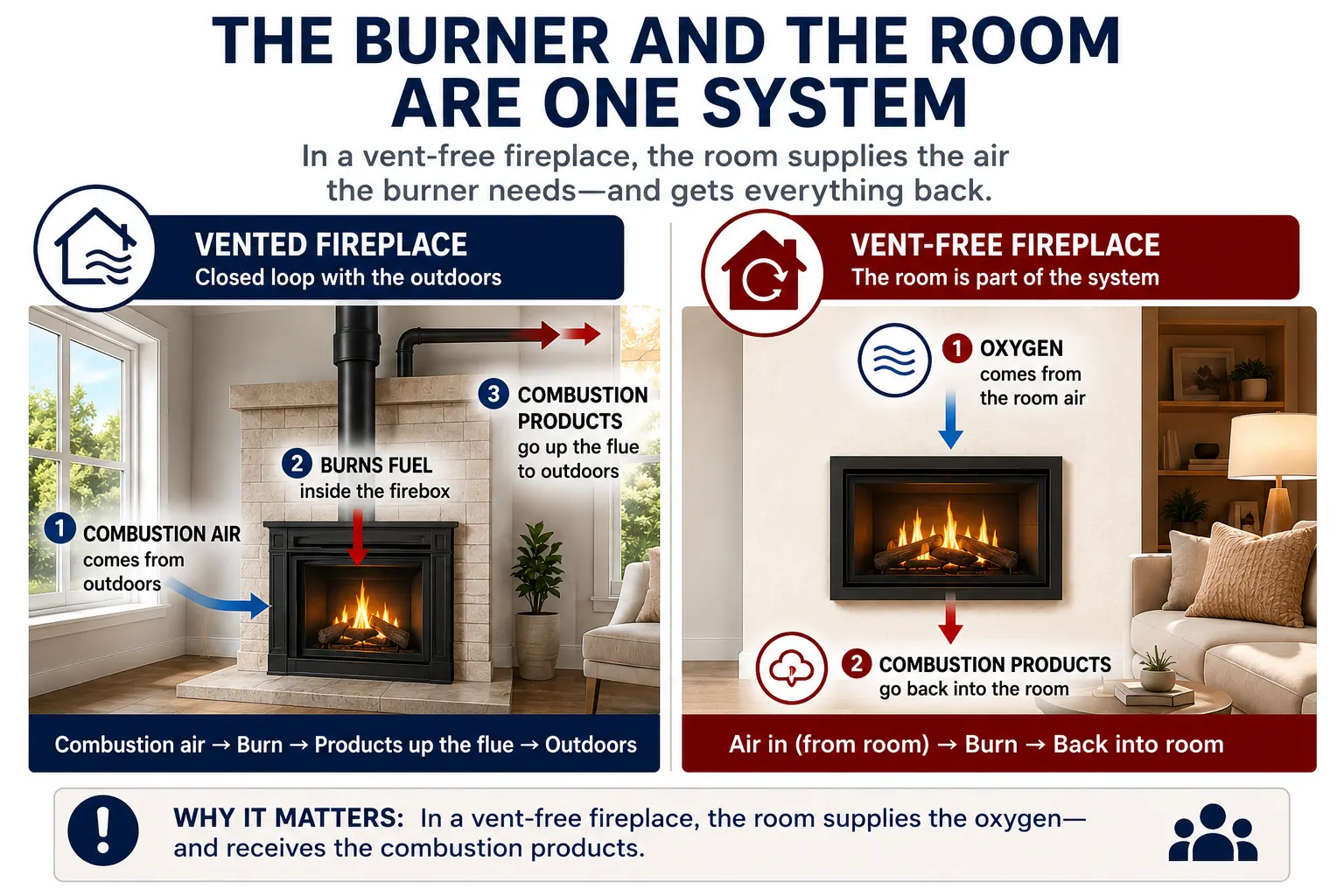
Yes, a vent-free gas fireplace consumes oxygen from the room it is in, because room air is where its flame gets the oxygen to burn. In a room with normal air exchange the draw-down is replaced as fast as it happens. In a small, closed, or tightly built room it is replaced more slowly, and that is the entire concern. Falling oxygen matters for two separate reasons: it affects the people in the room, and it degrades the combustion itself, which is how carbon monoxide gets made.
This page explains the physical process. The sensor built into the appliance to intervene in that process has its own page, because what the sensor catches and what it misses is a different question from what is happening in the air.
The burner and the room are one system
A vented appliance is a closed loop with the outdoors. It takes combustion air, burns it, and pushes the products up a flue. A vent-free appliance has no flue, so both halves of that loop run through your living room: the oxygen comes out of the room, and everything the flame produces goes back into it.
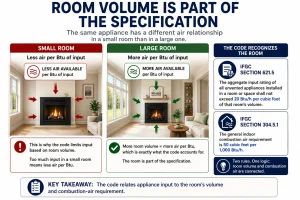
That is why the model fuel gas code does not regulate this appliance by its heat output alone. It regulates it by the size of the room. The 2021 International Fuel Gas Code, Section 621.5, states that “the aggregate input rating of all unvented appliances installed in a room or space shall not exceed 20 Btu/h per cubic foot” of that room’s volume (verified 2026-08-10 via the code text as adopted for the 2021 IFGC). A separate provision, Section 304.5.1, sets the general indoor combustion air requirement at “50 cubic feet per 1,000 Btu/h.”
Read those two rules together and the logic is visible: a fixed appliance in a small box of air is a different appliance than the same unit in a large open one. The room is part of the specification.
What falling oxygen does to the flame
Combustion is a reaction between fuel and oxygen. Given enough oxygen, the reaction runs close to completion and produces mostly carbon dioxide and water vapor. Starve it, and the reaction stops partway, and the partway product is carbon monoxide. This is the link that gets skipped in most content about this category, and it runs in the direction people do not expect.
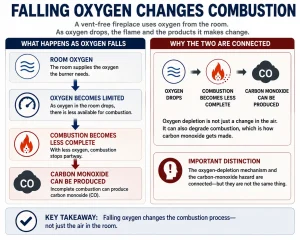
Oxygen depletion is not just a hazard on its own. It is also an input to the carbon monoxide hazard. A room that is exchanging too little air with outside gradually makes the combustion worse, and worse combustion produces more of the thing a low-oxygen sensor is not designed to detect. The full mechanism of that byproduct is covered on what carbon monoxide comes out of a vent-free burner.
That coupling is also why the code’s limit is written against room volume rather than against a comfort rating. It is not a heating rule. It is an air rule.
What the research actually measured
Independent measurement here is thinner than the marketing on either side suggests, but it is not absent. Francisco, Gordon and Rose measured combustion product concentrations in 30 homes using unvented gas fireplaces, sampling at one minute intervals for three to four days per home, and published the results in Indoor Air in 2010 (volume 20, issue 5, pages 370 to 379; abstract verified 2026-08-10).
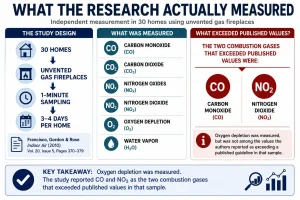
The study measured carbon monoxide, carbon dioxide, nitrogen oxides, nitrogen dioxide, oxygen depletion and water vapor, and compared them against published health-based standards. Its own finding on which of those crossed a guideline is worth quoting exactly: “The two combustion gases that exceeded published values were NO(2) and CO.”
So oxygen depletion was measured and was not among the values the authors reported as exceeding a published guideline in that sample. That is a real finding and it belongs on this page even though it complicates the story. It does not mean depletion is not happening, and it does not describe your room, your unit, or your ventilation. It means the two byproducts that showed up hardest in real houses were the two the sensor on your appliance is not watching for.
Why closed rooms and small rooms change the answer
Nothing above describes a fixed risk level, because the variable is your room’s air exchange rate, and that is not something a web page can know. What can be said is which direction each factor pushes.
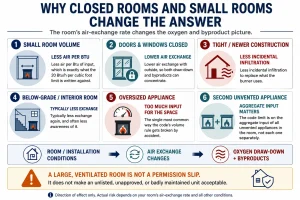
| Condition | Effect on the oxygen and byproduct picture |
|---|---|
| Small room volume | Less air per Btu of input, which is exactly what the 20 Btu/h per cubic foot limit is written against |
| Doors and windows closed | Lower air exchange with outside, so both draw-down and byproducts concentrate |
| Tight or newer construction | Less incidental infiltration to replace what the burner uses |
| Below-grade or interior room | Typically less exchange again, and often less awareness of it |
| Oversized appliance for the space | The single most common way the code’s volume rule gets broken by accident |
| A second unvented appliance in the same space | The code limit is on the aggregate input of all unvented appliances in the room, not each one separately |
None of these is a permission slip in reverse either. A large, ventilated room does not make an unlisted, unapproved, or badly maintained unit acceptable.
Why “crack a window” is the standard advice
Opening a window raises the air exchange rate, which dilutes both the oxygen draw-down and everything the flame produces. That is why it appears on nearly every manufacturer instruction sheet and on fire service guidance. Fairfax County Fire and Rescue’s ventless fireplace page (verified 2026-08-10) tells readers that if a carbon monoxide or ODS alarm sounds, they should “shut down the fireplace, open a window, if possible, get out of the home, and call 911.”
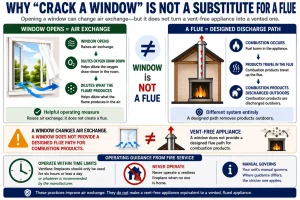
Notice where the window sits in that sentence. It is part of an evacuation sequence, not a substitute for a flue. A window is uncontrolled, weather-dependent ventilation with no minimum performance, and no code section credits an open window as making an unvented appliance equivalent to a vented one.
The same page also states two operating limits worth carrying: “Ventless fireplaces should only be used for six hours or less a day or whatever is recommended by the manufacturer,” and “Never operate a ventless fireplace when no one is home.” Your own unit’s manual governs, and where the two differ, the stricter one applies.
Who feels a change in air first
This site is not going to publish a threshold at which a given person is affected, because the sourced material does not support one and an invented number in this category is worse than silence.
What is well established is that susceptibility is not uniform. The US Environmental Protection Agency, writing about carbon monoxide indoors, notes that effects vary with “age, overall health and the concentration and length of exposure,” and describes effects at low concentrations including “fatigue in healthy people” and “chest pain in people with heart disease” (verified 2026-08-10). For nitrogen dioxide, the other byproduct that showed up in the measurement study, EPA describes low-level exposure as potentially causing “increased bronchial reactivity in some asthmatics” and “increased risk of respiratory infections, especially in young children.”
If someone in the household has a heart or respiratory condition, is pregnant, is an infant, or is elderly, that is a reason to raise the question with a physician and with a licensed installer before running an unvented appliance, not a reason to rely on how the room feels.
Where this leaves the decision
The honest summary is short. Oxygen depletion is a real mechanism, it is real enough that the adopted code sizes the appliance against the room’s cubic feet rather than against comfort, and it is coupled to the carbon monoxide question rather than separate from it. Whether any of that is permitted where you live is a different gate again, and it comes first: start at are ventless fireplaces legal, then read the category verdict on are ventless gas fireplaces safe.
Anything specific to your room, your unit, and your ventilation is a question for your local building department and a licensed installer, who can see the space. This page cannot, and neither can any other.
Frequently asked questions
Will I feel oxygen depletion happening?
Do not plan on it. The EPA’s own description of carbon monoxide effects starts at fatigue in healthy people, which is not a sensation anyone reliably attributes to the room. Awareness is the wrong instrument for this, which is why the appliance carries a shutoff device and why a working carbon monoxide alarm is a condition of running one at all.
Does room size really matter that much?
The adopted code thinks so. It caps the aggregate input of all unvented appliances in a room at 20 Btu/h per cubic foot of that room’s volume, which is a rule about the space rather than about the appliance. Measure the room before you shop, and treat any listing that recommends a unit without asking about your room’s volume as incomplete.
Does this happen with vented fireplaces too?
A vented appliance still consumes oxygen, but it is designed to draw combustion air and discharge its products through a flue rather than into the living space. That structural difference is the entire reason vent-free units carry conditions, room volume limits and a required shutoff device that vented ones do not.
Does the oxygen depletion sensor solve this?
It addresses one pathway, and only one. It responds to oxygen concentration, not to carbon monoxide, and it is not a general air quality monitor. What it does, what it does not do, and why it is still a genuine safety device are covered on the oxygen depletion sensor page.
Can I just run a fan to fix it?
Moving air around inside a closed room does not add outdoor air to it. Anything involving mechanical ventilation, makeup air or whole-house airflow is a licensed design question for a professional, and nothing on this site substitutes for one. See our disclaimer for the limits of what this site does.