
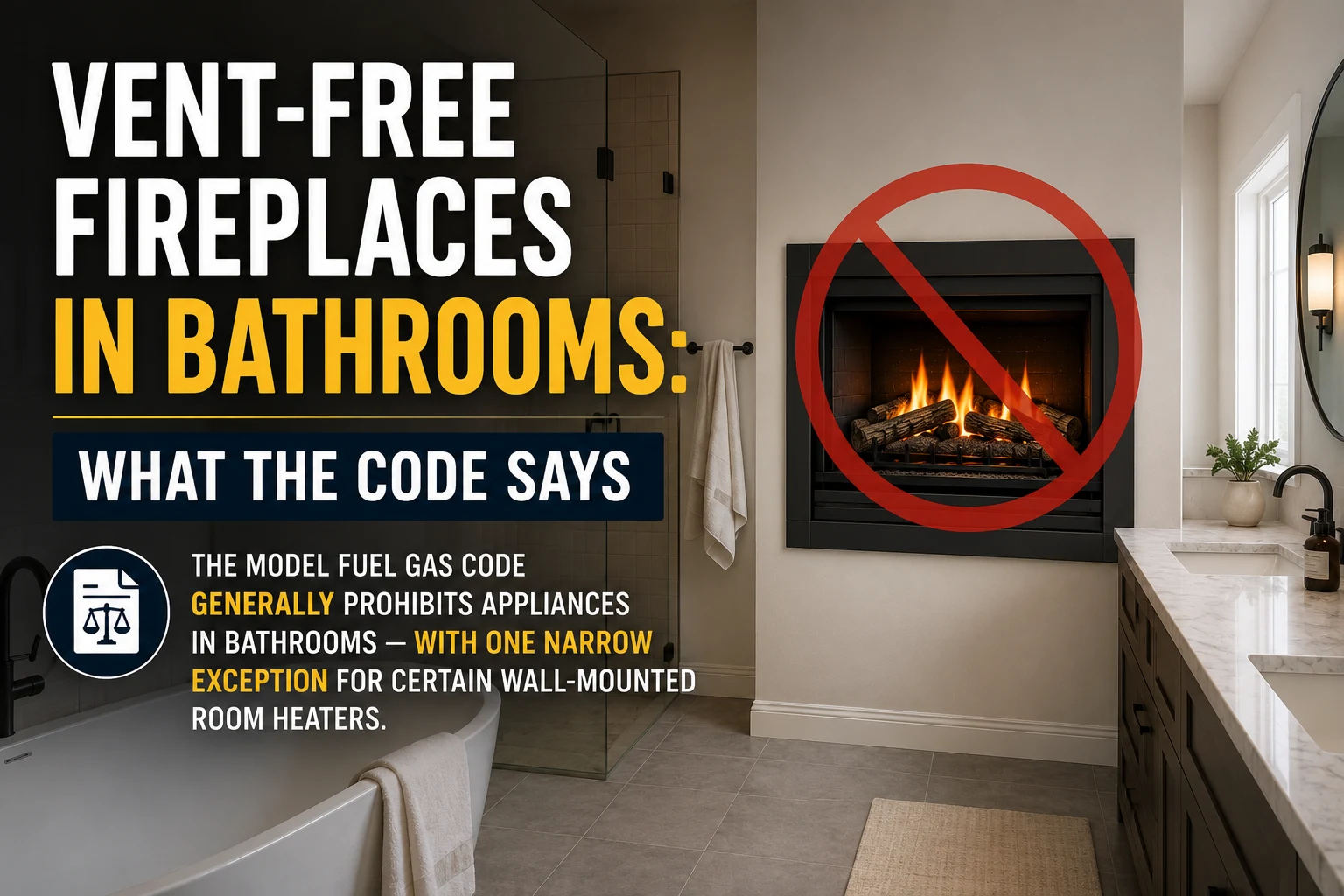
The model fuel gas code prohibits appliances in bathrooms, and then writes one exception: a single wall-mounted unvented room heater rated at 6,000 Btu/h or less, with the required oxygen shutoff, in a bathroom meeting a minimum volume. The exception is real. It is also the tightest one in the section, and it describes a small wall heater rather than the decorative vent-free fireplace or gas log set this site’s readers are usually looking at.
If you have found a 6,000 Btu/h product and a 6,000 Btu/h code line and concluded they match, this page is about the four other clauses in that sentence.
The prohibition and the exception, quoted
The 2021 International Fuel Gas Code, Section 303.3, “Prohibited locations,” states: “Appliances shall not be located in sleeping rooms, bathrooms, toilet rooms, storage closets or surgical rooms, or in a space that opens only into such rooms or spaces, except where the installation complies with one of the following” (code text verified 2026-08-10, cross-checked against a municipal ordinance adopting the 2018 edition with the same language).
Exception 3 is the bathroom case, in full:
“A single wall-mounted unvented room heater is installed in a bathroom and such unvented room heater is equipped as specified in Section 621.6 and has an input rating not greater than 6,000 Btu/h (1.76 kW). The bathroom shall meet the required volume criteria of Section 304.5.”
Note that the prohibition covers the toilet room separately from the bathroom, and covers any space that opens only into either. And note the number: 6,000 Btu/h, against a general ceiling for vent-free units of 40,000 Btu/h under Section 621.3. The bathroom exception is set at roughly a seventh of what the code otherwise allows this appliance category to be.
Five clauses, not one number
The 6,000 figure is the clause that gets quoted and the four around it are the ones that decide the outcome.
| Clause | The test | Common failure |
|---|---|---|
| “A single” | One unvented appliance in that space | Any second unvented appliance in the same room |
| “wall-mounted” | Fixed to the wall | Freestanding units, inserts, log sets |
| “unvented room heater” | The code’s room heater category | A decorative fireplace or log set sold for ambience |
| “equipped as specified in Section 621.6” | Intact oxygen depletion shutoff | A defeated, missing, or adjusted shutoff |
| “volume criteria of Section 304.5” | Enough cubic feet | Most bathrooms |
A decorative vent-free fireplace and a wall-mounted unvented room heater are different appliances in the code’s own vocabulary, even when both are vent-free, both burn gas, and both carry an oxygen shutoff. The exception is written for the heater.
The volume clause is where bathrooms usually fail
Section 304.5.1 gives the standard method for indoor combustion air: “The minimum required volume shall be 50 cubic feet per 1,000 Btu/h” (verified 2026-08-10). Section 621.5 arrives at the same place from the other side, capping the aggregate input of all unvented appliances in a room at 20 Btu/h per cubic foot of that room’s volume.
Apply the code’s own arithmetic to the code’s own bathroom ceiling. A 6,000 Btu/h heater calls for 300 cubic feet of room volume under the standard method. With a standard eight foot ceiling, that is a floor area in the region of 37 or 38 square feet before anything else is considered.
Measure a typical hall bathroom or a powder room against that. Many will not reach it, and a powder room very often will not. This is the clause that quietly disqualifies most of the installations people are picturing, and it is the one no product listing can evaluate, because the seller cannot see your room. Section 304.5.2 allows a different calculation where the air infiltration rate is known, which is a professional’s calculation rather than a homeowner’s.
Why bathrooms are their own case
The code treats bathrooms and sleeping rooms in the same prohibition but gives the bathroom the tighter cap, and the reasons are structural rather than arbitrary.
Bathrooms tend to be the smallest enclosed rooms in a house, which is the volume problem above. They are also the rooms most likely to be closed while occupied, and a closed door lowers the air exchange rate that everything on the oxygen depletion page depends on. Occupancy is frequently solitary, sometimes in a bath, which is the worst combination for anyone noticing a developing problem or acting on it.
There is also water. Combustion produces water vapor along with everything else, and it has nowhere to go in an unvented appliance. The Department of Energy’s Building America Solution Center guidance on unvented combustion appliances states that these products “release significant amounts of water vapor into the air,” and quantifies it: “These products produce 1 gallon of water vapor for every 100,000 Btus” (verified 2026-08-10). Adding vapor to the one room in the house already designed to generate it is not a neutral act, and this site publishes no indoor humidity target of its own to measure it against.
The same DOE guidance gives the plainest general statement in the literature: “Do not install unvented combustion appliances within the conditioned space of the home.”
Reading the rating, not the copy
If a listing says “bathroom safe” or “bathroom rated,” treat that as a claim to check rather than an answer.
The input rating in Btu/h is on the appliance’s data plate and in the manual. That is the number the code is talking about. A headline figure in a product description is not a rating.
The appliance category and mounting decide as much as the number does. If it is not a single wall-mounted unvented room heater, the exception does not apply at any input rating.
The room volume has to be measured, in cubic feet, and compared to the code’s method.
And the local rules govern, because the model code is a template. Jurisdictions adopt it, amend it, and sometimes delete the exception or prohibit the appliance category entirely. One municipal ordinance reviewed for this page keeps both exceptions but adds a carbon monoxide detection requirement referencing the residential code. Use the building department script to get the answer for your address, and see are ventless fireplaces legal for the wider picture.
Clearing all four still is not this site telling you the installation is safe. It means the code text does not immediately exclude it, and the decision belongs to your local building official and a licensed installer standing in the room.
If the goal was a warm bathroom
The goal is reasonable and the appliance is a poor route to it. Every constraint above points the same direction: the smallest room in the house, often the most closed, with the least tolerance for added moisture, is not where an appliance that discharges its combustion products into the room belongs.
Options that either burn nothing in the room or vent their products outside sit outside the prohibition entirely. The code’s own Exception 1 and Exception 2 name direct-vent appliances and vented room heaters and fireplaces as permitted cases, and electric heating raises none of these questions. This site will treat those comparisons on their own pages rather than wave at them here.
Section 621.2 also applies wherever the appliance ends up: “One or more unvented room heaters shall not be used as the sole source of comfort heating in a dwelling unit.” Supplemental is the code’s framing, not a caveat this site added.
Frequently asked questions
Is a 6,000 Btu/h unit automatically bathroom safe?
No. The rating is one clause of five. The appliance must also be a single wall-mounted unvented room heater with an intact Section 621.6 oxygen shutoff, and the bathroom must meet the volume criteria of Section 304.5, which is where many bathrooms fail. Local amendments then apply on top of all of it, and this site does not tell any reader that a specific installation is safe.
Does the exception apply to a decorative log set or a vent-free fireplace?
The exception’s own words are “a single wall-mounted unvented room heater.” A log set laid in a firebox and a freestanding or insert-style fireplace are not that appliance in the code’s vocabulary, regardless of input rating. That is the single most common misreading of this section.
What about a half bath or powder room?
The volume clause makes those the hardest cases, not the easiest. A 6,000 Btu/h appliance calls for 300 cubic feet under the standard method, which many powder rooms do not have. The code also names toilet rooms separately in the prohibition, and covers spaces that open only into such rooms.
Is a bedroom easier than a bathroom?
The bedroom exception is written at 10,000 Btu/h rather than 6,000, but it has the same five-clause structure and the same traps, and the sleeping-occupant rationale is if anything sharper. That case is covered on ventless fireplace in a bedroom.
Will an exhaust fan satisfy the requirement?
Nothing in the exception credits an exhaust fan. The clauses are about the appliance, its shutoff, and the room’s volume. Anything involving mechanical ventilation or makeup air is a design question for a licensed professional, and our disclaimer sets out the limits of what this site does.
Where does this leave the category overall?
The honest verdict, with the commercial incentives on both sides named, is on are ventless gas fireplaces safe.