
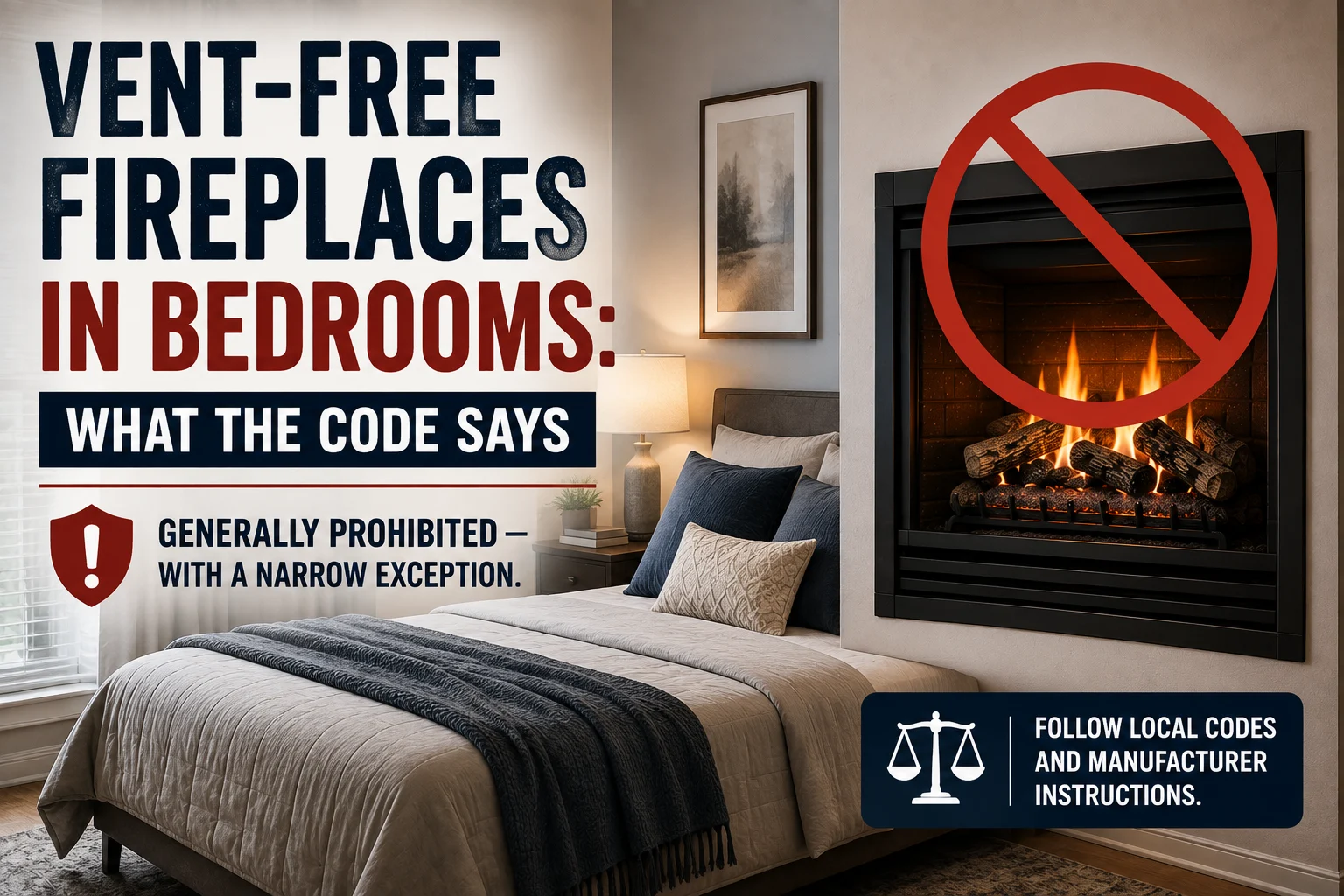
The model fuel gas code prohibits appliances in sleeping rooms. There is one narrow written exception, and it describes a single wall-mounted unvented room heater rated at 10,000 Btu/h or less with a required oxygen shutoff and a minimum room volume. It does not describe the decorative vent-free fireplaces and gas log sets this site’s readers are shopping for, and nothing on this page should be read as telling any reader that a vent-free fireplace is acceptable in their bedroom.
The cold bedroom problem is real. The answer to it is not this appliance.
The prohibition, in the code’s own words
The 2021 International Fuel Gas Code, Section 303.3, “Prohibited locations,” begins: “Appliances shall not be located in sleeping rooms, bathrooms, toilet rooms, storage closets or surgical rooms, or in a space that opens only into such rooms or spaces, except where the installation complies with one of the following” (code text verified 2026-08-10, and cross-checked against a municipal ordinance adopting the 2018 edition, which carries the same language).
Two features of that sentence get missed. The prohibition covers the sleeping room itself and any space that opens only into it, which catches the walk-in closet and the alcove people assume are a workaround. And the list of exceptions that follows is exhaustive. If an installation is not one of the listed cases, the prohibition simply stands.
The Department of Energy’s Building America Solution Center summarizes the general position for readers who never open a code book: “The National Fuel Gas Code prohibits the installation of ventless combustion heaters in bathrooms or bedrooms” (verified 2026-08-10). The code text is the more precise version, because the exception exists. It is just far narrower than the marketing around it.
The exception, quoted exactly, and what each clause rules out
Here is Exception 4 in full, from the 2021 IFGC Section 303.3:
“A single wall-mounted unvented room heater is installed in a bedroom and such unvented room heater is equipped as specified in Section 621.6 and has an input rating not greater than 10,000 Btu/h (2.93 kW). The bedroom shall meet the required volume criteria of Section 304.5.”
Every clause in that sentence is a filter, and most vent-free fireplaces fail more than one.
| Clause | What it requires | What it excludes |
|---|---|---|
| “A single” | One appliance, not one plus something else | A second unvented appliance anywhere in the same room |
| “wall-mounted” | Mounted on the wall | Freestanding stoves, inserts, and log sets laid in a firebox |
| “unvented room heater” | A room heater, the code’s own appliance category | A decorative fireplace or gas log set sold as an ambience product |
| “equipped as specified in Section 621.6” | The oxygen depletion shutoff, unmodified | Any unit whose safety shutoff has been defeated or is not present |
| “not greater than 10,000 Btu/h” | The data plate input rating, not the box copy | The general vent-free ceiling is 40,000 Btu/h under Section 621.3, four times higher |
| “volume criteria of Section 304.5” | Enough cubic feet of room | A small bedroom, regardless of the appliance |
The word doing the most work is wall-mounted room heater. A decorative vent-free fireplace and a small wall heater are two different appliances in the code’s vocabulary, even when both are vent-free and both burn gas. The exception was written for the second one.
The room volume clause is not a formality
Section 304.5 sets the indoor combustion air requirement, and Section 304.5.1 states the standard method: “The minimum required volume shall be 50 cubic feet per 1,000 Btu/h” (verified 2026-08-10).
Apply the code’s own number to the code’s own ceiling for this exception. A heater at the 10,000 Btu/h limit calls for 500 cubic feet of room volume under that standard method. A separate rule, Section 621.5, caps the aggregate input of all unvented appliances in a room at 20 Btu/h per cubic foot of that room’s volume, which arrives at the same 500 cubic feet from the other direction.
That is a real constraint on a real bedroom, and it is the clause a product listing will never mention, because the seller does not know your room. Note also that Section 304.5.2 permits a different calculation where the air infiltration rate is known, which is a professional’s calculation and not a homeowner’s.
Why sleeping rooms are singled out at all
The rationale is not bureaucratic. Every protection this appliance category relies on assumes an awake occupant.
The required oxygen depletion shutoff responds to falling oxygen and closes the gas valve. It is not a carbon monoxide detector, as its own page sets out, and it does not warn anybody of anything. It stops the fire.
Carbon monoxide itself gives no sensory warning, and its early effects are the ones a sleeping person is least equipped to notice or act on. EPA’s indoor air quality material describes effects at low concentrations including “fatigue in healthy people” and “chest pain in people with heart disease” (verified 2026-08-10). Those are not signals that wake somebody up.
And the byproducts are not limited to carbon monoxide. The one published measurement study of unvented gas fireplaces in real homes, Francisco, Gordon and Rose in Indoor Air, 2010 (volume 20, issue 5, pages 370 to 379; abstract verified 2026-08-10), reported that “the two combustion gases that exceeded published values were NO(2) and CO,” with nitrogen dioxide exceeding its comparison guideline in the larger share of the 30 homes. The nitrogen dioxide page covers what that means for a household with asthma.
A room where people spend seven or eight unconscious hours is the worst possible place for a hazard whose entire signature is that you do not notice it.
What to do if a product listing says “bedroom rated”
Some listings do say it, and some of those units genuinely are wall-mounted room heaters inside the exception’s scope. Most vent-free fireplaces are not. Here is what actually settles it, in order.
Read the data plate, not the listing. The input rating in Btu/h is stamped on the appliance and printed in the manual. Marketing copy is not the rating.
Check the appliance category and mounting. A freestanding stove, an insert, or a log set in a firebox is not a single wall-mounted unvented room heater no matter what its input rating is.
Measure the room, in cubic feet, and compare it against the code’s volume method rather than against how big it feels.
Confirm the local rules, because the model code is a template that jurisdictions adopt and amend. One municipal ordinance reviewed for this page adopts the same two exceptions but adds a carbon monoxide detection requirement referencing the residential code. Yours may amend it differently, or delete the exception entirely, and some jurisdictions prohibit the appliance category outright. The building department script is how to get that answer for your own address, and are ventless fireplaces legal covers the wider legality question.
Finally, remember what none of that establishes. Clearing all four does not mean this site is telling you the installation is safe. It means the specific appliance is not immediately excluded by the code text, and the decision is then between you, your local building official, and a licensed installer who can see the room.
The cold bedroom is a real problem with a different answer
Nothing on this page disputes that a cold bedroom is worth solving. The point is only that the appliance category this site covers is the wrong tool for that particular room, for reasons the code wrote down decades before anyone was shopping online.
The honest alternatives are the ones that either do not burn anything in the room or send their combustion products outside through a flue. Electric options and properly vented gas appliances both sit outside the prohibition in Section 303.3, and the code’s own Exception 1 and Exception 2 name direct-vent appliances and vented room heaters and fireplaces as the permitted cases. This site will cover those comparisons in their own pages rather than gesture at them here.
One more constraint applies regardless of room. Section 621.2 of the same code states that “one or more unvented room heaters shall not be used as the sole source of comfort heating in a dwelling unit.” This appliance is supplemental in the code’s own framing, everywhere in the house.
Frequently asked questions
Is any ventless fireplace safe for a bedroom?
This site does not tell any reader that a vent-free fireplace is safe for a bedroom, and it will not. The code prohibits appliances in sleeping rooms with one narrow exception written for a single wall-mounted unvented room heater at 10,000 Btu/h or less in a room meeting a volume requirement. Whether a specific appliance and a specific room fall inside that exception is a determination for your local building official and a licensed installer, not for a web page.
What does the 10,000 Btu/h exception actually cover?
A single wall-mounted unvented room heater, equipped with the oxygen depletion shutoff required by Section 621.6, with an input rating not greater than 10,000 Btu/h, in a bedroom meeting the volume criteria of Section 304.5. Four conditions, all of which must hold at once. The general ceiling for vent-free units under Section 621.3 is 40,000 Btu/h, so most of the category sits well outside this exception.
My unit is under 10,000 Btu/h. Does that settle it?
No. The input rating is one of four clauses. The appliance still has to be a single wall-mounted unvented room heater with an intact oxygen shutoff, and the room still has to meet the volume criteria. Local amendments then apply on top, and some jurisdictions do not permit the appliance at all.
What about a bathroom instead?
The code writes a separate, tighter exception for bathrooms, capped at 6,000 Btu/h, and it has the same structure and the same traps. That case is covered on ventless fireplace in a bathroom.
Does a carbon monoxide alarm make a bedroom installation acceptable?
No. A working alarm is a condition of operating this appliance anywhere, not a permission for a location the code prohibits. That distinction is the whole subject of a CO alarm is a condition of running one of these.
What if my house already has one in a bedroom?
Stop operating it and get it assessed by a licensed installer and your local building department. This page cannot evaluate an existing installation, and our disclaimer sets out why. The verdict on the category as a whole is on are ventless gas fireplaces safe.