
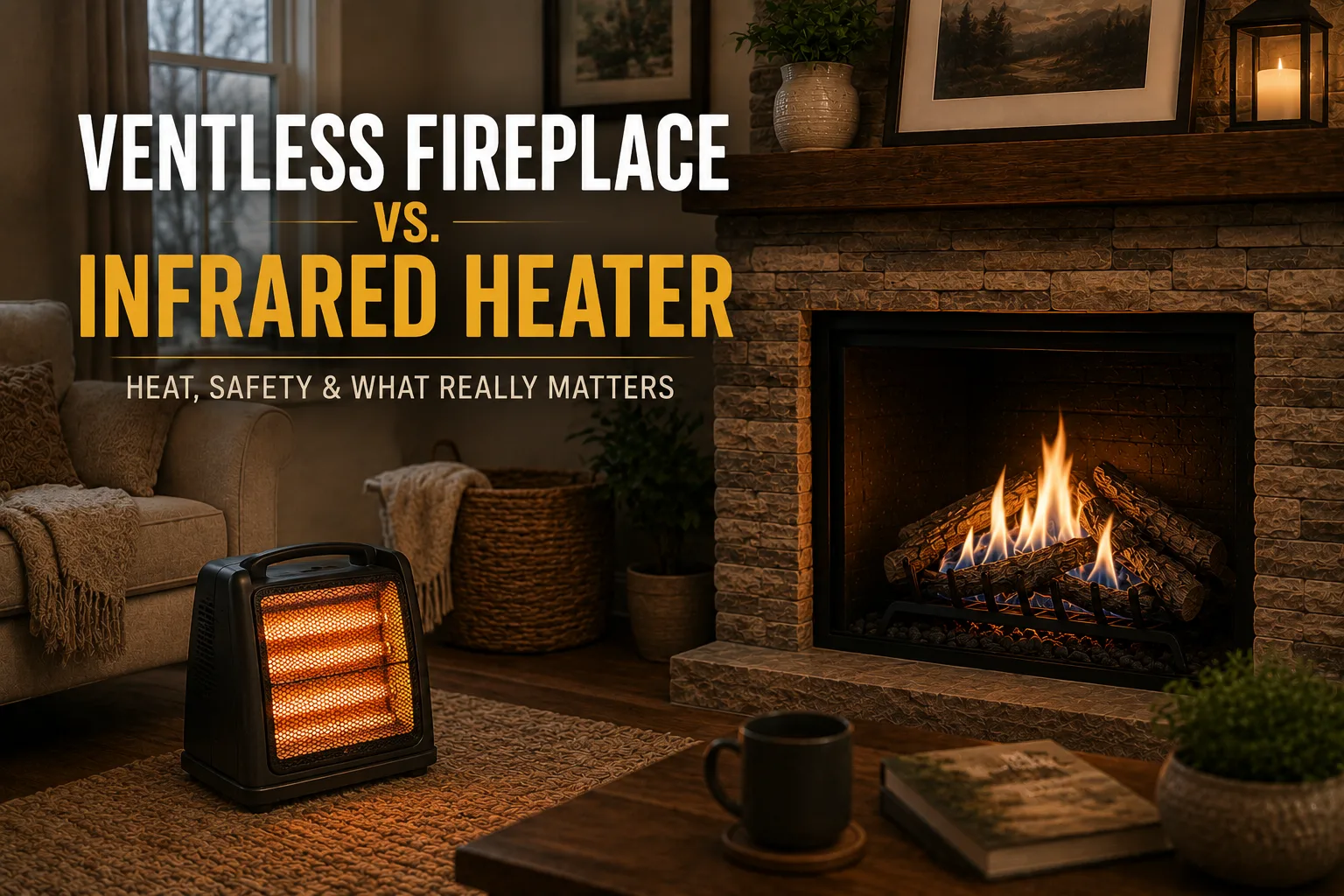
“Infrared” describes how heat travels, not what is burning, and that is why this comparison confuses people. An electric infrared heater has no combustion at all: it converts electricity into radiant heat and adds nothing to your indoor air. A ventless gas appliance burns fuel in the room and releases every combustion product, including water vapor, carbon monoxide and nitrogen dioxide, into that room, and some ventless gas models are themselves sold as “infrared” or “radiant” because of how they emit heat. So the first job is to work out which of three appliances you are actually comparing. Only one of them has a flame, a code question and a legality question.
Ventless fireplace vs infrared heater: three appliances, one word
| Electric infrared heater | Ventless gas infrared (radiant) heater | Ventless gas blue flame heater or fireplace | |
|---|---|---|---|
| What it burns | Nothing | Natural gas or propane | Natural gas or propane |
| How it emits heat | Radiant, from a quartz or ceramic element | Radiant, from heated ceramic plaques | Mostly convective, warming room air |
| Combustion products in the room | None | All of them | All of them |
| Oxygen depletion safety shutoff | Not applicable | Required by the listing standard | Required by the listing standard |
| Legality question | No | Yes, varies by jurisdiction | Yes, varies by jurisdiction |
| Room volume limit in code | None | Yes | Yes |
| Works in a power cut | No | Yes | Yes |
| Heat ceiling | Bounded by the outlet. Most US plug-in heaters are nameplated at 1,500 watts or less | Bounded by the code input limit for unvented room heaters | Same |
The middle column is the one that traps shoppers. Choosing the “infrared” version of a ventless gas heater does not reduce what goes into your air. It changes how the heat reaches you. The combustion is the same combustion.
What radiant heat actually does for you
Radiant energy travels in straight lines and warms the surfaces and people it lands on, rather than warming the air first. Convective heat does the opposite: it heats air, the air circulates, and the room temperature comes up.
That difference is real and you can feel it. In a drafty room, in a garage or workshop, or in a large space where you only occupy one corner, radiant heat gets you comfortable faster because it is not waiting for a volume of air to come up to temperature. In a small, reasonably sealed room where you want the whole space warm and even, a convective heater or a blue flame unit usually gives a more uniform result.
This is a comfort question, not an energy question, and the two get merged constantly in marketing copy.
The efficiency claim, taken apart
Two efficiency claims collide in this comparison, and both are technically true and practically misleading.
“Infrared heaters are more efficient.” Among electric heaters, this cannot mean more heat per kilowatt-hour. The Department of Energy’s Energy Saver guidance on electric resistance heating states that electric baseboard heating is about 100 percent efficient, converting nearly all the electricity into heat, and adds that it is nonetheless a costly way to heat a house (checked 2026-08-18). Every electric resistance heater sits at essentially the same place: the electricity you buy becomes heat in your room. A quartz element does not create more of it than a fan heater does. What infrared can do is deliver perceived comfort sooner and let you heat a person rather than a volume, which can mean running less. That is a usage saving, not a device efficiency.
“Ventless gas is 99.9 percent efficient.” Also true in its own terms, and for a blunt reason: nothing goes up a flue because there is no flue. The exhaust stays with you. We take that number apart in detail in “99.9% efficient”: what that number means and what it hides.
So the fair comparison is not efficiency percentages. It is cost per delivered Btu at your own utility rates, against the constraints of each appliance. Electricity is usually the more expensive fuel per unit of heat in most US markets, which is why gas heating attracts people in the first place, and that is exactly why the safety conditions attached to the gas option deserve full weight rather than a footnote.
The line that actually divides these appliances
Everything above is preference. This is not.
An electric infrared heater does not consume oxygen from your room, does not produce carbon monoxide, does not add nitrogen dioxide, and does not add water vapor. Its risk is fire, and that risk is managed by clearance from combustibles, a stable surface, plugging directly into a wall outlet, and turning it off when you leave the room or sleep.
A ventless gas appliance, radiant or blue flame, carries all of the following, and they are conditions rather than recommendations:
- A working carbon monoxide alarm, treated as part of the appliance. Carbon monoxide is colorless and odorless. The CPSC recommends CO alarms in the home and publishes placement guidance, which we point to in CO alarms and vent-free fireplaces.
- An oxygen depletion safety shutoff, which is not a CO detector. The code text requires the shutoff to act when oxygen in the surrounding atmosphere is depleted to the concentration set by the standard, not lower than 18 percent (2024 International Residential Code section G2445.6, as published on UpCodes, checked 2026-08-18). What it does and does not do is in the ODS explained.
- A room big enough under your adopted code. The same code section limits the aggregate input of unvented appliances in a room or space to 20 Btu/h per cubic foot, and caps an unvented room heater’s input at 40,000 Btu/h.
- Not in a bedroom or a bathroom, by default under adopted codes.
- A legality check for your own address, because the category is restricted or prohibited in some jurisdictions. Your building department or fire marshal, your state’s adopted code and your gas utility are the authorities, not a retailer’s product page.
- Licensed gas work. We publish no installation or gas connection procedure.
The full account is in are ventless gas fireplaces safe, an honest answer.
Why we will not print a square-foot coverage figure, and neither should anyone else
Product listings on both sides of this comparison advertise coverage: heats up to a given number of square feet. Those numbers have no standard behind them.
There is no test method that produces “heats 400 square feet” the way EPA test methods produce grams per hour for a wood stove or the way a nameplate produces an input rating. Coverage claims ignore ceiling height, insulation level, air leakage, window area, outdoor design temperature and how many exterior walls the room has. Two rooms of identical floor area in the same city can need very different amounts of heat.
Notice what the code does instead. It speaks in cubic feet, not square feet, because volume is the physically meaningful quantity for an unvented appliance: 20 Btu/h per cubic foot. That rule gives you something a marketing claim cannot. A 20,000 Btu/h unvented unit requires at least 1,000 cubic feet, which is 20,000 divided by 20. Measure your room in three dimensions, multiply, and you have a real constraint. Whether adjoining spaces count toward that volume is a code judgment for your installer and building official.
For sizing beyond that limit, a licensed HVAC professional doing a load calculation for your house is the only honest source. We are not it, and neither is a product page.
Choosing, in one pass
- A cold spot you occupy for an hour or two, in a rented or shared space: electric infrared. No permit, no gas, no code question, portable, and the whole risk is placement.
- A drafty garage, workshop or sunroom you own: radiant heat suits the space, and whether you go electric or gas turns on whether the gas category is permitted where you live and whether the space meets the volume rule.
- A living room the furnace never quite reaches, with a gas supply available: the ventless gas options are competitive here, and the conditions above apply in full. Compare them with the plug-in alternative in vent-free gas versus a portable electric space heater before choosing.
- Heat for the whole house: none of these. See can a vent-free fireplace be your only heat source, where the model code answers the question directly.
How this page was researched
We have never installed, lit or burned any of these appliances and we make no testing claim. This page draws on Department of Energy Energy Saver guidance for electric resistance heating, the model residential code text for unvented room heaters, the ANSI Z21.11.2 listing requirement that code references, CPSC carbon monoxide guidance, and manufacturer descriptions of radiant and blue flame ventless products, checked 2026-08-18. Where a number had no named authority behind it, we did not print it.
Frequently asked questions
Is an infrared heater better than a ventless gas fireplace?
For short, targeted warmth in a space you occupy briefly, and for any room where you cannot or should not put a gas appliance, yes. For sustained heat in a large living space with a gas supply, the ventless unit puts out far more heat per hour, and it brings combustion products, code limits and a legality question with it.
Are infrared ventless gas heaters safer than blue flame ventless heaters?
No. They are the same category of appliance with a different heat emitter. Both burn fuel in the room, both must carry an oxygen depletion safety shutoff, both fall under the same room volume and location rules, and both require a working carbon monoxide alarm in the home.
Do infrared heaters use less electricity?
They do not produce more heat per kilowatt-hour than any other electric resistance heater. What they can do is make you feel warm sooner and let you heat a person or a corner rather than a whole volume of air, so you may run the heater less. Judge them on that, not on a stated efficiency percentage.
Do electric infrared heaters produce carbon monoxide?
No. They have no combustion, so they produce no carbon monoxide, no nitrogen dioxide and no water vapor. You still want a working CO alarm in the home if any other fuel-burning appliance or an attached garage is present.
How big a room can a ventless heater serve?
Ask it in cubic feet, not square feet. The code limits the aggregate input of unvented appliances to 20 Btu/h per cubic foot of room volume and caps an unvented room heater at 40,000 Btu/h input. Measure the room, check the unit’s rated input on its data plate, and confirm the edition of the code your state has adopted with your building department.