
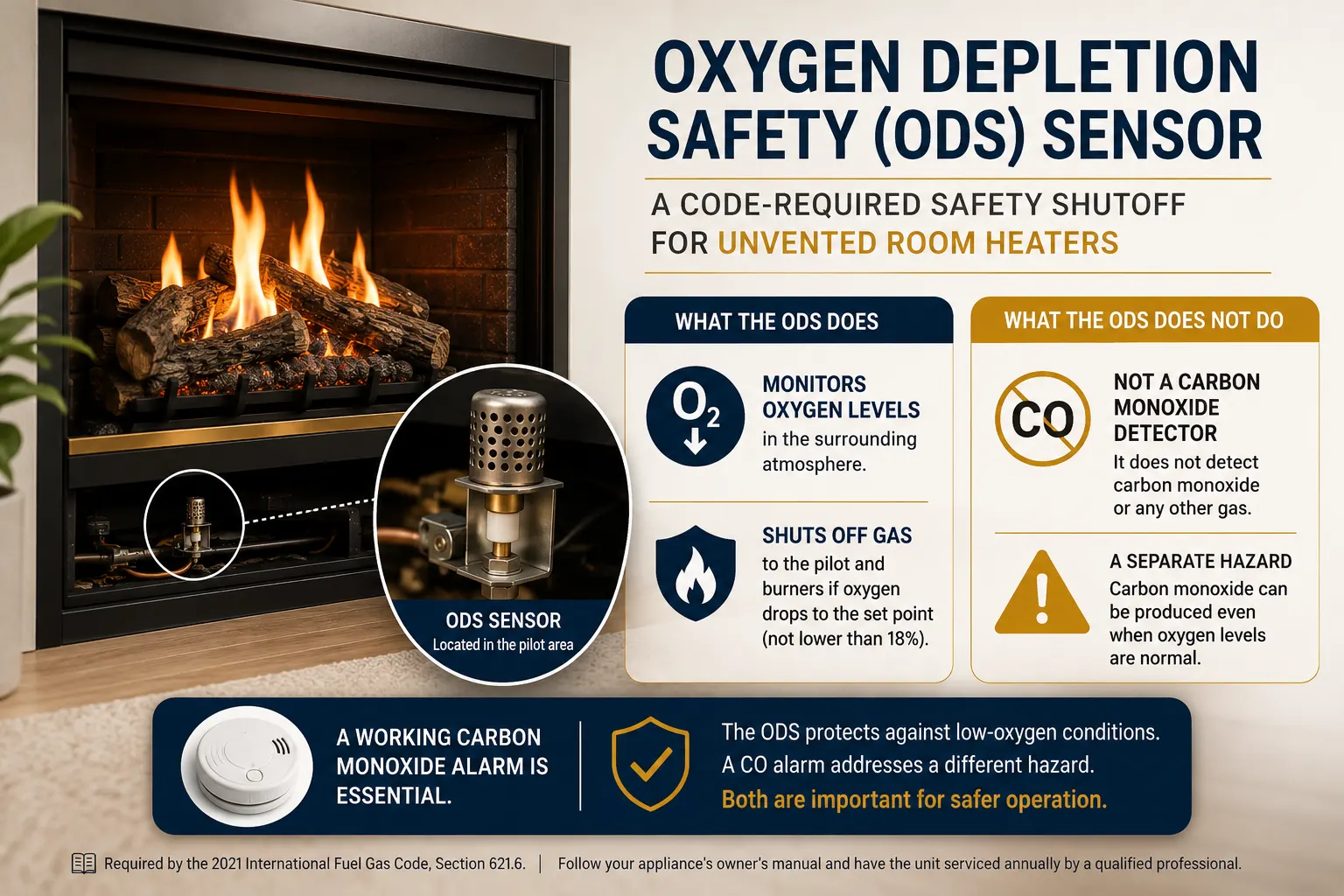
An oxygen depletion sensor is a low-oxygen gas shutoff. It closes the gas supply when the oxygen concentration in the room around the appliance falls to a set point. It is not a carbon monoxide detector, it does not respond to carbon monoxide, and it will not tell you carbon monoxide is present. Both halves of that sentence are true at once: the ODS is a genuine, code-required safety device that addresses a genuine failure mode, and it leaves a different failure mode entirely uncovered.
This is the reference page for how that device works on this site. Every other page here links to it rather than re-explaining it.
What the code actually requires
The requirement is not a manufacturer courtesy. It is written into the adopted model code. The 2021 International Fuel Gas Code, Section 621.6, “Oxygen-depletion safety system,” states that unvented room heaters “shall be equipped with an oxygen-depletion-sensitive safety shutoff system,” and that the system “shall shut off the gas supply to the main and pilot burners when the oxygen in the surrounding atmosphere is depleted to the percent concentration specified by the manufacturer, but not lower than 18 percent” (code text verified 2026-08-10).
Three things follow from reading the sentence closely.
The subject of the measurement is oxygen in the surrounding atmosphere. Not carbon monoxide, not nitrogen dioxide, not smoke.
The set point is the manufacturer’s, with 18 percent as the floor the code will accept, not a single universal trigger number. Your unit’s actual set point is in your unit’s documentation.
And the action is shutting off gas to the main and pilot burners. The device’s entire job is to stop the fire, not to warn you about the air.
The device is sealed against adjustment on purpose
The same code section adds a requirement that gets much less attention than the 18 percent figure: the system “shall not incorporate field adjustment means capable of changing the set point at which the system acts to shut off the gas supply to the room heater.”
That clause exists because a shutoff that an installer or an owner can move is not a shutoff. It also settles a question people ask in forums: there is no legitimate way to raise, defeat, bypass or work around an ODS. Doing so removes the appliance from the listed configuration the code requires under Section 621.1, which states that unvented room heaters “shall be listed in accordance with ANSI Z21.11.2 and shall be installed in accordance with the conditions of the listing and the manufacturer’s instructions.”
A unit whose safety shutoff has been tampered with is not a vent-free fireplace with a modification. It is an unlisted gas appliance, and it should not be operated.
Where the protection stops
The ODS is watching a falling-oxygen pathway. That pathway is real: a burner in a room with too little air exchange gradually works with less oxygen, and the mechanism behind that is covered on oxygen depletion in a closed room.
But there is a second pathway that does not run through room oxygen at all. A burner degraded by deteriorated or displaced logs, the wrong fuel, dust and obstruction, or simple neglect can combust incompletely in a room whose oxygen level is entirely normal. Carbon monoxide produced that way is not preceded by the signal the ODS is built to detect. The device is not defective in that case. It is simply not the instrument for it, and the byproduct mechanism is set out on what carbon monoxide comes out of a vent-free burner.
That gap is the reason this site treats a working carbon monoxide alarm as a condition of running the appliance rather than an accessory, which is the subject of its own page.
What the measurement research suggests about that gap
The gap is not hypothetical. Francisco, Gordon and Rose measured combustion products in 30 homes using unvented gas fireplaces, sampling at one minute intervals over three to four days per home, published in Indoor Air in 2010 (volume 20, issue 5, pages 370 to 379; abstract verified 2026-08-10). The authors compared their measurements to published health-based standards and reported that “the two combustion gases that exceeded published values were NO(2) and CO.”
Neither of those is what an ODS measures. In that sample, oxygen depletion was among the parameters recorded but was not among the values reported as exceeding a published guideline, while the two byproducts that did exceed guidelines were both outside the sensor’s scope. That is the clearest available illustration of what this page is saying: the required device is real and it is not the whole safety system.
The study is one sample of 30 houses and it is not a statement about your house. It is, however, measured data rather than a marketing claim from either side of this argument.
Keeping the sensor able to do its job
An ODS is a physical assembly in the pilot area of the appliance, and physical assemblies collect dust, lint, pet hair and soot. A sensor sitting in debris is a sensor whose response has been changed by something nobody chose.
The practical discipline is short. Follow the cleaning instructions in your own unit’s owner’s manual and nothing else. Have the appliance serviced annually by a qualified professional, who can inspect the pilot and ODS assembly properly. If the pilot behaves differently than it used to, if the unit shuts itself off without an obvious reason, or if anything about the flame has changed, stop using it and have it inspected before running it again.
What not to do is equally short. Do not disassemble the sensor. Do not clean it with anything the manual does not name. Do not attempt any adjustment. This site publishes no gas line, gas connection or burner procedure of any kind, because that is licensed work.
A note on what this page could not verify
Several sources circulating online state a specific year in which the ODS requirement was first introduced into the ANSI standard for this appliance category. This site was not able to open a primary source confirming that date, so no year is asserted here. What is verifiable, and is quoted above from the code text itself, is that the requirement is in force now, that the code sets 18 percent as the floor for the shutoff set point, and that field adjustment of that set point is prohibited.
That is the same discipline applied to every figure on this site. A number that cannot be traced to a document is not published here, and in this category an invented number is not a small error.
Frequently asked questions
Does an ODS mean I do not need a carbon monoxide alarm?
No. The two devices watch different things. The ODS responds to oxygen concentration and shuts off the gas; a carbon monoxide alarm responds to carbon monoxide and warns the people in the building. Neither substitutes for the other, and this site treats a working alarm as a condition of operating the appliance.
How do I know my ODS is working?
Not by testing it yourself. There is no owner-level test that safely proves an oxygen shutoff will trip at its set point, and attempting to create the condition that would trip it is not something to try. Verification belongs in an annual service visit by a qualified technician, who can inspect the pilot and ODS assembly against the manufacturer’s procedure.
Can an ODS be bypassed?
It must not be, and the code section quoted above bars a field-adjustable set point specifically to make that harder. A unit with a defeated safety shutoff is outside the listing that Section 621.1 requires, which means it is no longer the appliance the code permits.
What is the actual trigger percentage on my unit?
The code sets a floor of 18 percent and leaves the specific set point to the manufacturer, so the honest answer is that it is in your unit’s own documentation and this site is not going to guess it. If the documentation is missing, the manufacturer can supply it by model number.
Does the ODS respond to a gas leak?
No. It is an oxygen-sensitive shutoff on a burning appliance, not a fuel gas detector. Treat any gas smell as an emergency, leave the building, and call your gas utility or 911 from outside. See our disclaimer for the limits of what this site does.
Is a unit with an ODS therefore safe?
That question is answered on are ventless gas fireplaces safe, and the short version is that no single device makes a category safe. Whether the appliance is even permitted where you live is a separate gate covered on are ventless fireplaces legal.