
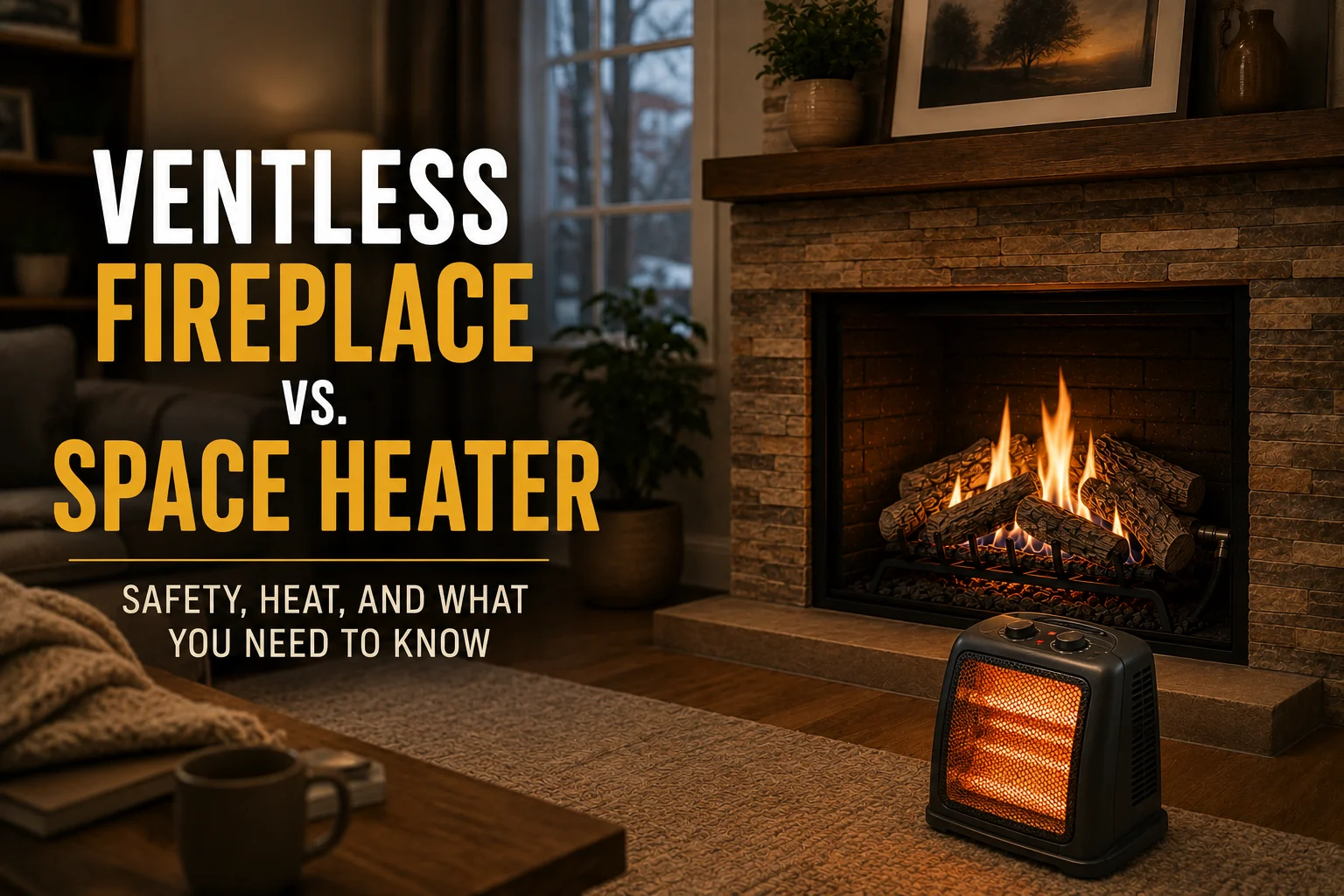
They fail in completely different ways, and that is the comparison worth making. The dominant documented harm from portable electric heaters is fire: NFPA’s home heating fire research attributes the majority of home heating fire deaths to space heaters. The dominant hazard of a ventless gas appliance is that it puts every one of its combustion products, water vapor, carbon monoxide and nitrogen dioxide, into the room you are sitting in, because it has no flue. A ventless unit delivers far more heat per hour than a plug-in heater can, and it brings a code question, a room-size limit and a legality question that no space heater has. Neither device is simply the safer one.
If you already own a space heater and you are asking whether a vent-free unit is an upgrade, read the risk section below before the heat section.
Ventless fireplace vs space heater, side by side
| Portable electric space heater | Ventless gas fireplace, stove or log set | |
|---|---|---|
| Energy source | 120-volt outlet | Piped natural gas or a propane supply |
| Heat ceiling | The nameplate on almost every US plug-in heater reads 1,500 watts or less. 1,500 watts is roughly 5,100 Btu/h by unit conversion | Input rating up to 40,000 Btu/h under the model code limit |
| Combustion products indoors | None. No combustion at all | All of them, by design |
| Installation | Plug it in | Licensed gas work, and often a permit and inspection |
| Permitted where you live | Effectively always | Restricted or prohibited in some jurisdictions |
| Bedroom use | Common, with the manufacturer’s clearances observed | Prohibited by default under adopted codes |
| Room size rule | None in code | Aggregate unvented input limited to 20 Btu/h per cubic foot of room volume |
| Required safety device | Tip-over and overheat protection on current models | Oxygen-depletion-sensitive safety shutoff, required by the listing standard |
| Works in a power cut | No | Yes |
| Portable | Yes | No. It is a fixed gas appliance |
| CO alarm needed in the home | Yes, because other appliances exist | Yes, as a condition of operating this one |
Code figures above come from section G2445 of the 2024 International Residential Code, the fuel gas provisions covering unvented room heaters, as published on UpCodes and checked 2026-08-18. Your state may have adopted a different edition or amended it.
Rank the risks by the evidence, not by the feeling
Most readers arrive with an instinct: gas feels dangerous, an electric heater feels benign. The evidence does not line up that way, and it does not reverse either.
| Risk | Which appliance | What the evidence says |
|---|---|---|
| Fire | Both, and the electric heater carries the documented history | NFPA’s Home Heating Fires research found US fire departments responded to an average of 48,530 heating equipment fires per year in 2014 to 2018, about 14 percent of reported home fires and 19 percent of home fire deaths. Space heaters were the equipment most often involved, accounting for more than two out of five heating fires and 81 percent of heating fire deaths in that period (NFPA, checked 2026-08-18) |
| Carbon monoxide | Ventless gas only | Colorless, odorless, produced whenever combustion is incomplete, and released into the room rather than a flue. Your senses give no warning. The CPSC runs a carbon monoxide information center and recommends working CO alarms in the home |
| Oxygen depletion | Ventless gas only | The required shutoff acts when oxygen in the surrounding atmosphere is depleted to the concentration set by the standard, and the code text puts that no lower than 18 percent |
| Nitrogen dioxide and moisture | Ventless gas only | Normal products of gas combustion, and with no flue they stay indoors. Relevant to asthma and to winter condensation |
| Electrical overload | Electric heater | A 1,500-watt load is a large continuous draw for a household circuit, which is why manufacturers tell you to plug it directly into a wall outlet |
The honest reading: the plug-in heater’s risk is well documented and is mostly about placement and the circuit, and it is preventable by behavior. The ventless unit’s central risk is a property of the appliance itself operating normally, and it is managed by code compliance, room size, run discipline and a working alarm rather than by tidiness.
The claim we keep finding, and it is wrong
Several pages comparing these two appliances state that ventless units on the US market “must have oxygen depletion and carbon monoxide sensors.” The first half is right. The second half is not.
The listing standard for unvented room heaters, ANSI Z21.11.2, and the code text that references it require an oxygen depletion safety shutoff. That device monitors oxygen in the surrounding air and cuts the gas at the threshold. It is not a carbon monoxide detector, it does not measure carbon monoxide, and no code requirement turns it into one. Some manufacturers add extra features to particular models, which is a model-specific thing to verify on the data plate and in the manual, not a category-wide guarantee.
This matters because a reader who believes the appliance is watching for CO will treat a separate alarm as optional. It is not optional. We explain the device and its limits in what the oxygen depletion sensor actually does, and the gas itself in carbon monoxide and vent-free fireplaces.
The substitution most readers are actually considering
Here is the practical fork, and it is where the two appliances stop being comparable.
People use space heaters in bedrooms. That is the single most common use case for a plug-in heater: a cold bedroom, an hour before sleep, an unheated corner of the house. You cannot substitute a ventless gas appliance into that use. Adopted codes prohibit fuel-burning appliances in sleeping rooms, bathrooms, toilet rooms and closets by default. The exceptions written into the code text are narrow, apply to small wall-mounted heaters with low input ratings, and require the local building official rather than a homeowner or a salesperson to sign off.
So if your heating problem is a cold bedroom, the ventless category is not the answer to it, whatever its heat output looks like on paper. We treat that case fully in vent-free fireplaces in a bedroom.
If your heating problem is a cold living room that the furnace never quite reaches, the comparison becomes real. That is where a ventless unit’s much higher heat ceiling, its independence from the power grid and its flame are genuine advantages, and where its conditions have to be met in full.
The conditions, if you go with gas
- Check whether the category is permitted at your address first. Not “in general”, at your address. Your building department or fire marshal, your adopted state code and your gas utility are the authorities. Start with are ventless fireplaces legal where you live.
- A working carbon monoxide alarm is a condition of operating the appliance, tested regularly, with battery backup so it survives the outage the appliance is designed to work through.
- Match the room, not the wish. The 20 Btu/h per cubic foot rule means a 20,000 Btu/h unit needs at least 1,000 cubic feet of room, and your installer applies the code’s own rules about what volume counts.
- Licensed gas work only. This site publishes no gas connection or installation procedure.
- Read your model’s manual for its operating restrictions. Some carry ventilation instructions or limits on how the appliance may be run. We do not publish a universal run-time figure because there is not one, and a wrong number here is worse than no number.
The wider version of this list is are ventless gas fireplaces safe, an honest answer.
And if you stay electric
Then the risk you are managing is fire, and the mitigations are unglamorous: keep the heater at the manufacturer’s stated clearance from anything that burns, plug it directly into a wall outlet rather than an extension cord or a power strip, put it on a hard level surface where it cannot be knocked over, and turn it off when you leave the room or go to sleep. Current models carry tip-over and overheat protection, which is a reason to retire an old one rather than a reason to relax.
If the appeal of the gas option was the radiant warmth rather than the flame, compare it with the electric radiant products in vent-free versus infrared and radiant heaters before you commit to gas work.
How this page was researched
We have never installed, lit or burned a ventless appliance and we make no testing claim. This comparison is built from NFPA home heating fire research, CPSC carbon monoxide safety guidance, the model residential code text for unvented room heaters and the ANSI Z21.11.2 listing requirement it references, checked 2026-08-18. Running costs are not published here because they depend on local electricity and gas prices that we cannot verify for your address.
Frequently asked questions
Is a ventless fireplace safer than a space heater?
Neither is simply safer. Space heaters account for the majority of home heating fire deaths in NFPA’s research, and that risk is largely about placement and the circuit. A ventless gas appliance adds carbon monoxide, nitrogen dioxide and water vapor to the room as part of normal operation, and it carries code, room-size and legality requirements a plug-in heater does not.
Does a ventless fireplace put out more heat than a space heater?
Usually yes, by a wide margin. A standard US plug-in heater is limited by its outlet, and its nameplate typically reads 1,500 watts or less, roughly 5,100 Btu/h. The code ceiling for an unvented room heater input is 40,000 Btu/h, with the room volume rule limiting what you can actually install in a given space.
Can I use a ventless gas fireplace instead of a space heater in my bedroom?
No. Adopted codes prohibit fuel-burning appliances in sleeping rooms by default, and the narrow exceptions in the code text are for small wall-mounted heaters approved by your local building official. Do not treat a decorative ventless unit as a bedroom appliance.
Do I need a carbon monoxide alarm if I only use an electric space heater?
Yes, if your home contains any fuel-burning appliance or an attached garage. The heater itself produces no combustion products, but the house usually has other sources. The CPSC recommends installing CO alarms on every level of the home and outside sleeping areas, and testing them regularly.
Which is cheaper to run?
That depends entirely on your local electricity rate against your local gas or propane rate, and we do not publish cost comparisons that would be wrong for most readers. Take the appliance’s rated input from its data plate, take your own current rates from your utility, and do the arithmetic for your own house.