
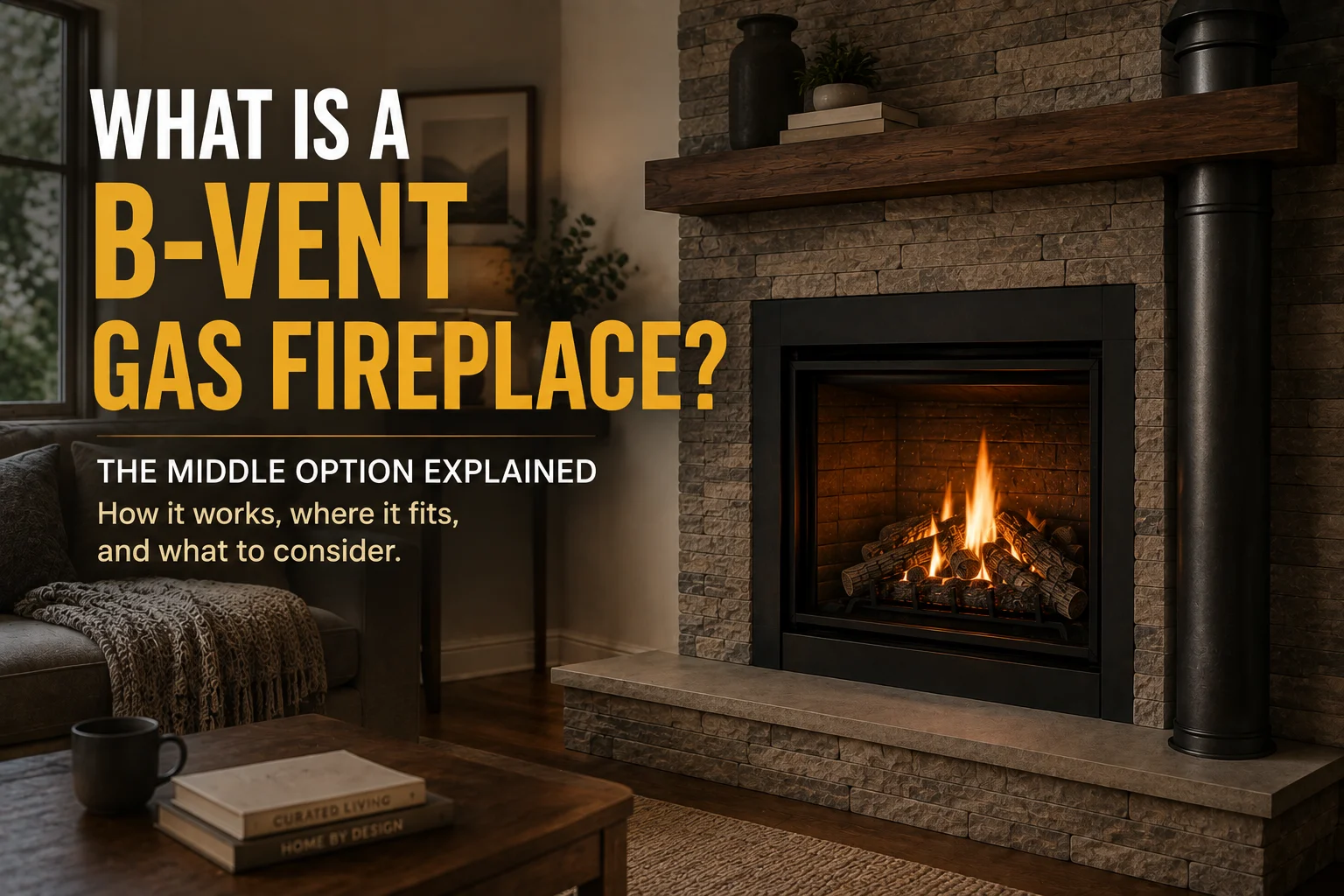
A B-vent gas fireplace (also called a natural vent fireplace) sits between the two options everyone talks about. It takes its combustion air from the room, like a vent-free unit, and it sends its exhaust up a vertical flue to terminate above the roof, like a vented one. So it does not require the sealed wall penetration a direct vent unit needs, and it does not put combustion products in your living space the way a vent-free unit does. The trade is that it burns air you already paid to heat, sends some of that heat up the flue, and relies on natural draft, which means its correct operation depends on the air pressure inside your house.
Two things to settle before the details. B-vent installation and vent sizing are permitted, code-governed work everywhere this site covers, so your building department is part of the process. And if you are weighing B-vent against a vent-free unit, remember that vent-free is a category whose legality changes by address: it is restricted or prohibited in some states, provinces and municipalities, and only your building department or gas authority can answer for yours.
Why you rarely see it compared
Comparison pages for gas fireplaces are almost all published by companies selling appliances or venting. Their comparisons run direct vent against vent-free, because those are the two ends of the range and the two biggest product lines. B-vent gets a paragraph or gets skipped.
The category has not gone away. Manufacturers including Majestic, Superior and Empire list B-vent models, and hearth retailers carry them. It occupies far less shelf space than direct vent, which is a market fact rather than a verdict on the technology. We do not sell any of it, and our mission page explains why this site publishes category comparisons rather than product recommendations.
How B-vent actually works
The burner sits in an open-front firebox. It draws combustion air from the room around it. Hot exhaust rises through a double-wall vent pipe, commonly called Type B vent, that runs vertically through the house and terminates above the roof line. A draft hood or diverter at the appliance lets room air mix into the vent, which is part of how natural draft venting is designed to work.
Nothing pushes the exhaust. Buoyancy does. Hot gas is less dense than the air around it, so it rises, and the vertical vent gives it somewhere to go.
That is elegant when the conditions hold, and it is the whole vulnerability when they do not.
The information gain: B-vent is the only one whose safety depends on your house
Compare the three gas categories on one specific question: what has to be true outside the appliance for the exhaust to end up outside the building?
| Category | What moves the exhaust | What can defeat it |
|---|---|---|
| Direct vent | A sealed pipe assembly isolating combustion from the room | Physical damage to the vent, glass or seals |
| B-vent | Natural buoyancy, in an open connection to the room | Depressurization of the house, blocked or cold flue, wrong flue size, downdraft |
| Vent-free | Nothing, by design | Not applicable, the exhaust is in the room already |
Direct vent is a closed system. Vent-free has no system. B-vent is the only one of the three where the rest of your building is part of the safety mechanism.
Depressurization is the practical version of that risk. A powerful kitchen range hood, a whole-house fan, a clothes dryer, a bathroom exhaust fan or several of them at once can pull enough air out of a tight house that make-up air comes back down the easiest available opening, which can be the flue of a natural draft appliance. When that happens, exhaust spills into the room instead of leaving it. This is the same physics that produces backdrafting at natural draft furnaces and water heaters, and it is why the tightness of modern construction changed the risk profile for this whole appliance class.
None of this makes B-vent unsuitable. It makes B-vent an appliance whose installation has to account for the house it is going into, which is a job for a licensed professional, not a specification you can read off a product page.
A working carbon monoxide alarm belongs in any home with a fuel-burning appliance, and with a natural draft appliance it is doing a specific job: it is watching for the spillage condition described above. Carbon monoxide is colorless and odorless. There is no reliable way to sense a draft failure by smell, and a B-vent fireplace gives you no glass, no seal and no fan to fail visibly.
B-vent versus vent-free: the pair people actually confuse
These two look alike from the sofa. Both usually have an open front. Both take combustion air from the room. A homeowner who inherited a gas fireplace with the house often cannot say which one they have, and the difference is not cosmetic.
They differ in exactly one respect, and it is the one that matters: a B-vent unit has a flue and a vent-free unit does not.
How to work out which you have, without touching the gas:
- Look for a vent. Trace whether the appliance connects to a pipe or flue going up and out of the building. A vent-free unit connects to nothing.
- Read the rating plate. Every listed appliance carries one, usually behind or under the firebox. Vent-free units are certified to ANSI Z21.11.2 and are labeled as unvented or vent-free room heaters. The plate also gives the input rating and the fuel type.
- Find the model number and download the installation manual from the manufacturer’s site. It will say plainly whether the unit is vented, and it will carry the room sizing and clearance requirements.
- If any of that is unclear, ask a qualified hearth technician. Guessing which class of appliance is running in your living room is not an acceptable outcome.
This matters because the rules attached to a vent-free unit are much stricter, and they follow the appliance rather than the room’s appearance. Vent-free units carry a mandatory oxygen depletion safety shutoff, room volume minimums tied to input rating, prohibitions on bedrooms and bathrooms, and a code limit against using them as the sole source of heating in a dwelling.
If you discover you have a vent-free unit, understand what that oxygen depletion sensor is and is not. It monitors oxygen in the room and shuts off the gas at the threshold the manufacturer specifies. It is not a carbon monoxide detector, it does not measure carbon monoxide, and it does not replace a working carbon monoxide alarm. Read are ventless gas fireplaces safe, an honest answer and then check whether the category is even permitted at your address in are ventless fireplaces legal where you live.
Efficiency, honestly
B-vent is the least efficient of the gas categories, and the reason is structural. It burns heated indoor air, and the same open connection that lets exhaust rise also lets warm room air go up the flue when the appliance is off unless a damper or vent restrictor is fitted per the manual. Retail pages quote efficiency percentages for the category. We are not going to repeat one, because the figure that governs your purchase is the one on the specific model’s rating plate and in its manual, and the way that figure is derived varies.
The honest positioning is that B-vent is generally chosen for the look of an open flame with the exhaust going outside, at a lower venting cost than direct vent, in a house that already has or can accept a vertical chase. It is not chosen as a heating appliance. If heat output is the goal, direct vent is the category to look at.
What is licensed work here
Everything structural. Building or altering a vent, connecting gas, converting an appliance between natural gas and propane, and specifying whether an existing chimney can house a B-vent liner are all jobs for a licensed gas fitter or a qualified hearth technician. Sizing a natural draft vent is not a rule of thumb: it comes from vent sizing tables in the National Fuel Gas Code (NFPA 54 / ANSI Z223.1) as adopted in your jurisdiction, together with the appliance manual. Your local building department and gas authority set the permit requirement.
This site publishes no gas line, venting or installation procedure, and it never will. Our disclaimer covers the limits of general guidance like this page.
Frequently asked questions
What is the difference between B-vent and direct vent?
Direct vent is a sealed system that draws combustion air from outside and expels exhaust outside through the same pipe assembly, with the firebox closed behind fixed glass. B-vent draws combustion air from the room and relies on natural buoyancy to carry exhaust up a vertical flue through the roof. Direct vent can often terminate horizontally through a wall. B-vent must go up.
Is a B-vent fireplace safe?
It is a vented appliance, so its combustion products are designed to leave the building, which is a meaningful advantage over an unvented unit. Its specific risk is draft failure, where house depressurization, a blocked or oversized flue or a downdraft causes exhaust to spill into the room. Correct sizing and installation by a licensed professional, annual servicing and a working carbon monoxide alarm are how that risk is managed.
Can a B-vent fireplace vent horizontally through a wall?
No. Natural draft venting requires a vertical run terminating above the roof. If you have no vertical path, B-vent is not an option for that location, and direct vent or a non-combustion alternative is where the conversation goes next.
Are B-vent fireplaces being discontinued?
Manufacturers still list them, and retailers still sell them, so the category is available. It has clearly lost ground to direct vent in the number of models offered. Availability of a specific model in your region is a question for a hearth dealer.
Do I need a permit for a B-vent installation?
Assume yes and confirm with your building department. Gas appliance installation and venting are permitted work in most jurisdictions, and vent sizing is code-governed. An unpermitted installation can also surface later at a home inspection or with your insurer.