
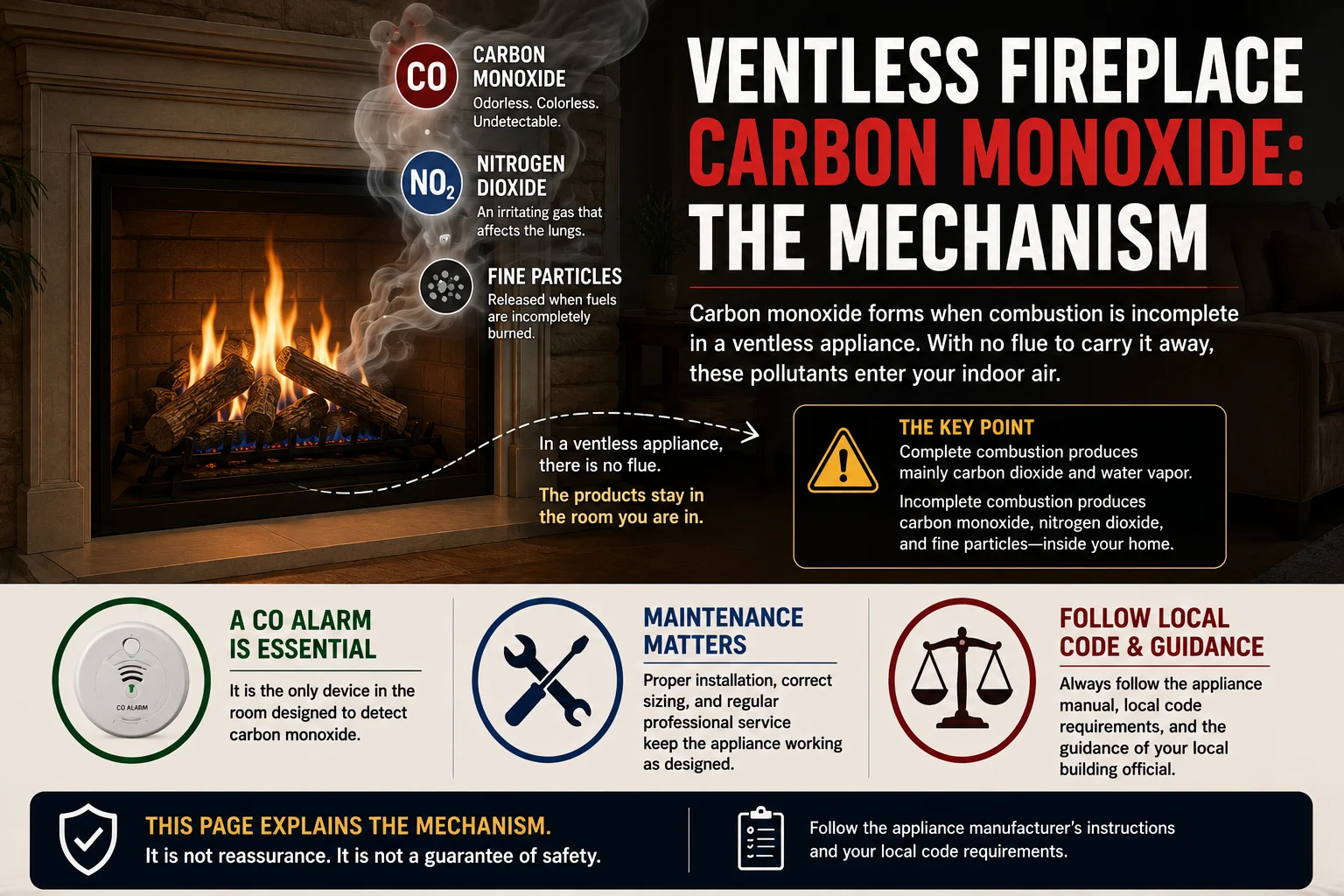
Carbon monoxide forms when combustion is incomplete, and a vent-free appliance has no flue to carry any of it away. That is the whole mechanism in one sentence. A correctly sized, correctly installed, well-maintained vent-free burner is engineered to combust close to completely, which is why the appliance’s condition and installation matter as much as its category. When something interferes with that combustion, whatever is produced enters the room you are sitting in, because there is nowhere else for it to go.
This page explains the mechanism. It is not reassurance, and it ends where it should end: with why the alarm is a condition of running the appliance.
Complete and incomplete combustion, in plain terms
Burning natural gas or propane is a reaction between fuel and the oxygen in the room air. Given enough oxygen and a burner working as designed, that reaction runs close to completion and the products are carbon dioxide and water vapor. Run it short of oxygen, or disturb the burner, and the reaction stops partway. Carbon monoxide is what partway looks like.
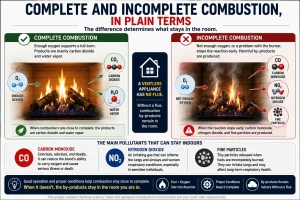
Nitrogen dioxide forms alongside it, from nitrogen in the air rather than from the fuel, and fine particles come out of incomplete burning too. The US Environmental Protection Agency lists unvented gas space heaters among its sources of combustion products and names the major pollutants released as carbon monoxide, nitrogen dioxide and particles, noting that particles are “released when fuels are incompletely burned.”
The word doing the work in all of this is unvented. A vented appliance produces the same chemistry and sends it up a flue. Remove the flue and the products have one destination: the room. That is not a defect in the design, it is the design, and it is why this appliance category carries conditions that a vented one does not.
What changes the odds
The category does not decide your risk on its own. The unit’s state does. These are the factors that push a burner away from complete combustion.
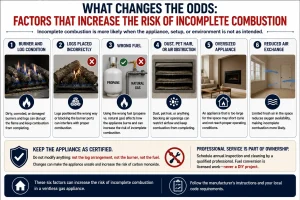
| Factor | Why it matters |
|---|---|
| Burner and log condition | Deteriorated, cracked, soot-loaded or displaced ceramic logs disturb the flame the unit was certified with |
| Logs placed wrong | Vent-free log sets are certified in a specific arrangement. Rearranging them is not decoration, it is a modification |
| Wrong fuel | An appliance set up for natural gas and fed propane, or the reverse, without a proper conversion by a licensed professional |
| Dust, pet hair, obstruction | Anything restricting the air the burner draws changes the fuel-to-air balance |
| Oversizing | A unit rated for a larger space than the room it sits in |
| Reduced air exchange | A tight or below-grade room exchanges less air with outside |
Two things follow. First, an annual service by a qualified professional is part of owning this appliance, not an optional upgrade. Second, do not modify anything: not the log arrangement, not the fuel, not the burner. Any gas line, gas connection or fuel conversion is licensed work, and we publish no procedure for it.
Why the oxygen depletion sensor does not solve this
Every unvented room heater in this category must carry an oxygen-depletion-sensitive safety shutoff. The model code language is specific about what it watches: the system “shall shut off the gas supply to the main and pilot burners when the oxygen in the surrounding atmosphere is depleted to the percent concentration specified by the manufacturer, but not lower than 18 percent.”
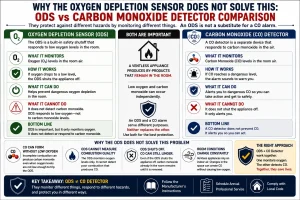
Read that again and notice the subject. The device measures oxygen. It does not measure carbon monoxide. It is designed to intervene on the falling-oxygen pathway, which is a genuine failure mode and a genuine mitigation. It is not a carbon monoxide detector, it will not tell you carbon monoxide is present, and a manufacturer or retailer describing it as though it were is describing it wrongly.
So the ODS covers one route to trouble. A burner degraded into incomplete combustion in a room with adequate oxygen is a different route, and the ODS is not the instrument that catches it. That gap is not a design scandal, it is simply what the device is. It is also exactly why the next section is not negotiable.
This is why a CO alarm is a condition, not a suggestion
A working carbon monoxide alarm is a condition of operating a vent-free gas appliance. If there is no working alarm in service, the appliance should not be running. That rule holds regardless of the unit’s age, price, brand, or how many safety devices its brochure lists.
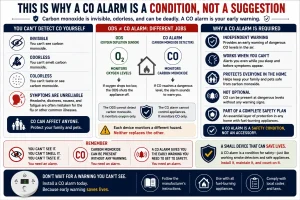
The reason is a property of the gas itself. Clinical references describe carbon monoxide as tasteless, odorless, colorless and nonirritating to mucous membranes or skin, characteristics that make it “essentially undetectable by human senses, allowing toxicity to develop gradually.” Your nose is not a sensor. The appliance’s own shutoff is watching a different variable. The alarm is the only thing in the room actually looking for this hazard.
For how many alarms to have and where to put them, follow the alarm manufacturer’s instructions and your local fire department’s guidance. That is a household alarm question rather than an appliance question, and we do not publish a placement rule.
Symptoms, and what to do the moment you suspect it
Public health and clinical sources describe carbon monoxide exposure as producing headache, dizziness, weakness, nausea, confusion, disorientation and fatigue, with presentations ranging from mild and flu-like through to far more serious outcomes. EPA separately notes that people with chronic heart disease can experience episodes of increased chest pain, and identifies fetuses, infants, elderly people, and people with anemia or a history of heart or respiratory disease as especially sensitive.
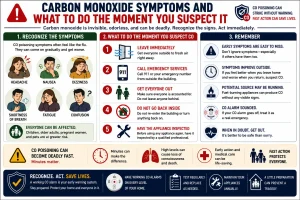
The practical problem is that the mild end of that list is indistinguishable from a winter virus, which is precisely how gradual exposure goes unrecognized. One pattern is worth knowing: symptoms that appear when the appliance is running and ease when you leave the house.
If an alarm sounds or you suspect exposure, do not investigate first. Fairfax County Fire and Rescue states the sequence directly: “If your carbon monoxide or ODS alarm sounds, shut down the fireplace, open a window, if possible, get out of the home, and call 911.” The same guidance includes a rule that gets ignored: “Never operate a ventless fireplace when no one is home.” Seek medical attention if anyone has symptoms. We are not clinicians and this is not medical advice; our disclaimer sets out our limits.
Putting it together
Nothing here says the appliance produces dangerous carbon monoxide in normal operation, and nothing here says it cannot. Both of those would be claims about your specific unit in your specific room, which no web page can make. What the mechanism supports is narrower and more useful:
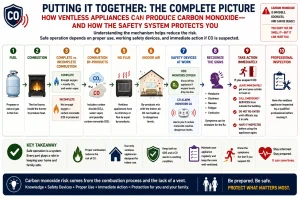
- Complete combustion is the design intent, and it is a state the appliance has to be kept in, not a permanent property it was sold with.
- The by-products of the incomplete case have no exit from a vent-free unit other than the room.
- The required safety device covers the oxygen pathway, not the carbon monoxide one.
- Therefore the alarm carries the detection job, and it is a condition of operating the appliance at all.
The honest overall verdict for the category, with the commercial incentives on both sides named, is on are ventless gas fireplaces safe. Whether the appliance is permitted where you live is a separate question again: start at are ventless fireplaces legal, and use the building department script to get an answer for your own address.
Frequently asked questions
Does a brand new unit still produce carbon monoxide?
Any hydrocarbon flame can produce carbon monoxide if combustion is incomplete, and no appliance is certified as producing none. A new, listed, correctly sized and correctly installed unit in good condition is the best case for this category. That is a reason to keep it in that condition, not a reason to treat it as exempt.
Is a small amount always present when it runs?
We are not going to give you a number, because a specific figure for your unit in your room is not something we can source, and an invented one would be worse than no answer. The mechanism is what matters: incomplete combustion produces it, a vent-free unit has no flue, and the alarm exists because you cannot sense the difference yourself.
Can I test for it myself?
A listed carbon monoxide alarm is the tool for continuous detection, and it is a condition of running the appliance. For evaluating the appliance itself, a combustion analysis by a qualified service technician during annual service is the appropriate check. Neither is a job for a color-changing card.
Does the oxygen depletion sensor shut the unit off if carbon monoxide rises?
Not directly. It responds to oxygen concentration falling to the level the manufacturer specifies, not to carbon monoxide. Some units carry additional detection features, but the required device is an oxygen shutoff, and you should verify what any specific model actually includes from its own documentation.
Does opening a window handle it?
Ventilation is one of the conditions of operating this appliance and EPA advises taking special precautions with fuel-burning unvented space heaters. It is not a flue and it is not a detector, and its effect depends on how far it is open and what the weather is doing. It supplements the conditions on this page; it does not replace any of them.
What if I smell something when it runs?
Carbon monoxide has no smell, so an odor is telling you about something else, possibly a gas leak or a fuel or combustion problem. Treat any gas smell as an emergency: leave and call your gas utility or 911 from outside. For anything else unusual, stop using the appliance and have it inspected by a qualified professional before running it again.