
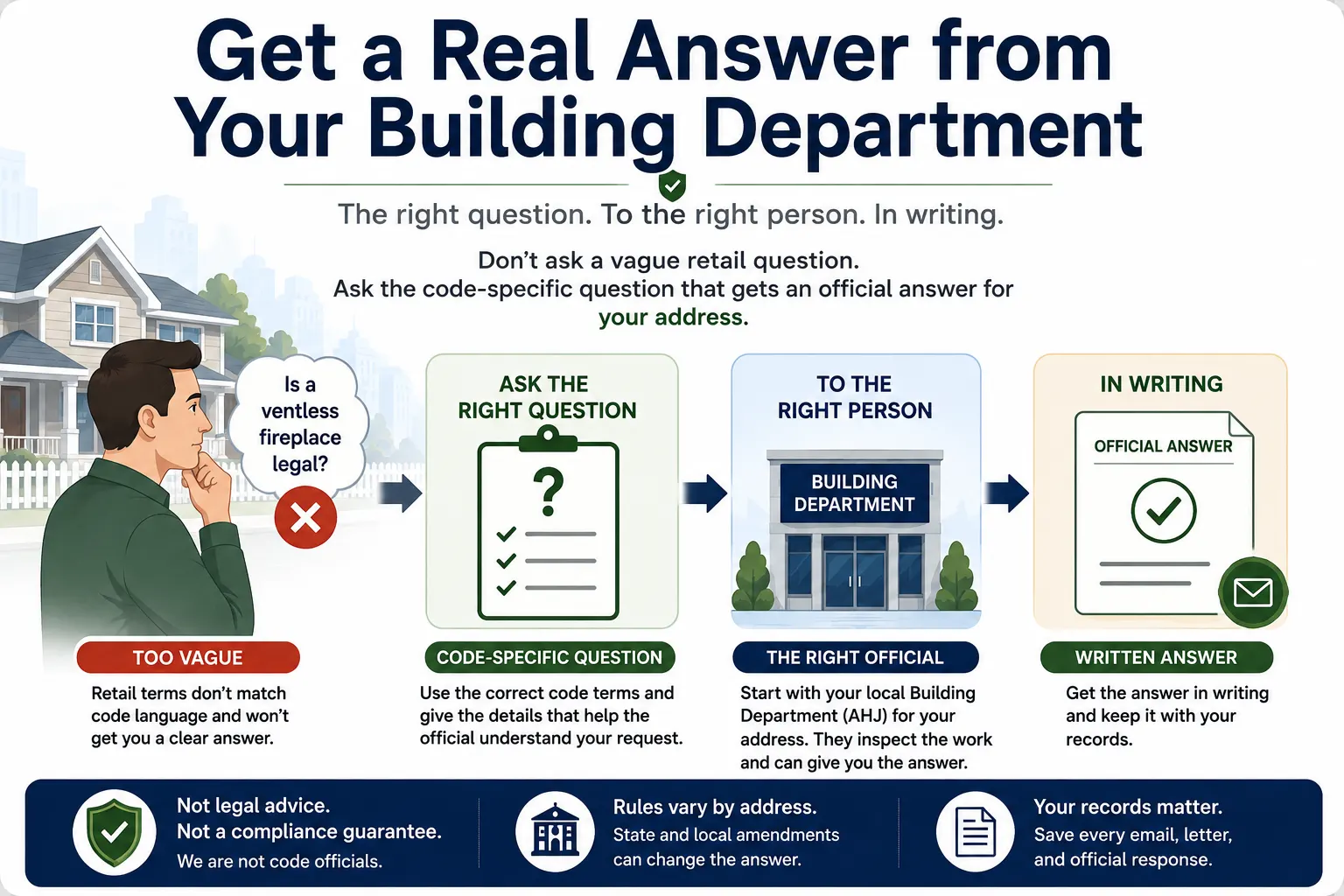
Ask about the appliance category and its listing standard, not the brand name on the box. The question that gets a real answer is close to this: “Is a listed, unvented gas room heater permitted for installation in a single-family residence at this address, and does it require a permit?” Then name the room. A front desk that cannot route “is a ventless fireplace legal” can usually route that, because it maps onto a section their adopted code actually contains.
This page is a communication script, not legal advice and not a compliance guarantee. We are not code officials. What follows is how to reach the person who is allowed to answer, and how to get their answer in a form you can keep.
Why the brand name is the wrong opening
“Ventless fireplace” is a retail phrase. Codes do not use it. The adopted code on the official’s desk has a section headed unvented room heaters, and a separate rule for unvented decorative appliances, and the difference between those two categories can decide your answer by itself.
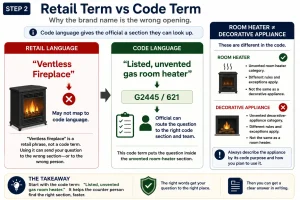
So the first sentence out of your mouth should hand the official a code term. In the International Residential Code and International Fuel Gas Code families, unvented room heaters sit at Section G2445 (621), which caps a unit at 40,000 Btu/h (11.7 kW) input, limits the aggregate input of all unvented appliances in a space to 20 Btu/h per cubic foot, requires an oxygen-depletion-sensitive safety shutoff system, and states plainly that unvented room heaters “shall not be used as the sole source of comfort heating in a dwelling unit.” Say “unvented room heater” and you are already inside that section with them.
If you have not yet worked out whether your state is even in play, start with our guide on whether ventless fireplaces are legal and the sourced list of places that ban or restrict them, then come back here for the phone call.
Which office to call, and in what order
Call the city or county building department that issues permits for your address first. That office is the authority having jurisdiction over your installation, and it is the one that will inspect the work. Names vary: Building Services, Development Services, Planning and Development, Permit Center.
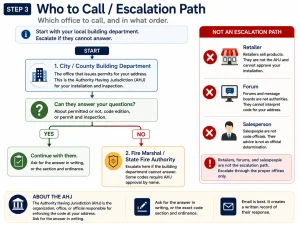
If that office cannot answer, escalate to the fire marshal or state fire authority, not to a retailer. Some adopted codes hand this specific appliance to the official’s discretion by name. The Nevada Mechanical Code 2018, at Section 916.2.1.1, permits a small wall-mounted unvented heater in a bathroom or bedroom only “where approved by the Authority Having Jurisdiction”, which means an actual human being signs off rather than a table. When a code is written that way, only that human’s answer counts.
A salesperson is not an escalation path. Neither is a forum. Our full method for locating your adopted code before you call is on the local code check page.
The script, word for word
Read this aloud or paste it into an email. Fill the brackets first.
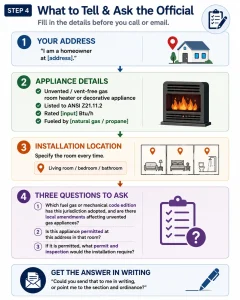
“I am a homeowner at [address]. I am asking about an unvented, vent-free gas room heater or decorative appliance, not a vented or direct-vent unit. It is listed to ANSI Z21.11.2, rated [input] Btu/h, fueled by [natural gas / propane], and would be installed in [the living room / a bedroom / a bathroom].
Three questions. First, which fuel gas or mechanical code edition has [jurisdiction] adopted, and are there local amendments affecting unvented gas appliances? Second, is this appliance permitted at this address in that room? Third, if it is permitted, what permit and inspection would the installation require?
Could you send that to me in writing, or point me to the section and the ordinance?”
ANSI Z21.11.2 is the product standard for gas-fired unvented room heaters, published in the ANSI catalog as Gas-fired room heaters, volume II, unvented room heaters. Naming it does two things at once: it tells the official the unit is a recognized listed appliance rather than an unknown object, and it signals that you already know this is a regulated category.
Name the room, every single time
Never ask “is this legal in my house.” Rooms are not treated alike, and the room is where most of the restriction actually lives.
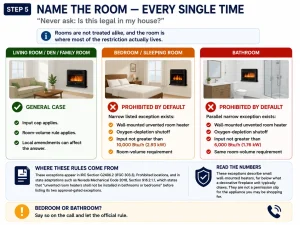
| Room | How the model codes treat it |
|---|---|
| Living room, den, family room | The general case. Governed by the input cap, the room-volume rule and the local amendment layer |
| Bedroom (sleeping room) | Prohibited location by default. A narrow listed exception exists for one wall-mounted unvented room heater with an oxygen-depletion shutoff, input not greater than 10,000 Btu/h (2.93 kW), with a room-volume requirement |
| Bathroom | Prohibited location by default. The parallel exception is not greater than 6,000 Btu/h (1.76 kW), same wall-mounted and shutoff conditions, same volume requirement |
Those exceptions appear at IRC Section G2406.2 (IFGC 303.3), Prohibited locations, and in state adaptations such as Nevada’s Section 916.2.1.1, which states outright that “unvented room heaters shall not be installed in bathrooms or bedrooms” before listing its two approval-gated exceptions.
Read the numbers. Those exceptions describe small wall-mounted heaters, and they sit far below what a decorative fireplace unit typically draws. They are not a permission slip for the appliance most readers are shopping for, and nothing on this site treats a bedroom or bathroom installation as safe. If your room is one of those two, say so on the call and let the official rule.
Getting it in writing, and why a verbal yes is not enough
Email beats a phone call because it produces the written record by itself. If you do call, close with: “Could you email me a confirmation of that, including the code section and edition it comes from?” Ask for the name of the person you spoke to.
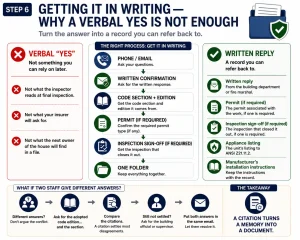
A verbal counter answer is not something you can rely on later. It is not what the inspector reads at final inspection, it is not what your insurer will ask for, and it is not what the next owner of the house will find in a file. The written reply, the permit, the inspection sign-off, the appliance listing and the manufacturer’s installation instructions belong in one folder together.
If two staff give you different answers, do not argue the conflict. Go back with specifics: ask which adopted code edition and which section each answer comes from. A citation settles most disagreements immediately, because it turns a memory into a document both people can read. If it does not settle, ask for the building official or the supervisor, and put both answers in the same email.
When the office has never dealt with this appliance
It happens, and it is not an approval. Silence is not permission and “I don’t think we regulate that” is not permission.
Three moves, in order. Rephrase using the code term rather than the retail term, since “unvented gas room heater” lands where “ventless fireplace” does not. Ask specifically which section of the adopted code covers unvented gas appliances, which forces a lookup instead of a recollection. Then ask who in the jurisdiction reviews gas appliance permits, and go to that person or to the fire marshal.
Be ready for a flat no that has nothing to do with your state. Local amendments can override the model code entirely: the Houston Residential Code 2015, at Section G2445.1, reads in full “Unvented fuel-burning room heaters and decorative appliances shall be prohibited.” One sentence, adopted locally, and the state-level answer stops mattering. That is the layer this phone call exists to find.
Any gas line, gas connection or appliance fuel conversion is licensed work. We publish no procedure for it, and neither the permit answer nor this article changes that. Our disclaimer sets out where our limits are, and the honest safety picture for the category is on are ventless gas fireplaces safe.
Frequently asked questions
Do I need a permit if the appliance itself is allowed?
Possibly, and it is a separate question you should ask in the same call. “Permitted” and “no permit required” are not the same finding. Ask which permit type applies, whether it must be pulled by a licensed contractor rather than by you, and what inspection closes it out.
What if two staff give me different answers?
Ask each for the code edition and section behind their answer. Most conflicts are one person quoting an older adopted edition. If the citations genuinely conflict, escalate to the building official or the fire marshal and send both answers in one email so the discrepancy is theirs to resolve, not yours.
Should I mention that I already bought the unit?
Mention the unit’s actual rating and listing, because those are the facts the answer depends on. Whether it is already in your garage does not change the code, and an official who thinks you are looking for permission after the fact tends to get more cautious, not less.
Can the retailer’s compliance page substitute for this call?
No. A retailer knows what it is allowed to ship, which is a different question from what your jurisdiction allows you to install, and it has a commercial interest in the answer. The only answer worth acting on comes from the office that will inspect the work.
What if I am in Canada?
The chain is different. Gas installations are regulated provincially rather than by a city building department, so the starting point is your provincial gas safety regulator. See our Canada page for why that changes the answer so completely.