
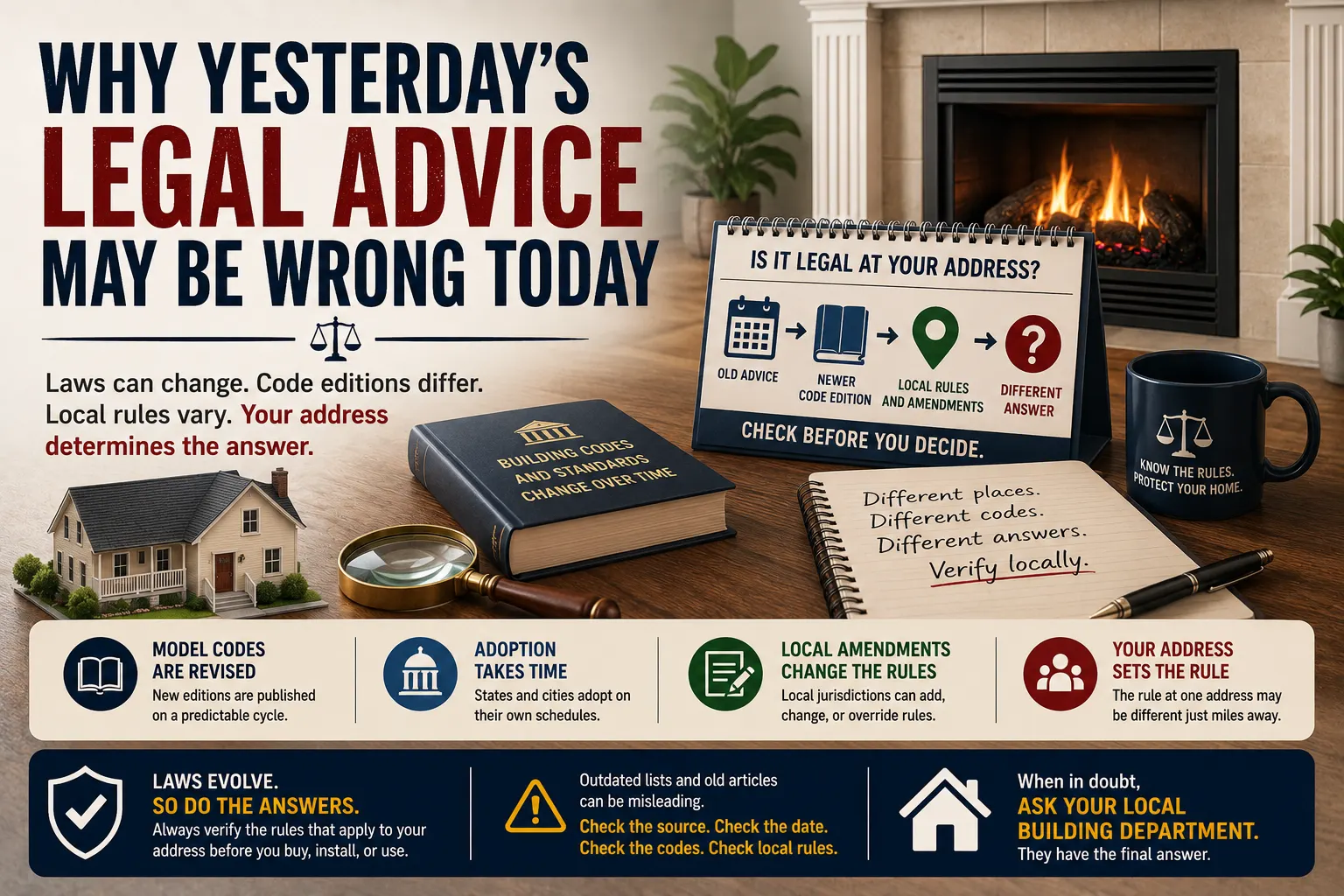
Yes, the answer can genuinely change, and it moves in both directions. Restrictions get added by cities and states, and restrictions get lifted. Underneath that, the model codes themselves are revised on a cycle and every jurisdiction adopts them on its own schedule, so two towns can be running different rulebooks in the same month. An article that was accurate when it was published can be wrong now without a word of it having been edited.
This page is not another legality verdict. It is about how to judge one, including ours. If you want the verdict, start at are ventless fireplaces legal.
The three things that move underneath a “banned states” list
Most articles on this subject present a static list, which quietly implies a static reality. Three separate mechanisms are moving under it.
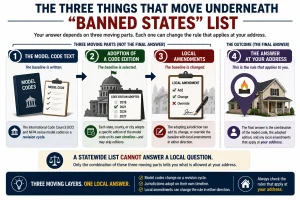
| What moves | Who moves it | What it does to your answer |
|---|---|---|
| The model code text | The International Code Council and NFPA, on a revision cycle | Changes the baseline rule that jurisdictions later adopt |
| Adoption of a code edition | Each state, county or city, on its own timeline | Decides which edition of that baseline is actually enforced at your address |
| Local amendments | The adopting jurisdiction | Overrides the baseline entirely, in either direction |
Only the first of those makes news. The second and third are where your answer actually gets decided, and they change quietly, in ordinance language, without a press release.
How US model codes get adopted, and why the lag matters
The International Codes are revised on a repeating cycle rather than continuously. The International Code Council describes moving to “a single continuous three-year cycle”, a change it states “will not take effect until the code development cycle beginning in 2024 for the development of the 2027 International Codes.” So a new edition arrives every few years, on a schedule you can look up.
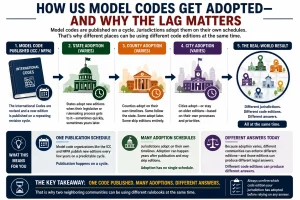
Adoption is the part with no schedule. A state or municipality adopts an edition when its own legislative or rulemaking process gets to it, which can be years after publication, and it can skip editions. The practical result is a patchwork: jurisdictions running current editions, jurisdictions several editions behind, and code libraries still carrying documents like the Nevada Mechanical Code 2018, whose unvented room heater section permits certain installations only where approved by the authority having jurisdiction.
Then the amendment layer lands on top of all of it. The Houston Residential Code 2015, at Section G2445.1, reads in full: “Unvented fuel-burning room heaters and decorative appliances shall be prohibited.” One locally adopted sentence, and every state-level summary of Texas is beside the point at that address.
A worked example: the case where the lists contradict each other
New York is the cleanest demonstration, and we have already documented it in full on the where are ventless fireplaces banned page, so this is the mechanism rather than a re-run of the evidence.
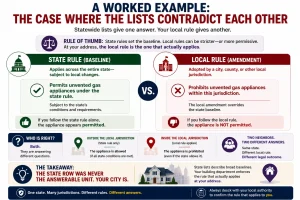
Some pages list New York as banned. Others say New York lifted its ban. Read against the codes, both framings fail the same way: they answer at the state level when the rule that binds you was set locally. The state code and the New York City code point in opposite directions, so a reader upstate and a reader in Brooklyn get opposite correct answers from the same state row.
Now notice what a stale page does with that. It picks one, prints it as a state fact, ranks, and is never revisited. The reader has no way to tell whether they are reading a current reading of both layers or a five-year-old summary of one.
The same failure produces the recurring claim that Alaska, Montana, Minnesota, Massachusetts and New York all “lifted statewide bans.” When we tried to trace those claims to a statute or code section on July 31, 2026, some could be sourced and some could not. Alaska and Montana could not, in either direction, so they appear on our list under what we left out rather than as a fact.
How to tell if the page you are reading is current
Apply this to any article on this topic, this one included. It is four questions, and they do not require you to know anything about codes.
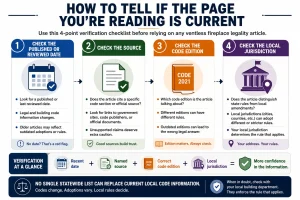
- Is there a stated date? Not a “last updated” stamp on a template, but a sentence saying when the claims were checked. A page with no date is asking you to assume it is current.
- Is there a named source per claim? A statute number, a code section, an edition year. “Some states ban them” with no citation cannot be verified by you or by anyone.
- Does it name the edition, not just the code? “The International Fuel Gas Code” is not a citation. “The 2021 International Fuel Gas Code, Section 303.3” is, because it can be checked and because the edition year is what varies by jurisdiction.
- Does it distinguish state from local? A page that only has state rows has already lost the layer where prohibitions most often live.
A page failing all four is not necessarily wrong. It is unverifiable, which for a decision involving a combustion appliance in your living room should be treated the same way.
What we do about it on this site, and what you should still do
Every legality claim on this site carries the date it was read and the statute or code section it was read against. Where a claim circulates widely but we could not trace it to a source, we say so in the article rather than repeating it or silently dropping it. Where a source contradicts itself, we publish the part we can stand behind and name the gap. That method is set out on our editorial policy page.
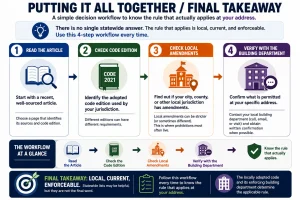
We are not claiming to be current forever. We are claiming to be dated, which is the property that lets you judge us. Treat any page on this subject that does not carry a checked-on date as unreliable, including ours if the date has gone stale.
And the discipline the whole cluster keeps pointing at does not change: before you buy, install or run one of these, confirm the answer with the office that will inspect the work. Our local code check page shows how to find your adopted code, and the building department script gives you the words to use. Do that even if the article you read was published last week, because no article, ours included, is written about your address.
Frequently asked questions
How often do these laws actually change?
There is no single cadence, because three different things are changing on three different schedules. The model codes are revised on a stated cycle, jurisdictions adopt new editions whenever their own process reaches it, and local amendments can be passed at any time. That is why the answer is “re-verify before you act” rather than a number of years.
Why did I get a different answer than I did last year?
The most common explanation is not that a law changed but that you reached a different layer or a different person. A jurisdiction may have adopted a newer code edition, an amendment may have passed, or the first answer may have been a state-level generality applied to a local question. Ask which code edition and section the new answer comes from and compare it to the old one.
If a state lifted its ban, does that mean I can install one?
No. A state permitting something does not stop your city or county from restricting or prohibiting it, and the room you intend to use still carries its own restrictions. State first as a filter, then local, always.
Does an older article being wrong mean the appliance got safer?
No, and this is worth separating carefully. Legality and safety are different questions with different answers. The combustion behavior of a vent-free appliance has not changed because a jurisdiction revised an ordinance. See are ventless gas fireplaces safe for the safety side, which does not move with the legal side.
How do I check a claim myself without buying a code book?
Start with the jurisdiction’s own website. Building departments usually publish which code editions they have adopted, and municipal codes of ordinances carry the amendments. Between those two pages you can verify most claims for your own address, which is the only address that matters to you.