
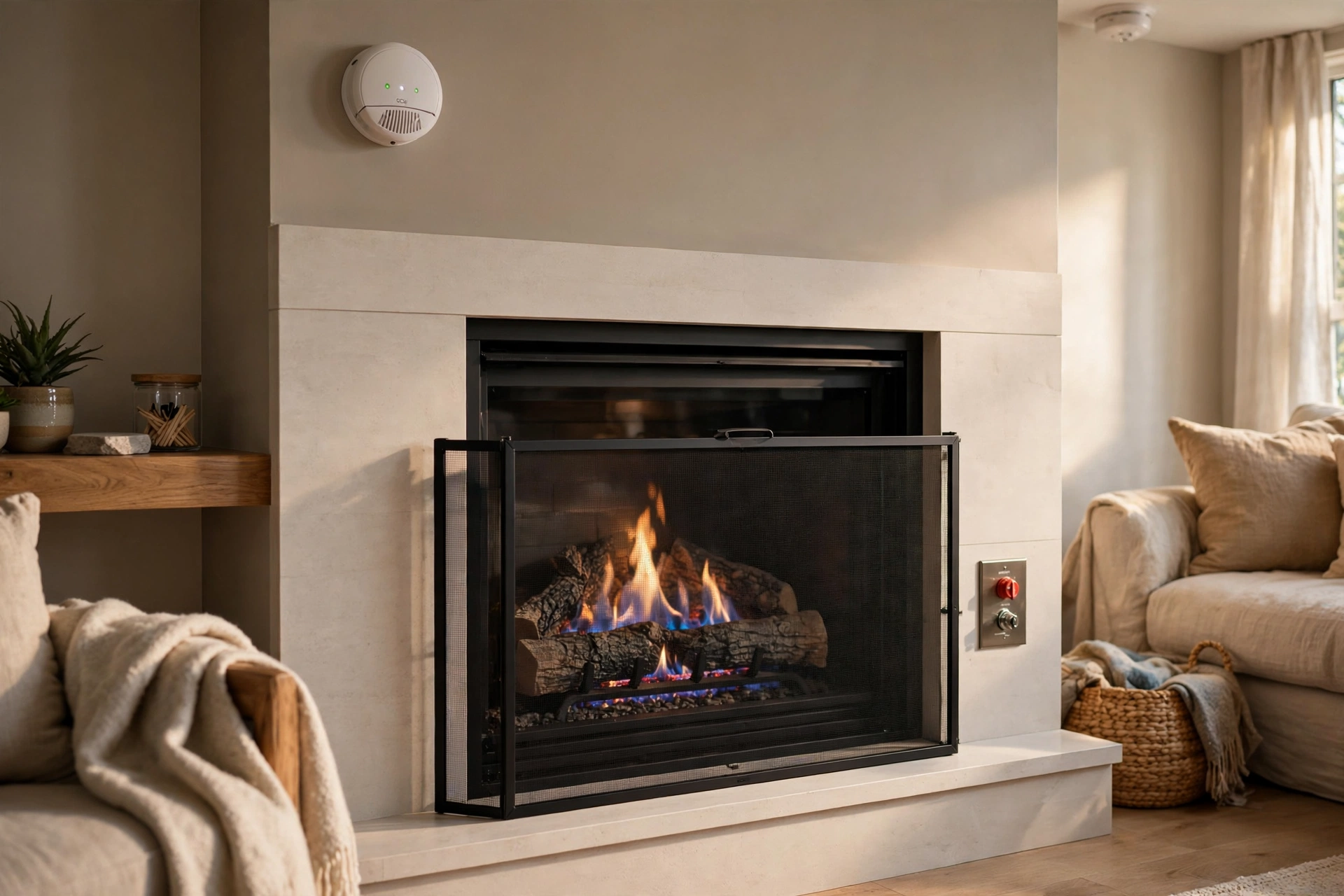
The one ventless fireplace safety feature the fuel gas code names outright is an oxygen-depletion-sensitive safety shutoff, usually called the ODS. It must shut off gas to the main burner and the pilot when room oxygen falls to the level the manufacturer sets, which the code says must be “not lower than 18 percent”, and it may not be adjustable in the field. The pilot, its flame sensor and the gas valve they control make up the rest of the system. None of it detects carbon monoxide, so a working CO alarm is a condition of running the unit.
Two questions come before any feature list: whether a vent-free appliance is allowed where you live, and whether your household and room suit one at all, which our honest answer on vent-free safety works through. A unit with every feature on the list is still the wrong purchase in a jurisdiction that prohibits it.
We have not installed, lit or run any of these appliances. This page is built from published code text, federal agency pages, a county fire department page and manufacturers’ own pages, each named where it is used and read on September 11, 2026.
Carbon monoxide comes before every feature
A vent-free unit sends its combustion products into the room you are sitting in. There is no flue to carry anything away. The U.S. Consumer Product Safety Commission’s Carbon Monoxide Information Center (read September 11, 2026) calls carbon monoxide the “Invisible Killer” because it is “a colorless, odorless, poisonous gas”, and lists the symptoms of poisoning as “headache, dizziness, weakness, nausea, vomiting, sleepiness, and confusion”. The EPA’s page on carbon monoxide’s impact on indoor air quality (read the same day) names “unvented kerosene and gas space heaters” among indoor sources and tells readers to “keep gas appliances properly adjusted”.
That is why this site treats a working CO alarm as a condition of operating a vent-free appliance, not an accessory. Where the alarm goes and how many you need is set by the alarm maker’s instructions and CPSC’s guidance. Our page on the CO alarm as a condition of use explains why no built-in feature replaces it.
The ventless fireplace safety features the code requires
The residential fuel gas code text we read on UpCodes, section G2445 (numbered 621 in the International Fuel Gas Code) in a 2024 adoption, sets out what an unvented room heater must have (UpCodes, unvented room heaters, read September 11, 2026):
- A listing. Unvented room heaters “shall be listed in accordance with ANSI Z21.11.2 and shall be installed in accordance with the conditions of the listing and the manufacturer’s instructions.”
- An oxygen-depletion safety shutoff. The system must shut off “the gas supply to the main and pilot burners” when oxygen falls to the percentage the manufacturer specifies, “not lower than 18 percent”. The code adds that the system “shall not incorporate field adjustment means capable of changing the set point”.
- An input ceiling. Unvented room heaters “shall not have an input rating in excess of 40,000 Btu/h”.
- A room-volume limit. The aggregate input rating of all unvented appliances in a room “shall not exceed 20 Btu/h per cubic foot” of room volume, under the conditions the code sets.
Two rules sit beside those features rather than inside the appliance. The same section says one or more unvented room heaters “shall not be used as the sole source of comfort heating in a dwelling unit”, and it sends location questions to a separate prohibited-locations section. The U.S. Department of Energy’s Building America Solution Center page on unvented combustion appliances (read September 11, 2026) states that the National Fuel Gas Code, which NFPA publishes as NFPA 54/ANSI Z223.1, “prohibits the installation of ventless combustion heaters in bathrooms or bedrooms”. No feature on a spec sheet changes either rule.
Your jurisdiction adopts its own edition of these codes and may amend it, so the version that binds you is the one your building department enforces.
How the ODS, pilot and shutoff valve work as one system
Retail listings name these as three features. On a vent-free unit they behave as one.
The pilot burns the whole time the appliance is in use. A sensor sits in that pilot flame, commonly a thermocouple, and while it stays hot it holds the gas valve open. If the pilot goes out, the sensor cools and the valve closes, so gas stops flowing to a burner that is not lit. That is the flame-failure half.
The ODS applies the same principle to oxygen. The pilot is built so that, as oxygen in the room falls, the flame changes and stops heating the sensor properly. The valve then closes, and the code requires that this happens before oxygen drops below the manufacturer’s set point, which cannot be lower than 18 percent. Typically the ODS and the flame sensor are parts of one pilot assembly listed with the appliance; the parts list in the manual shows how yours is built. Our page on what the oxygen depletion sensor does not catch covers its limits in depth.
For a buyer, the line that matters most is the last one in that code section. The set point is not adjustable in the field. A seller, a forum post or a technician who offers to change it, bypass it, or fit a pilot part not listed for that model is offering to take the appliance outside its listing.
| Feature | What it does | What it does not do | Where the requirement comes from |
|---|---|---|---|
| ODS pilot and shutoff | Cuts gas to the main burner and pilot when oxygen falls to the set point | Measure or respond to carbon monoxide directly | Code section G2445.6 (621.6) |
| Flame sensor, often a thermocouple | Closes the valve if the pilot goes out | Tell you why the pilot went out | Part of the listed pilot assembly |
| Listing to ANSI Z21.11.2 | Shows the design was tested to the unvented room heater standard | Make the unit legal or right for your room | Code section G2445.1 (621.1) |
| Input and room-volume limits | Cap how much gas can burn in a given space | Account for your ventilation, household or health | Code sections G2445.3 and G2445.5 |
| Working CO alarm | Warns the household when carbon monoxide builds up | Shut the appliance off | Condition of use on this site; CPSC guidance |
Features sold as safety that are not
Listings mix comfort features in with safety ones. These are the ones that get confused most:
- A thermostat. It holds a heat level. It does not watch oxygen or carbon monoxide.
- A remote or a blower. Convenience and heat distribution. Neither changes what the burner produces.
- Efficiency claims. An efficiency figure describes where the heat goes. Because a vent-free unit has no flue, everything the burner produces stays in the room along with the heat, which our page on what 99 percent efficiency really means explains.
- “Automatic shutoff” with no further detail. On a vent-free unit this usually means the ODS. Ask which shutoff, to what standard, and find it in the manual before you rely on the phrase.
What no built-in feature covers
The code-required features answer one narrow question: is the flame lit, and is there enough oxygen for it. They do not answer these:
- Carbon monoxide from a poor flame. A burner can have enough oxygen and still burn badly if it is dirty, out of adjustment, or has logs out of position. That is why the alarm is not optional.
- Nitrogen dioxide and water vapor. Both are normal products of burning gas indoors. The ODS does not respond to either.
- An empty house. Fairfax County Fire and Rescue’s ventless fireplace safety page (read September 11, 2026) says never to operate one when nobody is home, and if an alarm sounds, to shut the unit down, open windows, leave the home and call 911.
- A design flaw. The same page tells owners to watch for manufacturer recalls. A safety device built wrong cannot protect you, and a recall notice is how you find out.
How to check a unit’s safety features before you buy
- Ask for the installation and owner’s manual for the exact model, and read the safety section before the specifications.
- Confirm the manual and the rating plate describe an oxygen depletion safety shutoff. Monessen, for example, states on its user guides and manuals page that all of its products carry a rating plate, and its product pages send buyers to the manual for listing information (read September 11, 2026).
- Confirm the plate names ANSI Z21.11.2 and a certification organization.
- For a used unit, ask whether the pilot assembly has ever been replaced, and with what part. If nobody can say, a qualified technician should inspect it before it is lit.
- Treat any offer to adjust, bypass or “fix” an ODS that keeps shutting the unit off as a reason to walk away. Repeated ODS shutdowns are a symptom for a licensed technician to diagnose, not something to work around.
Installation and repair are licensed work
Connecting, converting, adjusting or repairing the gas side of a vent-free appliance, including the pilot assembly that carries the ODS, is work for a licensed gas fitter or a qualified hearth technician, under whatever permit and inspection your jurisdiction requires. We publish no installation or repair procedure. If the pilot will not stay lit, if you smell gas, or if soot appears on the logs, the glass or the wall above the unit, stop using it and call that professional.
What we checked, and when
All read September 11, 2026: residential fuel gas code sections G2445.1 through G2445.7.1 (IFGC 621), as published on UpCodes in a 2024 adoption; U.S. Department of Energy Building America Solution Center, Unvented Combustion Appliances; the NFPA 54/ANSI Z223.1 product page; CPSC Carbon Monoxide Information Center; EPA, Carbon Monoxide’s Impact on Indoor Air Quality; Fairfax County Fire and Rescue, Ventless Fireplace Safety; Monessen’s user guides and manuals page. The ANSI Z21.11.2 standard is sold rather than published free, and we have not read its clauses.
Frequently asked questions
What safety features does a ventless fireplace need?
The code requires a listing to ANSI Z21.11.2 and an oxygen-depletion-sensitive safety shutoff that cuts gas to the main burner and pilot before oxygen falls below the manufacturer’s set point, which may not be lower than 18 percent. It also caps the input rating and the input per cubic foot of room. A working carbon monoxide alarm is a separate condition of use.
Does the oxygen depletion sensor detect carbon monoxide?
No. It responds to falling oxygen through the behavior of the pilot flame. Carbon monoxide can build up from a poorly burning flame while oxygen is still above the shutoff point, which is why a CO alarm is required on this site.
Can the ODS be adjusted if it keeps shutting the fireplace off?
Not by anyone. The code says the system may not include field adjustment means capable of changing its set point. Repeated shutoffs mean something is wrong with the appliance, the room or the air supply, and a licensed technician should find out what.
Is a thermocouple the same thing as an ODS?
Not quite. The flame sensor, often a thermocouple, closes the gas valve when the pilot flame is lost. The ODS is a pilot designed so that the same sensor also stops the gas when oxygen falls. They are usually parts of one assembly, listed with the appliance.
The bottom line
Treat the listing and the ODS as the minimum, not as selling points, and treat everything else on the feature list as comfort. What actually keeps a household safe around a vent-free unit is a working CO alarm, a room and household that suit one, a licensed installer, and an owner who never leaves it burning with nobody home.