
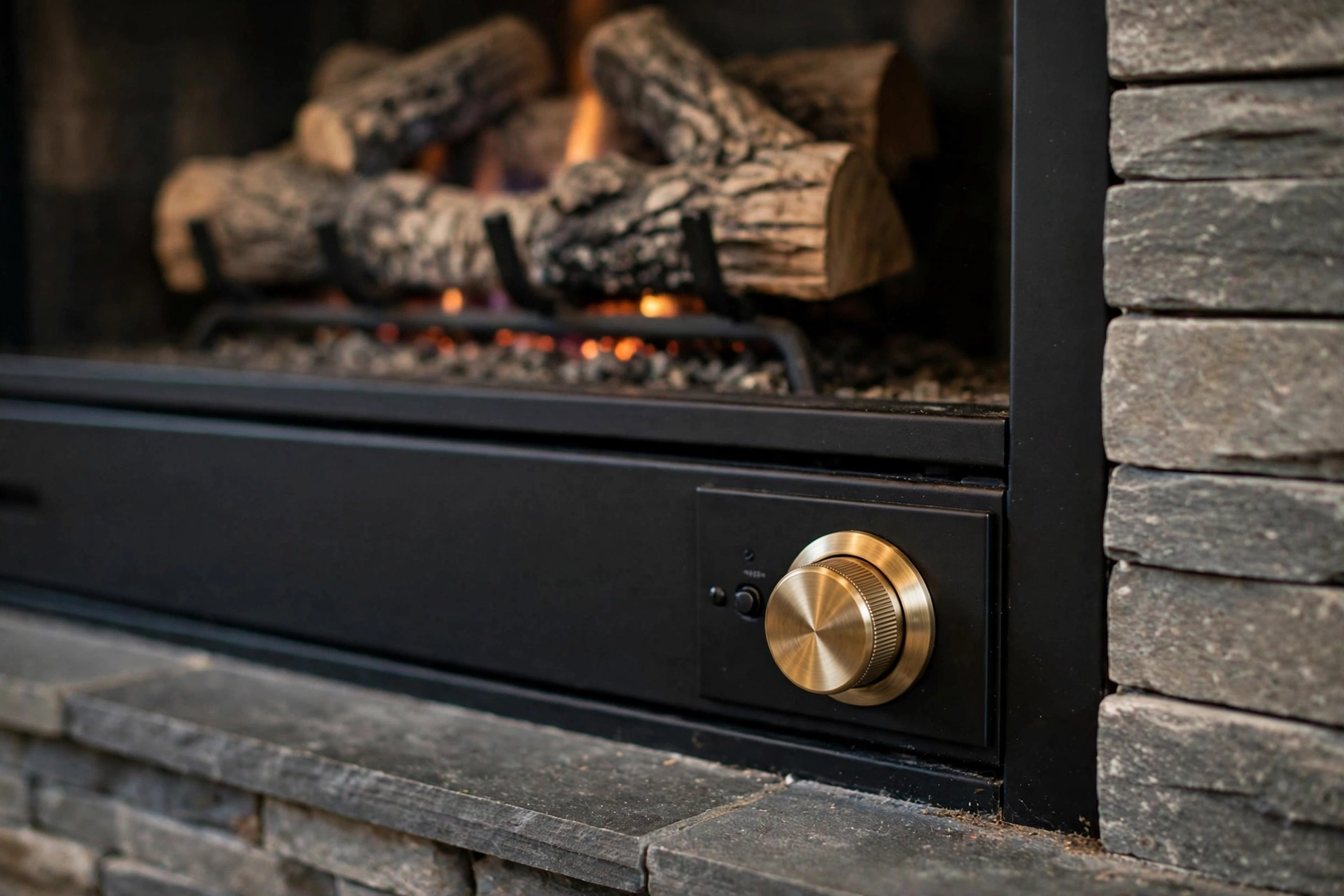
Many vent-free units can hold a heat level, but only if you buy a thermostat model. On those, the control knob sets a heat level and the gas valve raises, lowers or cycles the main burner to hold the room near it, while the pilot stays lit. A manual model does only what you set: off, pilot, and a flame from low to high. Neither kind of ventless fireplace thermostat control watches oxygen or carbon monoxide, and neither lets the burner exceed its rated input.
Before comparing controls, confirm that a vent-free appliance is legal where you live and read our honest answer on whether vent-free units are safe. The control type is a comfort choice you make after those two questions, never instead of them.
We have not installed or operated any of these appliances. This page draws on published code text, federal agency pages, a county fire department page and manufacturers’ own product pages, each named where it is used and read on September 11, 2026.
Carbon monoxide first, whatever the control
Every vent-free unit burns gas in the room and keeps its combustion products there. The CPSC’s Carbon Monoxide Information Center describes carbon monoxide as “a colorless, odorless, poisonous gas”, and the EPA’s page on carbon monoxide’s impact on indoor air quality lists “unvented kerosene and gas space heaters” among its indoor sources (both read September 11, 2026).
A thermostat decides how much gas burns. It does not decide how cleanly that gas burns. A working CO alarm is a condition of running one of these appliances, and our page on the CO alarm as a condition of use explains why no control setting replaces it.
Manual vs thermostat control: the difference
| Control type | What you set | What the valve does | What to confirm in the manual |
|---|---|---|---|
| Manual | Off, pilot, and a flame height from low to high | Holds the flame where you left it until you change it | The valve’s range and the shutdown sequence |
| Thermostat, built into the valve | A heat level on the knob | Adjusts or cycles the main burner to hold the room near that level while the pilot stays lit | How the valve senses temperature, and whether it cycles the burner fully off |
| Millivolt | Varies by model | Runs on power generated at the pilot rather than house current; some are sold ready for a remote | Whether a remote is supported and what it controls |
| Intermittent pilot ignition (IPI) | Varies by model | Lights the pilot when needed rather than keeping it lit | What powers it, and what happens in a power cut |
Manufacturers describe these in their own words. Pleasant Hearth’s page for a compact vent-free stove, on its parent company GHP Group’s site, says the “thermostat control knob automatically maintains your ideal heat level” (GHP Group, Pleasant Hearth compact vent-free gas stove, read September 11, 2026). Monessen describes its Lyric vent-free burner as having “Millivolt Control with Autospark Ignition” and a “remote ready millivolt control”, and says the burners for its Dynamo vent-free log set come in “millivolt or IPI operation” (both read September 11, 2026).
How a ventless fireplace thermostat control works
On a thermostat model, temperature sensing is part of the gas valve assembly on the appliance. The valve responds to the air around its sensor. That has three practical consequences.
It reads the air near the fireplace, not the whole house. A control on the front of the unit knows the temperature where its sensor sits. The far side of a long room may feel different, and the unit has no way of knowing.
It works inside the burner’s rated input. A thermostat can turn the burner down or off. It cannot make it burn more than its rating. The residential fuel gas code text we read on UpCodes, section G2445 (numbered 621 in the International Fuel Gas Code) in a 2024 adoption, says unvented room heaters “shall not have an input rating in excess of 40,000 Btu/h”, and that the aggregate input rating of unvented appliances in a room “shall not exceed 20 Btu/h per cubic foot” of room volume under the conditions it sets (UpCodes, unvented room heaters, read September 11, 2026). Those limits are written against the input rating. A room too small for a unit at full input does not become big enough because the thermostat will often hold the burner lower.
It is not a safety control. The oxygen depletion safety shutoff the code requires is a separate device in the pilot assembly. The same code section says it must cut gas to the main and pilot burners before oxygen falls below the manufacturer’s set point, “not lower than 18 percent”. The thermostat plays no part in that.
What a thermostat does not change
- Running time. A unit that holds the room at a comfortable level can burn for hours without anyone touching the knob. That is the convenience you are paying for, and it is also how an appliance ends up running far longer than its owner intended. Decide how long you will run it before you light it, and follow the manual.
- Primary heat. Code section G2445.2 (621.2) says one or more unvented room heaters “shall not be used as the sole source of comfort heating in a dwelling unit”. A thermostat makes the unit behave more like a furnace. It does not change that rule, which our page on a ventless fireplace as primary heat covers.
- Unattended use. Fairfax County Fire and Rescue’s ventless fireplace safety page (read September 11, 2026) says never to operate one when nobody is home. A thermostat holding a heat level is not supervision.
- The ODS and the alarm. Both are exactly as necessary on a thermostat model as on a manual one.
The trade-offs you decide at purchase
The control type is part of the appliance you buy. Changing the valve later means work on the gas side of a listed assembly, so treat the choice as fixed.
- Thermostat or remote can be an either-or. Pleasant Hearth’s page for its dual-fuel vent-free log set states that the “thermostatically controlled unit does not support a millivolt remote controller” (GHP Group, Pleasant Hearth Wildwood vent-free gas log set, read September 11, 2026). If you want both, check model by model before you buy.
- Power. The same log set page says “No electricity required”. Whether any other control you are considering needs house current or batteries is a question its manual answers; an ignition system that lights the pilot on demand may depend on a power source. Our page on using a gas fireplace during a power outage explains what keeps working when the lights go out.
- Where you sit. Because the sensor sits at the unit, a thermostat model in a long room may keep the fireplace end warm while the far end stays cool. That is a room question more than a product question, and no knob solves it.
Where this page stops
This page covers the control built into the appliance. Whole-house heating controls, and anything added to a gas valve after purchase, are outside it. Adding or changing any control on a gas appliance is licensed work, done only as the manufacturer’s manual allows.
Questions to ask before you buy
- Is this model manual, thermostat, millivolt or intermittent pilot ignition, and where does the manual say so?
- On a thermostat model, does the valve turn the burner down, cycle it fully off, or both?
- Can it take a remote, and what does the remote actually control?
- Does the control need house current or batteries to light or to run?
- Is the unit listed to ANSI Z21.11.2, with an oxygen depletion safety shutoff named on the rating plate and in the manual?
Installation is licensed work
Connecting the gas supply, converting the fuel and servicing the valve are jobs for a licensed gas fitter or a qualified hearth technician, under the permit and inspection your jurisdiction requires. We publish no installation or adjustment procedure. If the burner will not respond to the knob, the pilot keeps going out, or you smell gas, stop using the unit and call that professional.
What we checked, and when
All read September 11, 2026: residential fuel gas code sections G2445.1 through G2445.7.1 (IFGC 621), as published on UpCodes in a 2024 adoption; CPSC Carbon Monoxide Information Center; EPA, Carbon Monoxide’s Impact on Indoor Air Quality; Fairfax County Fire and Rescue, Ventless Fireplace Safety; GHP Group product pages for the Pleasant Hearth compact vent-free gas stove and the Pleasant Hearth dual-fuel Wildwood vent-free gas log set; Monessen product pages for the Lyric vent-free burner and the Dynamo vent-free log set. Product pages change, so confirm the control type in the manual for the exact model you buy.
Frequently asked questions
Can you put a thermostat on a ventless fireplace?
Only as its manufacturer allows. Thermostat control is usually built into the gas valve of models sold as thermostat models. Changing or adding a control on a gas appliance is licensed work done only as the manual permits, and on some models a thermostat and a remote are not offered together.
Does a thermostat make a ventless fireplace safer?
No. It controls how much heat the unit produces, not how cleanly it burns. The oxygen depletion safety shutoff and a working carbon monoxide alarm do the safety work, and the code’s input and room-volume limits apply whatever the thermostat is doing.
What is the difference between manual and thermostat control on a vent-free heater?
A manual model holds whatever flame you set until you change it. A thermostat model adjusts or cycles the main burner to hold the room near the heat level on the knob, with the pilot staying lit.
Can I leave a thermostat-controlled ventless fireplace running while I am out?
No. Fairfax County Fire and Rescue says never to operate one when nobody is home, and a thermostat supervises nothing. Running one while the household sleeps raises the same concern, and the National Fuel Gas Code prohibits these appliances in bedrooms.
The bottom line
A thermostat model buys you a steadier room, not a safer appliance. Choose the control type at purchase, check it against the manual, and keep the rules that matter most unchanged: a working CO alarm, a room the unit is sized and permitted for, a licensed installer, and somebody at home whenever it burns.