
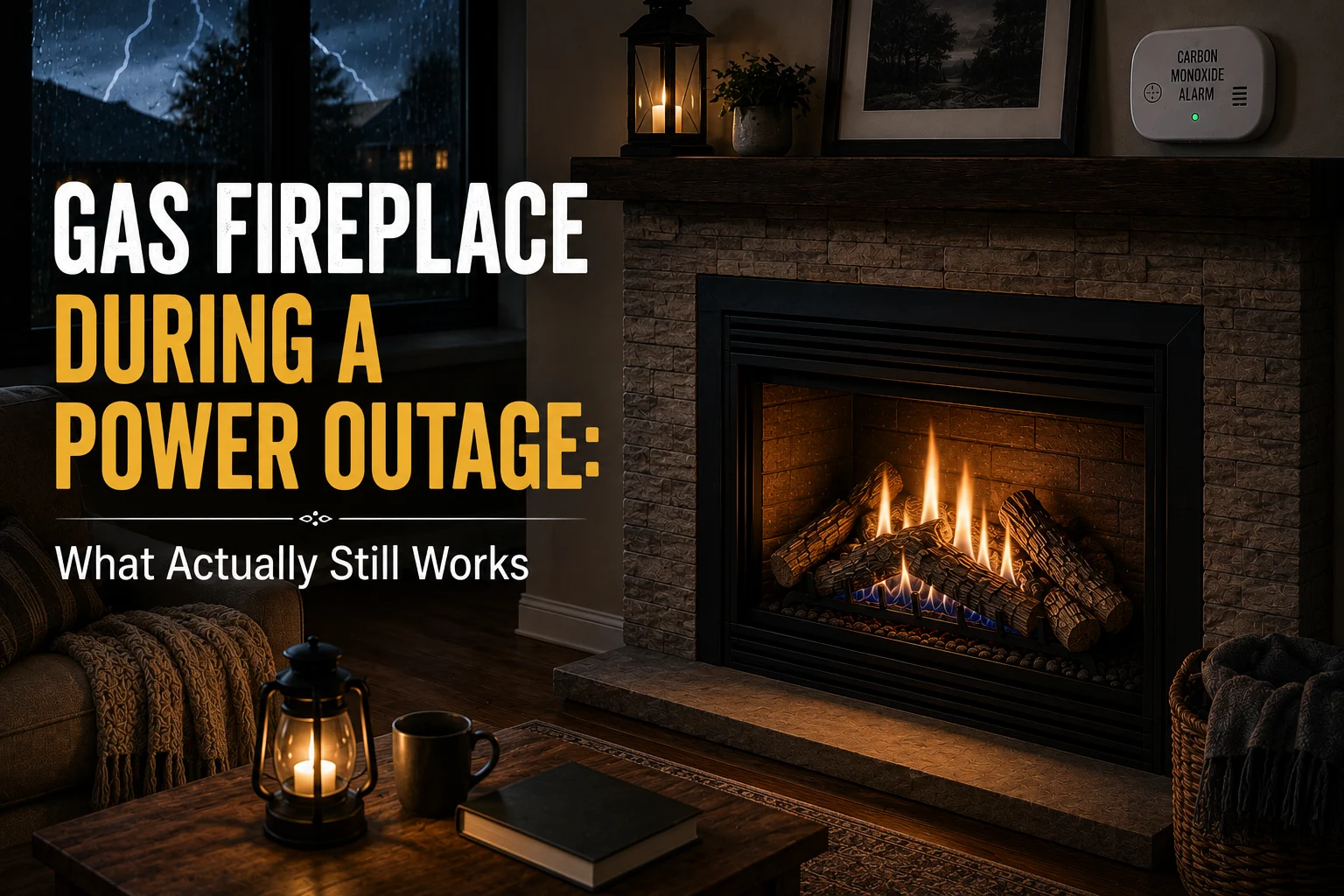
A vent-free gas appliance puts its combustion products into the room, including carbon monoxide, nitrogen dioxide and water vapor. A working carbon monoxide alarm is a condition of operating one. During a power cut this becomes more important rather than less, because a hard-wired alarm without battery backup is not working, and our page on the CO alarm as a condition of use explains why that is not a detail.
Now the argument itself, stated fairly, because it is the one genuine advantage the category has and this site is not in the business of pretending otherwise.
The advantage is real, and it is narrow
Many gas hearth appliances run on a millivolt system. The pilot flame heats a thermopile, the thermopile generates the small voltage that holds the gas valve open, and the appliance therefore operates with no mains electricity at all. A vent-free unit of that kind will light and burn during an outage.
Compare the alternatives on that one criterion:
- A furnace or heat pump needs mains power for the blower and the controls. No power, no heat.
- An electric fireplace or space heater is entirely dependent on mains power, which is the subject of vent-free gas versus electric.
- A direct vent gas fireplace may also run on millivolt, though many modern units use electronic ignition and some require power for a fan. A direct vent unit with a standing pilot gives you outage heat without putting exhaust in the room, which is the comparison that actually matters and is covered in direct vent versus ventless.
- A wood or pellet stove: wood needs nothing, pellet stoves generally need power for the auger. See vent-free versus a pellet or wood stove.
So the honest version of the claim is not “vent-free is the outage answer.” It is “appliances that do not depend on mains power keep working, and vent-free is one of several.”
Why the advantage does not reduce the risk
This is the part every page selling the outage argument leaves out, and it is the whole reason this page exists.
The appliance’s output is identical during a power cut. It emits exactly what it emits on a normal evening. Nothing about the grid being down changes the chemistry.
What does change is everything around it, and all of it in the wrong direction.
- The house gets colder, so people close doors and seal rooms. Reduced air exchange is the single variable that makes a vent-free burner’s output worse, and a household in an outage does it deliberately.
- People gather in one room. More occupants, same room volume, longer exposure.
- The run gets longer. An outage is not an evening’s fire. It is hours or days, and the code’s model of this hazard is input rate against room volume, which accumulates.
- People sleep in the heated room. This is the most dangerous thing on the list. Carbon monoxide is colorless and odorless and a sleeping person gets no warning. IRC G2406.2 prohibits fuel-burning appliances in sleeping rooms subject to narrow exceptions, and the reasoning is on our bedroom page. A living room that people are sleeping in during an emergency is a sleeping room for the purposes of the hazard, whatever it is called on the floor plan.
- The CO alarm may be down. A hard-wired alarm with no battery backup fails at the same moment the appliance becomes most relevant.
An emergency does not relax any of the rules on this site. It removes several of the conditions those rules assume. The correct conclusion from “the power is out” is that the appliance needs more caution than usual, not less.
What the code still says during an outage
The provisions do not have an emergency clause. Read through UpCodes on 28 August 2026:
- G2445.2: unvented room heaters shall not be used as the sole source of comfort heating in a dwelling unit. An outage is exactly the scenario where a household ends up doing this.
- G2445.5: the aggregate input rating of all unvented appliances in a room or space shall not exceed 20 Btu/h per cubic foot of volume.
- G2445.6: the appliance must carry an oxygen-depletion-sensitive safety shutoff acting when oxygen in the surrounding atmosphere is depleted to the manufacturer’s specified concentration, but not lower than 18 percent.
That last one is worth reading twice in this context. The ODS acts on oxygen, not on carbon monoxide, and what it does and does not catch is on its own page. Do not treat it as a device that makes a sealed room acceptable.
The thing never to do, in any circumstance
Never bring an appliance designed for outdoor use inside. Generators, camping heaters, charcoal or gas grills, and patio heaters are not vent-free appliances that have been certified for indoor use. They have no oxygen depletion shutoff, no indoor certification and no room-volume rating, and bringing one indoors during a cold outage is one of the recurring patterns behind carbon monoxide deaths.
CPSC’s newsroom archive carries a release proposing a ban on unvented gas space heaters in 1978, a release approving a mandatory standard in 1980, and a release revoking that standard in 1984. We cite those titles and years only: cpsc.gov returned an HTTP 403 to our fetch on 28 August 2026, and we do not quote or paraphrase documents we could not open.
If outage heat is the actual reason you are shopping
Say that out loud when you talk to a dealer, because it changes the recommendation.
A direct vent unit with a standing pilot gives you the same power independence with the combustion sealed off from the room. It costs more to install because it needs a vent through a wall or roof, and that installation is licensed work. It removes the entire mechanism this page has been describing.
Where the work stops being yours. Any gas connection, appliance installation, conversion or venting work is for a licensed gas fitter or a qualified hearth technician. This site publishes no gas-line, gas-connection or installation procedure at any depth, and a page that walks you through one during an emergency would be the worst version of that mistake.
What this page is not saying
It is not saying a vent-free appliance is a safe outage heat source. It is saying it is a working one, which is a different claim, and that the conditions an outage creates are precisely the conditions the appliance’s rules assume you will not create.
It publishes no run-time figure, because we could not source one to any standard, and no heat-output or cost figure, because those belong to your specific unit’s manual.