
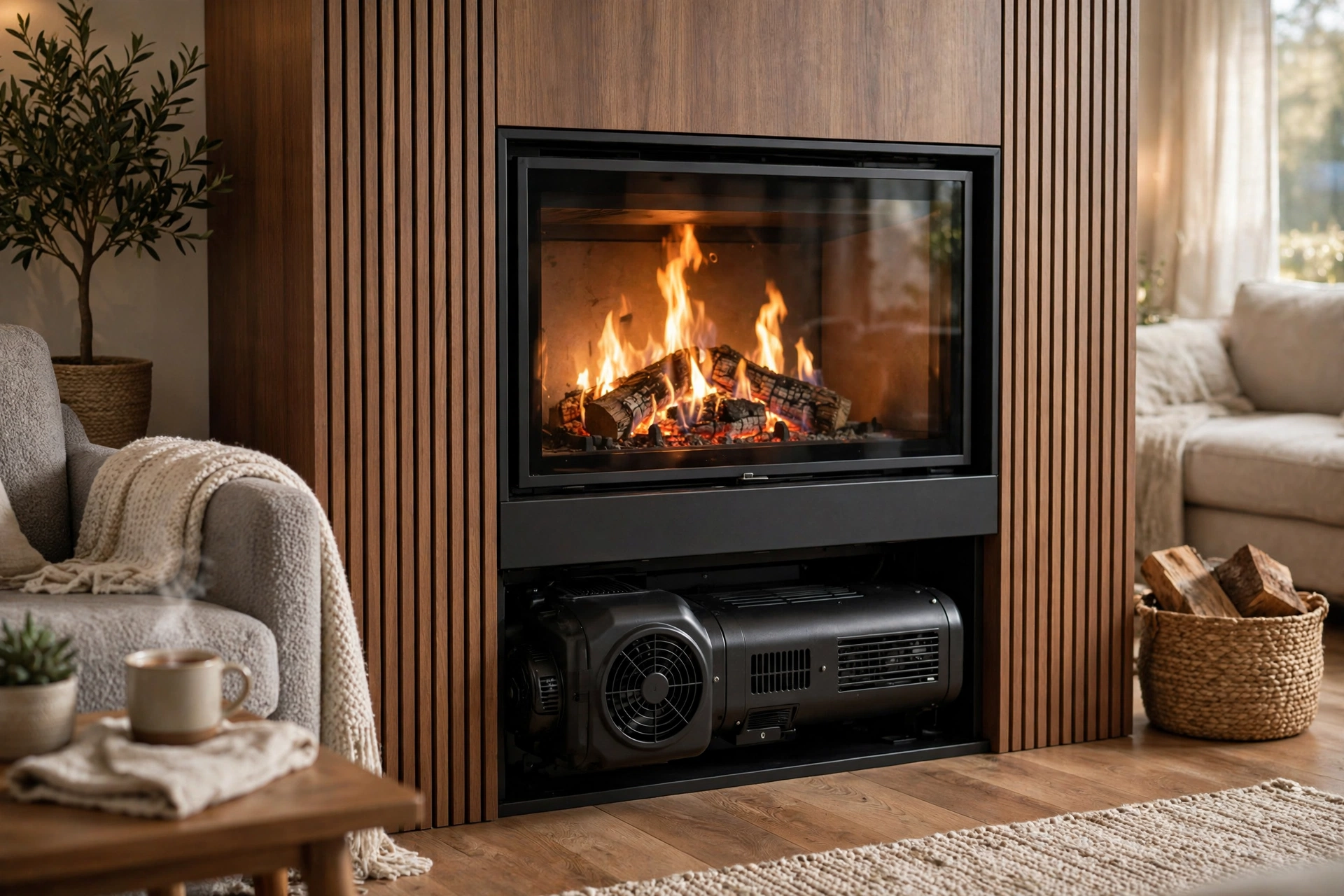
A blower can be worth it when heat pools in front of the fireplace and you want it spread across the room, and when the maker sells one certified for your exact model. It does not raise the burner’s heat output, it does not vent anything out of the room, and it runs on electricity, so it stops in a power cut. Whether a ventless fireplace blower is worth it depends on your room and your unit, not on a percentage in a listing.
That answer assumes the appliance itself is the right one. Check first that a vent-free unit is legal where you live, and read our honest answer on whether vent-free units are safe. A blower is an add-on to a decision, not a reason to make it.
We have not installed or run a vent-free fireplace or a blower. We have not measured airflow or room temperatures. This page is built from manufacturers’ own product pages, published code text and agency pages, each named where it is used and read on September 11, 2026.
Carbon monoxide first: a blower moves air, it does not clean it
A vent-free appliance puts its combustion products into the room along with its heat. The CPSC’s Carbon Monoxide Information Center calls carbon monoxide “a colorless, odorless, poisonous gas”, and the EPA’s page on carbon monoxide’s impact on indoor air quality names “unvented kerosene and gas space heaters” among indoor sources (both read September 11, 2026).
A blower circulates room air, and with it whatever the burner has added to that air. It removes none of it. A working CO alarm is a condition of running one of these appliances, blower or no blower, and our page on the CO alarm as a condition of use explains why.
What a vent-free blower actually does
A fireplace blower draws room air through channels around the firebox, where it picks up heat from the hot metal, and pushes it back out into the room. The burner, the flame and the heat produced stay the same. The blower changes where the warm air goes.
Pleasant Hearth’s page for its GFB100 vent-free fireplace blower, on its parent company GHP Group’s site, describes the purpose in exactly those terms: “Improve heat distribution from your Pleasant Hearth Vent Free Fireplace System” (GHP Group, Pleasant Hearth GFB100 vent-free fireplace blower, read September 11, 2026). The same page says:
- it has a manual mode (“Turn ON at the flick of a switch”) and an automatic mode in which the “Fan automatically operates when the heater gets above 113 degrees Fahrenheit to ensure it’s blowing ONLY warm/hot air”;
- it “Includes power supply (6′ Cord Length), and all necessary wiring”;
- it is “Designed and certified to only operate with Pleasant Hearth Vent Free Fireplace Systems”, with a list of compatible models.
Note what the page does not claim. It gives no percentage for improved circulation and no room-temperature result. Circulation figures do appear in retail listings. A figure with no stated method is not evidence, and we could not find one on the maker’s own page.
What a blower changes and what it does not
| Question | With a blower | Without a blower |
|---|---|---|
| How much heat the burner makes | Same, set by the burner’s input rating | Same |
| Where the warm air goes | Pushed out into the room | Rises from the unit and spreads by itself |
| What the burner adds to the room’s air | Same, and mixed through the room faster | Same |
| Needs electricity | Yes, the maker’s blower comes with a power cord | The burner may not, depending on its controls |
| Code limits on input and room size | Unchanged | Unchanged |
| Noise | Adds fan noise; the stove page below offers variable speed | None from a fan |
When a blower is likely to be worth it
- Your unit is a firebox, insert or stove the maker sells a blower for. The blowers we found on manufacturers’ own pages are sold for specific vent-free fireplace systems and stoves. GHP Group’s ZCB100 zero-clearance firebox circulating blower page uses the same “Designed and certified to only operate with Pleasant Hearth Vent Free Fireplace Systems” wording (GHP Group, zero clearance firebox circulating blower, read September 11, 2026), and Pleasant Hearth’s compact vent-free stove page lists a “Separately sold variable speed blower (PBAR-2427)” (GHP Group, Pleasant Hearth compact vent-free gas stove, read the same day).
- Heat collects near the unit and the room is long or oddly shaped. That is the problem a blower is built for.
- The people using the room sit away from the fireplace. Moving warm air toward them is the whole benefit.
When it probably is not
- There is no blower made for your model. A blower that is not named in your appliance’s manual, or by its maker for that model, is a part the listing never covered. The code requires an unvented room heater to be “installed in accordance with the conditions of the listing and the manufacturer’s instructions” (residential fuel gas code section G2445.1, numbered 621.1 in the International Fuel Gas Code, UpCodes, read September 11, 2026). Ask the maker before buying a generic fan kit.
- You bought a loose log set for an open masonry fireplace. The blowers we found are sold for fireboxes, inserts and stoves, not for log sets on their own.
- The room is already comfortable. A blower spends electricity and adds noise to fix a problem you may not have.
- You hoped it would let you run a smaller room or a longer burn. It does neither. The code’s input and room-volume limits are written against the appliance’s input rating, and a fan does not change that rating.
Electricity: the part listings play down
A blower needs power, and a power outage is when many owners most want their vent-free unit. Pleasant Hearth’s dual-fuel vent-free log set page says “No electricity required” for that burner (GHP Group, Pleasant Hearth Wildwood vent-free gas log set, read September 11, 2026). A blower does, so in an outage you are back to the heat the unit gives off by itself. Our page on using a gas fireplace during a power outage covers what still works.
The cord has to reach an outlet. If there is no suitable outlet within reach of the cord as the manual routes it, adding one is work for a licensed electrician, not an extension cord behind a heat-producing appliance.
What a blower cannot fix
- The air. Nitrogen dioxide, water vapor and any carbon monoxide from a poor flame stay in the room. A fan only spreads them.
- Efficiency claims. A vent-free unit already keeps all its heat in the room, together with everything else it produces, which our page on what 99 percent efficiency really means explains. A blower adds no heat; it redistributes it.
- A unit that is the wrong size or in the wrong room. No accessory changes the code limits or the prohibited locations.
Installation is licensed work
Fitting a blower into a firebox or stove means working around the burner and gas controls. Follow the maker’s instructions for your model, and have the work done by a licensed gas fitter or a qualified hearth technician, with any new outlet installed by a licensed electrician. If the blower fails, the unit sounds or smells wrong, or soot appears, stop using the appliance and call that professional.
What we checked, and when
All read September 11, 2026: GHP Group product pages for the Pleasant Hearth GFB100 vent-free fireplace blower, the zero clearance firebox circulating blower, the Pleasant Hearth compact vent-free gas stove and the Pleasant Hearth dual-fuel Wildwood vent-free gas log set; residential fuel gas code sections G2445.1 through G2445.7.1 (IFGC 621), as published on UpCodes in a 2024 adoption; CPSC Carbon Monoxide Information Center; EPA, Carbon Monoxide’s Impact on Indoor Air Quality. We made no measurements of our own.
Frequently asked questions
Does a blower make a ventless fireplace produce more heat?
No. Heat output is set by the burner’s input rating. A blower moves the warm air the unit already makes out into the room, which can make the room feel warmer where you sit.
Can I add a universal blower to my vent-free fireplace?
Ask the manufacturer first. The makers’ blowers we found are certified for their own vent-free systems only, and the code requires the appliance to be installed within the conditions of its listing and the manufacturer’s instructions. A part the manual does not name takes you outside that.
Does a ventless fireplace blower work during a power outage?
No. The blower runs on house power through its cord. Some vent-free burners need no electricity, so the fire may still run, but without the fan.
Does a blower help with the air quality from a ventless fireplace?
No. It circulates room air and removes nothing from it. A working carbon monoxide alarm remains a condition of use.
The bottom line
Buy a blower for distribution, not for heat, and only one its maker says fits your model. If heat already reaches where you sit, skip it. Whatever you decide, the rules that matter do not change: a working CO alarm, a room the unit is sized and permitted for, a licensed installer, and somebody at home while it burns.
1 thought on “Is a Ventless Fireplace Blower Worth It? What It Changes”