
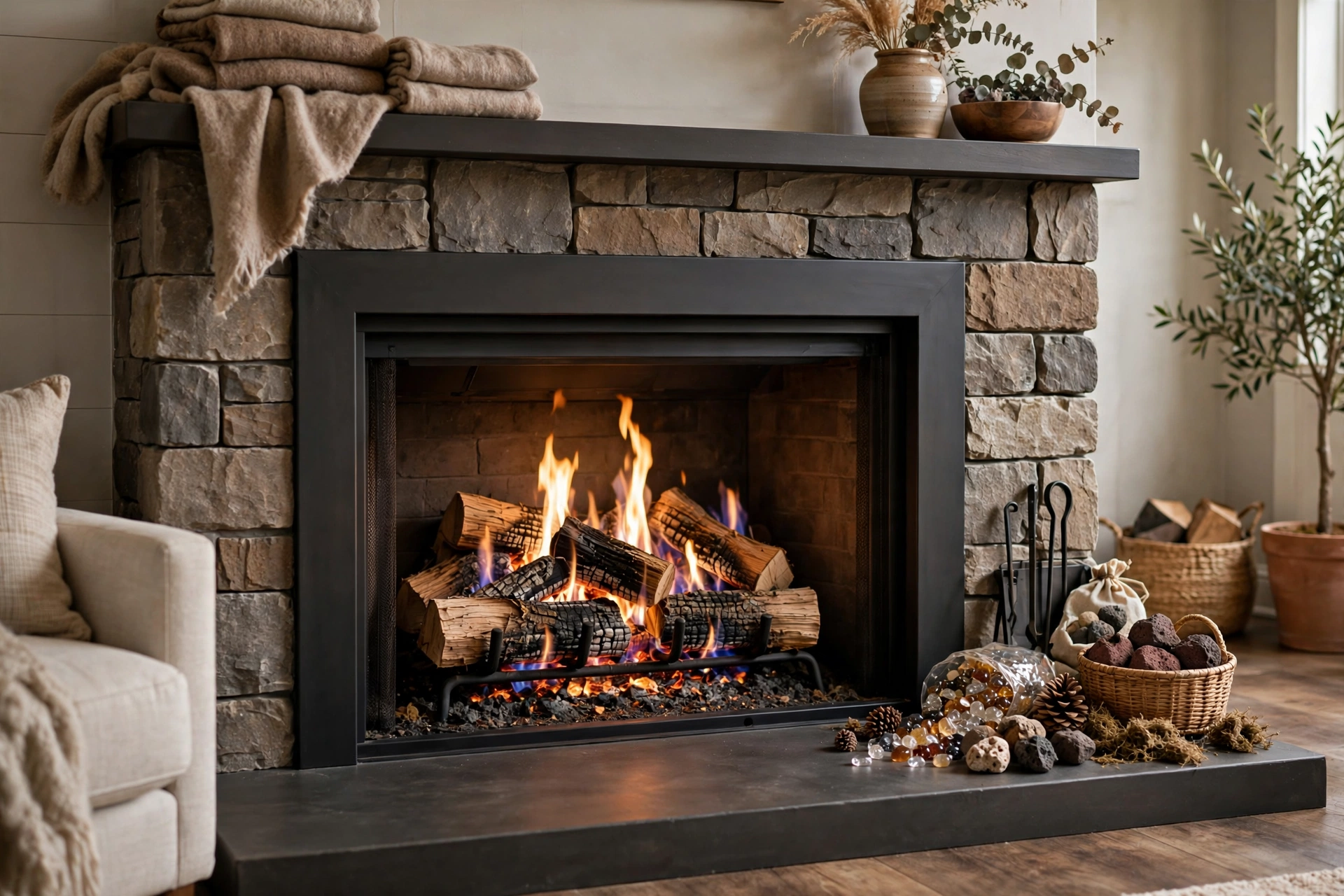
Most of a vent-free log set’s realism is decided the day you buy it. The burner, the logs and any ember or glass media are designed to work together, and the manual fixes where each piece goes, so the look cannot be freely rearranged, topped up with extra logs or dressed with media the maker did not specify. What you actually choose is the log style and material, the burner pattern and the media type. Ventless gas log realism is a trade against a clean burn in the room you sit in.
Two questions come before the look: whether a vent-free appliance is legal where you live, and whether it suits your household, which our honest answer on vent-free safety works through.
We have not seen these sets burning in person, and we have not tested or photographed any of them. This page is built from manufacturers’ own product pages, published code text and agency pages, each named where it is used and read on September 11, 2026. Whether a set “looks real” is your judgment to make, and we do not make it for you.
Carbon monoxide: why the look and the air are linked
On a vent-free set, where the logs sit decides where the flame touches them. A flame that hits a cool surface in the wrong place cannot burn completely. It leaves soot, and incomplete burning is the same process that produces carbon monoxide, as our page on the mechanism behind ventless fireplace carbon monoxide explains. That is why the arrangement is not a matter of taste.
The CPSC’s Carbon Monoxide Information Center calls carbon monoxide “a colorless, odorless, poisonous gas”, and the EPA’s page on carbon monoxide’s impact on indoor air quality names “unvented kerosene and gas space heaters” among indoor sources and advises readers to “keep gas appliances properly adjusted” (both read September 11, 2026). A working CO alarm is a condition of running one of these sets, as our page on the CO alarm as a condition of use sets out.
What decides ventless gas log realism
Four things set the look, and all four are chosen at purchase.
Log material and finish. Makers describe their logs in specific terms. Pleasant Hearth’s vent-free Wildwood set, on its parent company GHP Group’s site, has “7 handpainted concrete logs inspired by nature” (GHP Group, Pleasant Hearth Wildwood vent-free gas log set, read September 11, 2026). Monessen describes its Dynamo vent-free log set as using “Burncrete® Hybrid Technology”, combining the “durability and realism of concrete and the glow of fiber” (Monessen, Dynamo vent-free gas log set, read September 11, 2026).
The burner pattern. The flame comes from the burner, and the logs are shaped to sit around it. Pleasant Hearth says its Wildwood set’s “Dual burner system provides two rows of flames”. Empire’s American Hearth brand says: “From the curve of each log to the height of the stack, your American Hearth Log Set complements the burner pattern for a lifelike fire” (American Hearth, read September 11, 2026).
Embers and media. Some sets use a glowing ember bed; others replace logs with glass. Monessen describes Dynamo’s “Glow Getter Technology combining a vibrant ember bed with glowing logs”, and its Lyric vent-free burner uses “fireglass media” with “flames that move and flicker” (both read September 11, 2026).
The flame itself. Retailer guides that rank for this question describe vent-free flames as shorter and less yellow than vented ones. Monessen’s Lyric page adds a caution that applies to every product photo: the “appearance” of a unit “may vary”, and it refers buyers to the owner’s and installation manual for “complete requirements, specifications, testing and listing information”.
What you can and cannot change later
| Element | Chosen at purchase? | Can you change it later? | Why |
|---|---|---|---|
| Log style and material | Yes | Only with the maker’s replacement logs for that model | The logs are part of the set the manual describes |
| Log arrangement | Yes, by the manual’s diagram | No, except to return logs to the diagram | Position controls where the flame touches, and so the burn |
| Number of logs | Yes | No | Extra pieces change the flame path and are outside the instructions |
| Ember or glass media | Yes | Only with the maker’s specified media, in the amount the manual allows | Media sits in or near the flame |
| Burner and flame pattern | Yes | No | The burner is the listed appliance |
| Flame height | Within the valve’s range | Only within that range | Adjusting the gas side is licensed work |
| Your view of it | No | Yes: seating, lighting, where you watch from | Nothing about the appliance changes |
The code explains why the middle column is so short. The residential fuel gas code text we read on UpCodes, section G2445.1 (numbered 621.1 in the International Fuel Gas Code) in a 2024 adoption, says unvented room heaters “shall be listed in accordance with ANSI Z21.11.2 and shall be installed in accordance with the conditions of the listing and the manufacturer’s instructions” (UpCodes, unvented room heaters, read September 11, 2026). The log diagram is part of those instructions. A set rearranged for looks is no longer installed the way it was certified.
Things not to add, however good they look online
- Extra logs, branches or decorative pieces from another set or another maker.
- Lava rock, glass, stones or embers the manual does not list for that model.
- Pine cones, wood or anything combustible, even for effect.
- Logs from a vented set. Vented and vent-free sets can look alike, but they are different appliances, and the logs are shaped for their own burner.
If a set looks thin to you once installed, the honest fix is a different set chosen before purchase, not additions afterward.
Realism vs a clean burn: the trade-off
A vented set sends its products up a chimney, so its designers can chase a tall, lazy, yellow flame. A vent-free set releases its products into the room, so its designers have to keep the burn clean first and make it look good second. That is the reason vent-free sets tend to look less like wood, and it is a trade you should make knowingly. Our comparison of gas logs and a wood-burning fireplace covers what you give up against real wood.
How to judge realism before you buy
- Ask for the manual before you pay. The log diagram and the media section show what the finished set will look like and what it may contain.
- Look for the maker’s own photographs or video of that model burning, in the fuel you will use, rather than staged retail photos.
- Check the media. An ember bed, glass and bare logs give very different looks, and you cannot swap between them later on most sets.
- Compare like with like. A vented set in a showroom is not a preview of a vent-free set, however similar the logs.
- Confirm the listing. The rating plate should name ANSI Z21.11.2.
Installation and log placement are professional work
Setting the logs to the diagram at installation, checking the flame and re-setting logs after service belong with a licensed gas fitter or a qualified hearth technician, who also handles the gas connection under the permit and inspection your jurisdiction requires. We publish no installation or adjustment procedure. If soot appears on the logs, the glass or the wall above the unit, or the flame changes shape or color, stop using the set and call that professional.
What we checked, and when
All read September 11, 2026: GHP Group product page for the Pleasant Hearth Wildwood vent-free gas log set; Monessen product pages for the Dynamo vent-free gas log set and the Lyric vent-free burner; American Hearth’s home page; residential fuel gas code section G2445.1 (IFGC 621.1), as published on UpCodes in a 2024 adoption; CPSC Carbon Monoxide Information Center; EPA, Carbon Monoxide’s Impact on Indoor Air Quality. Product pages change, so confirm materials and media in the manual for the exact model you buy.
Frequently asked questions
Can I add more logs to a ventless gas log set?
No. The number and position of logs are set by the manufacturer’s instructions, and the code requires the appliance to be installed within the conditions of its listing and those instructions. Extra pieces change where the flame touches, which affects how cleanly it burns.
Can I use fire glass or lava rock with vent-free logs?
Only if the manual for that model lists it, and only in the amount it allows. Media sits in or near the flame, so anything the maker did not specify is outside the listing.
Why do vent-free logs look less realistic than vented logs?
Because a vent-free set releases its combustion products into the room, it is designed to burn cleanly first. Retailer guides describe the result as shorter, less yellow flames. A vented set sends its products up a chimney, so its flame can be designed for looks.
What does soot on vent-free logs mean?
Soot is a sign of incomplete burning, often from logs out of position or a burner needing service. Stop using the set and have a qualified technician check it, and make sure your CO alarm is working.
The bottom line
Choose the look before you buy, because on a vent-free set you will not be allowed to improve it afterward. Pick the log material, burner pattern and media from the manual, not from a photo, keep the logs where the diagram puts them, and keep a working CO alarm in the house.