
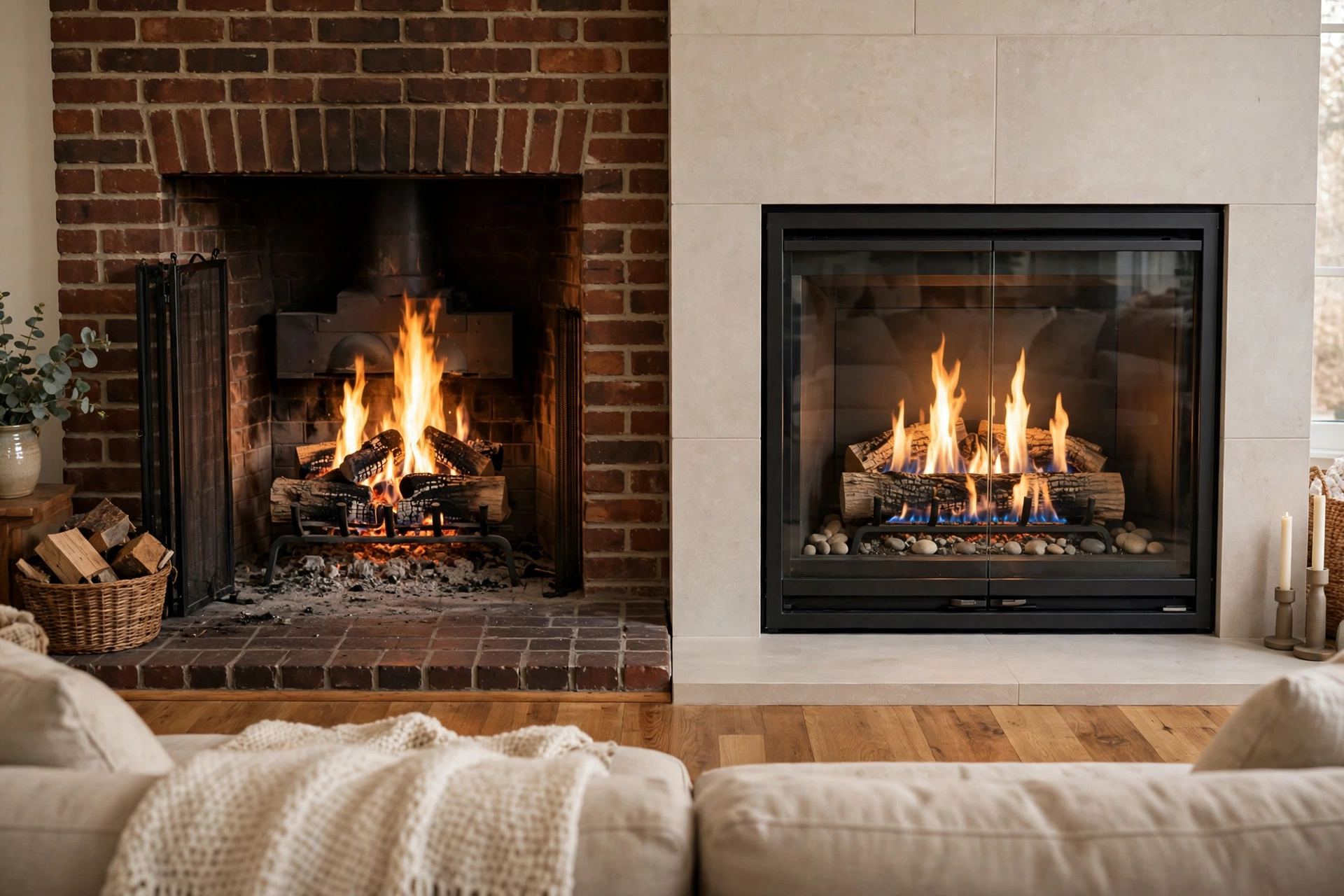
Vented and vent-free gas logs are different appliances listed to different standards, even when the product photos match. A vented set is a decorative appliance listed to ANSI Z21.60/CSA 2.26, or ANSI Z21.84 for manually lighted natural gas sets, made to burn in a working solid-fuel fireplace with its combustion products going up the chimney. A vent-free set is an unvented room heater listed to ANSI Z21.11.2, with a required oxygen depletion shutoff, and its products stay in the room. The rating plate and the manual tell you which one you are buying.
Whichever you are considering, two questions come first: whether a vent-free appliance is legal where you live, and whether it suits your household, which our honest answer on vent-free safety works through. A vented set sidesteps the vent-free rules only if you have a working fireplace and chimney to put it in.
We have not installed or burned either kind. This page is built from published code text, federal agency pages and manufacturers’ own product pages, each named where it is used and read on September 11, 2026.
Carbon monoxide: why this mix-up is dangerous
The two kinds of log set handle combustion products in opposite ways. A vented set relies on the chimney to carry them out. A vent-free set is designed and limited so that it can release them into the room, and the code requires it to carry an oxygen depletion shutoff. The code text for vented decorative appliances that we read requires a flame safeguard device but says nothing about an oxygen depletion shutoff. Put a vented set where its products cannot leave, and you have an appliance burning into the room without the one device the code requires on vent-free sets.
The CPSC’s Carbon Monoxide Information Center calls carbon monoxide “a colorless, odorless, poisonous gas”, with symptoms including “headache, dizziness, weakness, nausea, vomiting, sleepiness, and confusion”. The EPA’s page on carbon monoxide’s impact on indoor air quality lists “unvented kerosene and gas space heaters” among indoor sources (both read September 11, 2026). Whichever kind of set you own, a working CO alarm is a condition of running it, as our page on the CO alarm as a condition of use explains.
Vented vs vent-free gas logs at a glance
The code sections below come from the residential fuel gas code text we read on UpCodes, in a 2024 adoption, with the matching International Fuel Gas Code numbers in brackets: decorative appliances for installation in fireplaces and unvented room heaters, both read September 11, 2026.
| Vented gas logs | Vent-free gas logs | |
|---|---|---|
| What the code calls it | A decorative appliance for installation in an approved solid fuel-burning fireplace | An unvented room heater, or an unvented decorative room heater |
| Standard it must be listed to | ANSI Z21.60/CSA 2.26; ANSI Z21.84 for manually lighted natural gas sets (G2432.1 [602.1]) | ANSI Z21.11.2 (G2445.1 [621.1]) |
| Where combustion products go | Up a working chimney | Into the room |
| Safety device named in the code | A flame safeguard device that shuts off gas when ignition fails, except on Z21.84 sets (G2432.2 [602.2]) | An oxygen-depletion safety shutoff set no lower than 18 percent oxygen and not field-adjustable (G2445.6 [621.6]) |
| Size and room limits in the code | Location limits by reference (G2432.3 [602.3]) | Input no higher than 40,000 Btu/h, and no more than 20 Btu/h per cubic foot of room across all unvented appliances (G2445.3, G2445.5) |
| Factory-built fireplaces | Follow the fireplace and log set instructions | Not allowed unless the fireplace system is tested, listed and labeled for that use under UL 127 (G2445.7 [621.7]) |
Two sentences from the code are worth reading in full. Vented sets “shall be listed in accordance with ANSI Z21.60/CSA 2.26 and shall be installed in accordance with the manufacturer’s instructions”, and vent-free units “shall be listed in accordance with ANSI Z21.11.2 and shall be installed in accordance with the conditions of the listing and the manufacturer’s instructions”. Everything else follows from those two lines.
Why they look identical online
A single manufacturer’s catalogue shows the problem. GHP Group’s gas logs collection (read September 11, 2026) lists two 18-inch Pleasant Hearth sets side by side, one vented and one vent-free. Both product pages describe “7 hand-painted concrete logs inspired by nature”, with only a small difference in spelling between them.
The differences are further down the page. The vented Arlington Ash set is “Natural Gas Ready” with “match lit ignition”. The vent-free Wildwood set is dual fuel and “Thermostatically controlled”, and says “Not for sale in California or Canada” and “Check your local regulations on installation restrictions and requirements” (both read September 11, 2026). Neither product page we read named its certification standard.
Photographs of logs, and descriptions of logs, do not identify the appliance. The burner, the pilot and the listing do.
How to tell them apart before you buy
- Do not stop at the listing title. “Vented” or “vent-free” in a product name is a start, not a confirmation.
- Ask for a photograph of the rating plate and the manual for the exact model. The standard named there is the answer: ANSI Z21.60 or Z21.84 means a vented decorative appliance; ANSI Z21.11.2 means an unvented room heater.
- Look for the oxygen depletion safety shutoff in the manual. The code requires one on vent-free units. Its absence on a set sold as vent-free is a reason to stop.
- Check the fuel. A set that is natural gas ready and convertible with a kit is a different purchase from a dual-fuel set. Conversions are licensed work.
- Match the set to the fireplace you have. A vented set needs an approved solid fuel-burning fireplace. A vent-free set cannot go into a factory-built fireplace unless that fireplace system is listed for it under UL 127, and a ventless firebox enclosure has to be listed to ANSI Z21.91 (G2445.7.1 [621.7.1]).
- Check where it may be sold and installed. Pleasant Hearth’s vent-free page itself says it is not for sale in California or Canada. Your own jurisdiction may have rules of its own.
Mix-ups to avoid
- A vented set with no working chimney, or with the flue closed. The set depends on the chimney to carry its products away. Its manual sets out the flue conditions for that model; follow them, and if you are not sure your fireplace meets them, a qualified professional decides, not you.
- A vent-free set in a factory-built fireplace that is not listed for it. The code prohibits this unless the fireplace system is tested, listed and labeled for that use.
- Mixing logs and burners from different sets. Logs are shaped and placed for a particular burner. Empire’s American Hearth brand puts it plainly: “From the curve of each log to the height of the stack, your American Hearth Log Set complements the burner pattern for a lifelike fire” (American Hearth, read September 11, 2026).
- Treating one kind as convertible into the other. A vented set does not become vent-free by adding a part, and a vent-free set does not become vented by opening a flue. They are listed as what they are.
If you are replacing a wood fire, our page on converting a wood fireplace to ventless gas logs covers the decision in order, and our overview of vented and ventless gas fireplace types sets the log question alongside the other options.
The honest trade-off
Retailer guides that rank for this question describe vented sets as producing taller, more yellow flames that look more like wood, and vent-free sets as keeping their heat in the room. What they say less clearly is why: a vent-free set is designed to burn cleanly enough to release its products into the room, and a vented set is not held to that because its products go outdoors. You are choosing between a flame designed for looks with a chimney behind it, and a flame designed for the room you sit in.
Installation is licensed work
Running a gas line to a fireplace, fitting either kind of set, converting fuel and confirming that an existing fireplace is fit for a vented set are jobs for a licensed gas fitter or a qualified hearth technician, under the permit and inspection your jurisdiction requires. We publish no installation procedure. If you smell gas, see soot, or your CO alarm sounds, stop using the set, get everyone out and call the professional or emergency services.
What we checked, and when
All read September 11, 2026: residential fuel gas code sections G2432.1 through G2432.3 (IFGC 602) and G2445.1 through G2445.7.1 (IFGC 621), as published on UpCodes in a 2024 adoption; CPSC Carbon Monoxide Information Center; EPA, Carbon Monoxide’s Impact on Indoor Air Quality; GHP Group’s gas logs collection and product pages for the Pleasant Hearth Arlington Ash vented set and Wildwood vent-free set; American Hearth’s home page. Standards and product pages change, so confirm against the rating plate and manual of the exact set you buy.
Frequently asked questions
How do I know if my gas logs are vented or vent-free?
Read the rating plate and the manual. A plate naming ANSI Z21.60 or Z21.84 is a vented decorative appliance; one naming ANSI Z21.11.2 is an unvented room heater. If the plate is missing or unreadable, have a qualified technician identify the set before it is lit.
Can I burn vented gas logs with the damper closed?
No. A vented set is made to burn with its products going up a working chimney, and its manual sets the flue conditions. Burning it closed puts its combustion products into the room, and the code does not require vented sets to carry the oxygen depletion shutoff that vent-free sets must have.
Can vent-free logs go in a fireplace that has a chimney?
Possibly, if the set’s listing and manual allow it for that fireplace and your jurisdiction permits vent-free appliances. For a factory-built fireplace, the code requires the fireplace system itself to be tested, listed and labeled for that use under UL 127.
Why do vented and vent-free sets look the same in photos?
Because the logs can be nearly identical. The same maker can describe both sets with the same words. What differs is the burner, the pilot and the listing, none of which a photograph shows.
The bottom line
Buy the listing, not the logs. Ask for the rating plate and the manual before you pay, match the set to the fireplace you actually have, and keep a working CO alarm whichever kind you choose.