
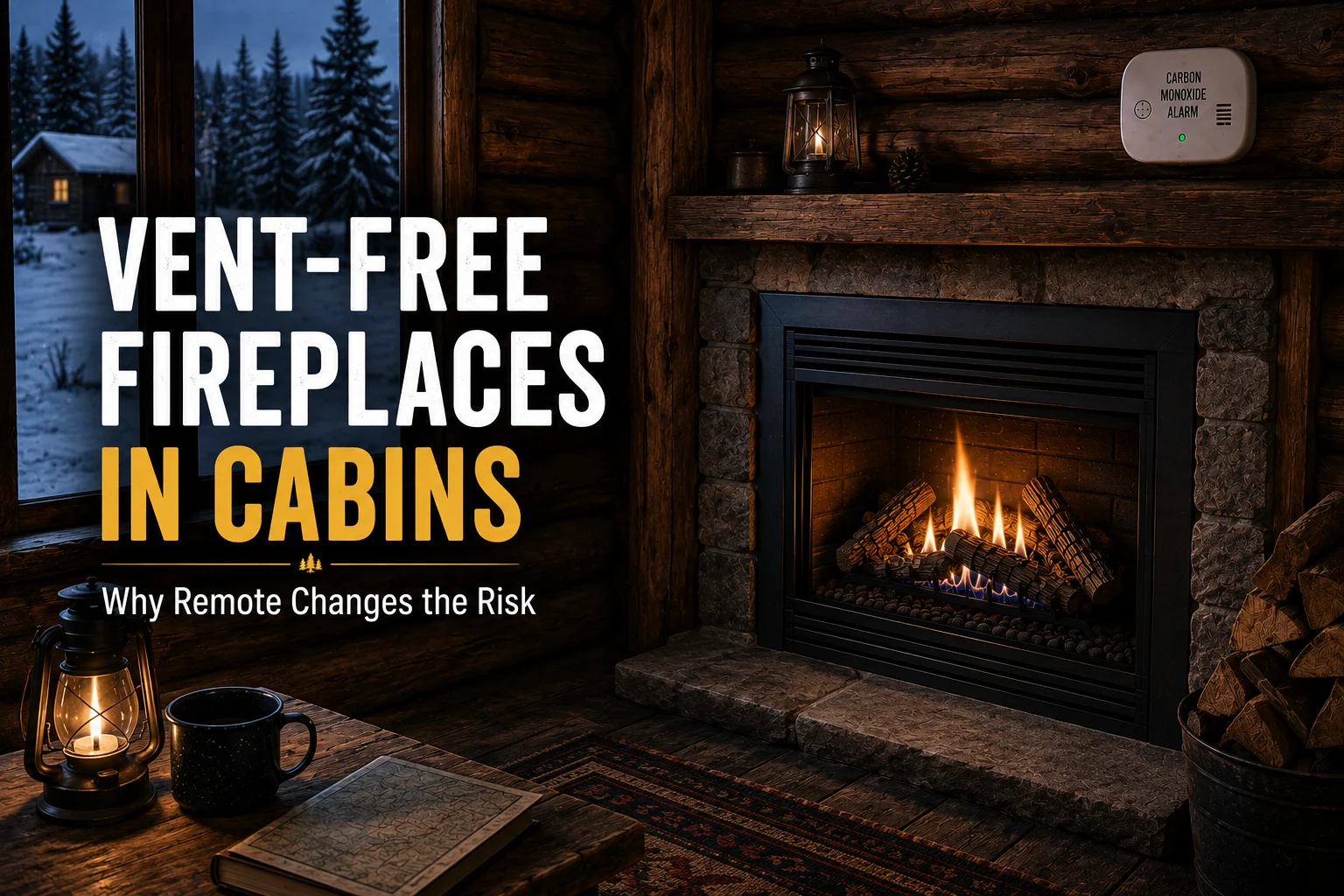
A vent-free gas appliance sends its combustion products into the room, including carbon monoxide, nitrogen dioxide and water vapor. A working carbon monoxide alarm is a condition of running one. In a remote building that condition is harder to meet and more important, and our page on why the alarm is a condition applies here without modification.
And the legality question does not stop at a property line. A cabin, a hunting camp, a workshop and a converted outbuilding are all subject to the code adopted where they stand, and several states and provinces restrict or prohibit this category outright. Start at are ventless fireplaces legal where you live and confirm with the building department for that county, not the one where you live the rest of the year.
Now the question readers actually arrive with: it is a cabin with no power and nobody around. Do different rules apply?
The short answer
Different circumstances. The same rules, and a worse risk profile.
There is a widely held instinct that remoteness earns a discount: no inspector, no neighbors, rough conditions, so the ordinary caution is for suburban houses. Every element of that instinct points the wrong way. A cabin is not a place where a vent-free appliance is less hazardous. It is a place where each of the factors that make one hazardous is more pronounced and where the consequences of getting it wrong take longer to reach help.
Why the risk goes up, factor by factor
Volume. A cabin room is usually small. The model code caps the aggregate input rating of all unvented appliances in a room or space at 20 Btu/h per cubic foot of volume (IRC G2445.5, read through UpCodes 28 August 2026), and a single unvented room heater at 40,000 Btu/h (G2445.3). A small cabin can fail the volume rule with an appliance that would be unremarkable in a living room. Measure the room and do the arithmetic before you buy anything.
Tightness. Cabins are frequently insulated and sealed hard, precisely because they are heated intermittently and cheaply. Less air exchange means less dilution of the appliance’s output.
Sleeping. This is the decisive one. A cabin is usually a single space that people sleep in. IRC G2406.2 prohibits appliances in sleeping rooms, with a narrow exception for a single wall-mounted unvented room heater of not more than 10,000 Btu/h with the shutoff of G2445.6 in a bedroom meeting the volume criteria of G2407.5. A one-room cabin where the bed is fifteen feet from the heater is a sleeping room in every way that matters to carbon monoxide, whatever the floor plan calls it. The reasoning is on our bedroom page.
Run length. A weekend at a cabin in winter means the heater runs for many consecutive hours, not for an evening. Combustion products accumulate; that is the model the code’s rate-against-volume rule is built on.
Alcohol and fatigue. It is worth naming what a cabin trip actually looks like, because the early symptoms of carbon monoxide exposure, headache, dizziness and nausea, are exactly the symptoms a tired person who has had a drink will attribute to something else.
Distance from help. Everywhere else on this site, the response to symptoms is to get out into fresh air and call someone. In a remote building both halves of that get harder, and there may be no cell signal to make the call with.
Off-grid is a power question, not a safety question
The reason vent-free comes up in off-grid conversations is that many gas hearth appliances run on a millivolt system: the pilot heats a thermopile, the thermopile holds the valve open, and no mains electricity is involved. That is genuine, and it is the same property that makes a gas appliance keep working when the grid goes down.
It says nothing about what the appliance emits. Power independence and indoor air quality are two unrelated properties, and the marketing that runs them together is doing something this site treats as a category error. A direct vent appliance with a standing pilot is also power-independent, and it exhausts outside. See direct vent versus ventless.
Manufactured homes, RVs and trailers
If the building is a manufactured home, the answer changes and it changes federally rather than locally.
24 CFR 3280.709 requires complete separation of the combustion system from the interior atmosphere. An unvented heater fails that requirement by definition, because separating the combustion system from the interior atmosphere is exactly the thing it does not do. That is a US-wide rule attached to a class of housing rather than to a place, so it does not vary by state.
RVs, campers and trailers have their own appliance standards and their own certification labels. An appliance certified for a home is not thereby certified for a recreational vehicle.
Workshops and garages
A workshop adds a hazard the rest of this page does not cover: the fuels, solvents, finishes, and dust that live in a workshop are an ignition problem near any open flame, entirely separately from the combustion-byproduct question. Sawdust in suspension, aerosol finishes, gasoline for outdoor equipment and solvent rags are all reasons a naked flame in a workshop is a different decision from a naked flame in a den.
Household chemicals also change what a combustion appliance produces, which is a general point about vent-free operation and not specific to workshops.
What actually works for a remote building
The categories that remove the mechanism rather than managing it:
- A direct vent or sealed combustion gas appliance, which draws combustion air from outside and exhausts outside. Power-independent on a millivolt system, and the room air is not part of the circuit. Compared in direct vent versus ventless.
- A wood stove, correctly installed with its flue, which is the traditional cabin answer for good reasons. Compared in vent-free versus a pellet or wood stove.
- Nothing burning at all, where there is power. See vent-free gas versus electric.
Where the work stops being yours. Installing any of these, running any gas line, connecting propane, or cutting a vent through a wall is licensed work for a licensed gas fitter or a qualified hearth technician, and remoteness does not change that either. This site publishes no gas-line, gas-connection or installation procedure at any depth. A remote building is the worst possible place to be following one.
What this page refuses to do
It does not offer a cabin exception, a hunting-camp exception or an emergency exception, because none exists in the code and none exists in the chemistry.
It publishes no minimum cabin size, no BTU recommendation and no run-time figure. Those numbers belong to your appliance’s manual and to the code adopted where the building stands.