
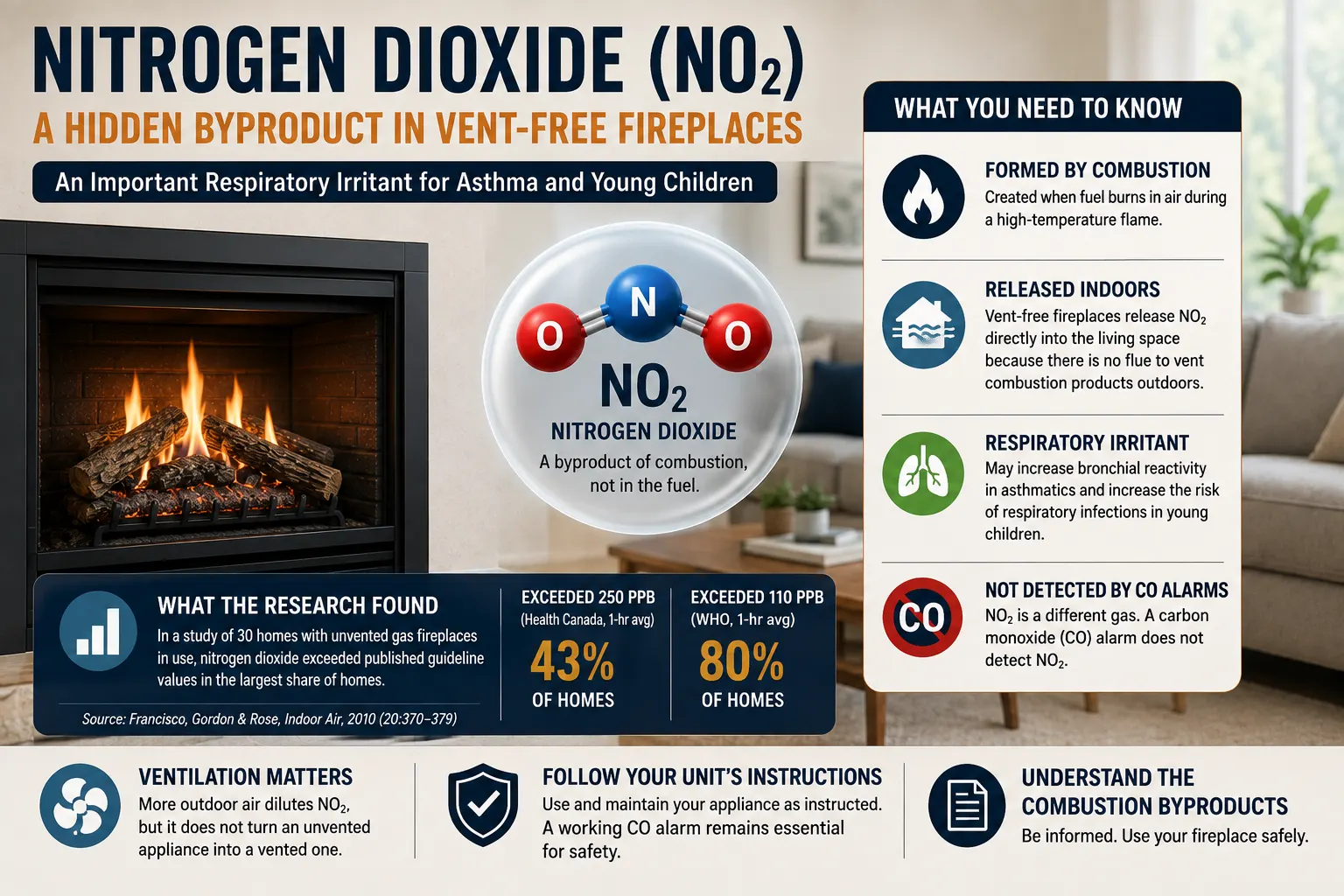
Nitrogen dioxide is a second combustion byproduct that a vent-free gas appliance releases into the room, and it is a recognized respiratory irritant that matters most to people with asthma and to young children. It is a different gas from carbon monoxide, and a carbon monoxide alarm does not detect it. Almost every safety discussion in this category is written as though carbon monoxide were the whole risk. It is not, and for a household with a person who has asthma, the byproduct that is not being discussed may be the more relevant one.
This page names the gas, cites what the public health record actually says, and stops short of anything that would be medical advice.
What nitrogen dioxide is and where it comes from here
Nitrogen dioxide, written NO2, is formed when combustion happens hot enough for nitrogen and oxygen already present in the air to react. It is not a contaminant in the fuel. It is a product of burning anything in air, which is why it appears wherever a flame does.
The US Environmental Protection Agency’s indoor air quality material on nitrogen dioxide (verified 2026-08-10) lists the indoor sources plainly: “The primary sources indoors are combustion processes, such as: unvented combustion appliances, e.g. gas stoves, vented appliances with defective installations, welding, tobacco smoke, kerosene heaters.”
A vent-free gas fireplace sits in the first category named in that sentence. The Department of Energy’s Building America Solution Center guidance on unvented combustion appliances puts the structural point more bluntly: “Any unburned combustion byproducts are released directly into the living space because there is no chimney to vent them out of the home” (verified 2026-08-10). The absence of a flue is not a detail of this appliance. It is the definition of it.
What the health record says, and what it does not
EPA describes the mechanism in one sentence: NO2 “acts mainly as an irritant affecting the mucosa of the eyes, nose, throat and respiratory tract.”
For lower level exposure, the same source describes two effects that matter directly to this page’s reader. Low-level exposure may cause “increased bronchial reactivity in some asthmatics,” and “increased risk of respiratory infections, especially in young children.”
Increased bronchial reactivity is the clinical way of describing an airway that responds more readily to whatever else it meets. For someone with asthma, that is not an abstract finding. It is the property that determines how the rest of their winter goes.
There is one more thing EPA says that belongs here for honesty: “No standards have been agreed upon for nitrogen oxides in indoor air.” EPA notes that ASHRAE and the National Ambient Air Quality Standards list 0.053 ppm as the average annual limit for NO2 in outdoor air. That outdoor annual figure is not an indoor exposure limit and this site will not present it as one.
The measurement that exists
There is one directly relevant measurement study, and it is worth reading rather than summarizing loosely. Francisco, Gordon and Rose measured combustion product concentrations in 30 homes where unvented gas fireplaces were in use, sampling carbon monoxide, carbon dioxide, nitrogen oxides, nitrogen dioxide, oxygen depletion and water vapor at one minute intervals for three to four days per home, and published in Indoor Air in 2010 (volume 20, issue 5, pages 370 to 379; abstract verified 2026-08-10).
Their finding on which measurements crossed a published guideline is quoted here exactly:
“The two combustion gases that exceeded published values were NO(2) and CO. For NO(2), the Health Canada guideline of 250 ppb (1-h average) was exceeded in about 43% of the sample and the World Health Organization (WHO) guideline of 110 ppb (1-h average) was exceeded in 80% of the sample.”
Nitrogen dioxide was the byproduct that exceeded a published guideline in the largest share of those homes. That is the strongest single reason this page exists, and it is why treating carbon monoxide as a synonym for “the risk” understates the picture.
Two limits on that finding, stated rather than buried. It is one study of 30 homes, and it does not describe your house, your unit, or your ventilation. And the guidelines it compared against are Health Canada’s and the World Health Organization’s one hour averages, cited here as the study’s own comparators, not as adopted US indoor limits, because as EPA says, none have been agreed.
Why a carbon monoxide alarm does not cover this
A carbon monoxide alarm is a device built to detect one specific gas. Nitrogen dioxide is a different molecule with different chemistry, and a listed CO alarm is not designed, tested or listed to respond to it.
This is worth stating flatly because the reasoning that gets people into trouble is reasonable-sounding: there is an alarm on the wall, the alarm is for combustion byproducts, therefore combustion byproducts are covered. The first two are true and the conclusion does not follow. The alarm covers carbon monoxide. It is still a condition of running this appliance and nothing here reduces that. It is simply not doing the job people assume it is doing for this second gas.
There is no household device this site is going to recommend as the NO2 equivalent, because this site does not review or recommend detection devices at all, and because the honest answer to “what should I put on the wall for NO2” is not a product.
Ventilation, and its honest limits
More outdoor air dilutes NO2 the same way it dilutes everything else the burner produces. That is why manufacturer instructions and fire service guidance both talk about ventilation, and why the model code sizes this appliance against the room’s volume: the 2021 International Fuel Gas Code caps the aggregate input of all unvented appliances in a room at 20 Btu/h per cubic foot of that room (Section 621.5, verified 2026-08-10).
What ventilation does not do is turn an unvented appliance into a vented one. An open window has no rated performance, changes with the weather, and is not credited anywhere in the code as an equivalent to a flue. Specific ventilation practice for your unit is in your unit’s manual, and any question involving mechanical ventilation or makeup air is a design question for a licensed professional.
If someone in the house has asthma
This site is not qualified to tell you whether a vent-free appliance is acceptable for a specific person’s respiratory condition, and it is not going to pretend otherwise. What it can do is name the decision correctly.
The relevant facts are that this appliance discharges its combustion products into the occupied room by design, that nitrogen dioxide is among them, that EPA associates NO2 with increased bronchial reactivity in some asthmatics and higher respiratory infection risk in young children, and that the one published measurement study in real homes found NO2 exceeding its comparison guidelines in the majority of the sample.
Those facts belong in a conversation with the affected person’s physician, and with a licensed installer who can see the room. They are not a diagnosis and this page is not one. Our disclaimer sets out the limits of what this site does.
Two further gates apply before any of this becomes relevant. Whether the appliance is permitted at your address is covered on are ventless fireplaces legal, and the honest overall verdict on the category, with both sides’ commercial incentives named, is on are ventless gas fireplaces safe.
Frequently asked questions
Is nitrogen dioxide dangerous to people without asthma?
EPA describes NO2 as acting mainly as an irritant affecting the mucosa of the eyes, nose, throat and respiratory tract, which is not limited to people with a diagnosed condition. What the record singles out for lower-level exposure is increased bronchial reactivity in some asthmatics and higher respiratory infection risk in young children, so those groups are named specifically rather than exclusively.
Does a carbon monoxide alarm detect NO2?
No. They are different gases and a listed CO alarm is built and listed for carbon monoxide. Keeping a working CO alarm remains a condition of operating this appliance; it simply is not the instrument for this second byproduct.
Is there a safe indoor NO2 level I can aim for?
EPA states that no standards have been agreed upon for nitrogen oxides in indoor air, so this site does not publish an indoor target. The 0.053 ppm figure that appears in searches is the annual average limit for outdoor air under the National Ambient Air Quality Standards, and using it as an indoor exposure limit would be a misreading.
Does an oxygen depletion sensor shut the unit down if NO2 rises?
No. An ODS responds to oxygen concentration and shuts off the gas at a set point; it is not monitoring byproducts at all. What it does and does not cover is set out on the oxygen depletion sensor page.
Is this the same concern as a gas stove?
EPA lists gas stoves and unvented combustion appliances together as primary indoor sources of NO2, so the gas is the same. The difference this site is concerned with is duration and design intent: a range burner runs for minutes over a cooking surface that is often ventilated, while a vent-free fireplace is designed to run for hours in an occupied room with no flue at all.
Where does this leave water vapor and the other byproducts?
The same combustion produces water vapor and carbon dioxide as well. The measurement study above reported that moisture problems were not evident in its test homes, and the mechanism for the carbon monoxide side is on what carbon monoxide comes out of a vent-free burner.